

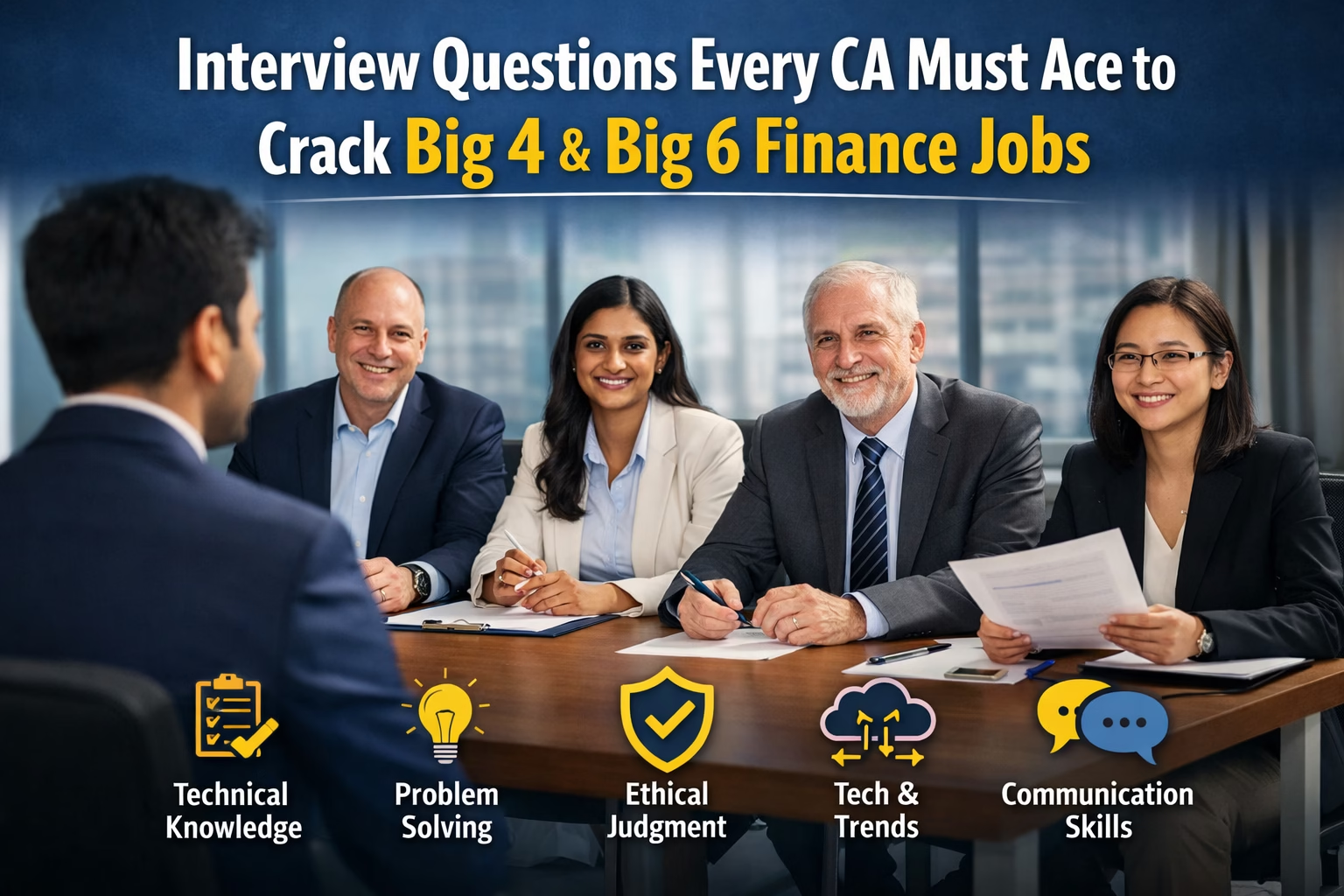
Interview Questions Every CA Must Ace to Crack Big 4 & Big 6 Finance Jobs
In today’s competitive landscape, chartered accountants are not just expected to know accounting rules — they must also think like strategic business partners, speak confidently about technology, regulatory change, risk, and business outcomes, and demonstrate behavioral maturity under pressure. CA Abhishek Jain
Here are the 15 most powerful Interview Questions Every CA Must Ace to Crack Big 4 & Big 6 Finance Jobs — with reasoning, what interviewers are assessing, and sample answer directions.
Interview Questions Every CA Must Ace to Crack :
✅ 1. Tell Me About Yourself (Structured & Impactful)
This classic HR question sets the tone.
What interviewers look for: Clarity, confidence, logical flow, and alignment with the role.
How to answer:
- Brief background — academics + CA journey
- Articleship/ work experience highlights
- Key skills relevant to role (ex: audit, tax, financial analysis)
- Why this firm and role next. Thinking Bridge
✅ 2. Why Do You Want to Join Our Firm (Big 4/Big 6)?
Interviewers test intent and cultural fit.
Focus points:
- Firm’s values and service lines
- Why their clients/industry focus excites you
- What you bring that matters
Avoid generic praise — tie answers to what they do. LinkedIn
✅ 3. Explain a Complex Accounting Standard (e.g., Ind AS 115/116)
Technical drilling starts here.
What they assess:
- Conceptual clarity
- Real-world application
- Communication skills
Tip: Explain why the standard matters, not just definition. CA Study Notes
✅ 4. How Would You Audit Revenue Recognition?
Core audit competency.
Key areas to cover:
- Understanding performance obligations
- Walkthroughs
- Risk points like fictitious sales or cut-off errors
- Evidence collection strategies
Bonus: Relate to risk assessment frameworks. CA Study Notes
✅ 5. What Is Deferred Tax, and How Is It Accounted For?
Classic financial reporting question.
Look out for:
Deferred tax resulting from temporary differences and how this impacts financial ratios or decision-making.
✅ 6. How Do You Stay Updated on Standards, Regulations & Technology?
Modern firms value lifelong learners.
Good answers include:
- Following accounting bodies (ICAI updates, FASB/IASB)
- News sites, newsletters, and tech forums
- Certifications on data analytics or finance tools
This shows curiosity & adaptability — a top trait in 2025 hiring. CA Abhishek Jain
✅ 7. Scenario: You Find a Material Misstatement Two Days Before Report Sign-Off — What Do You Do?
This tests professional judgment and ethics.
What to emphasize:
- Risk assessment
- Communicating with stakeholders
- Documentation and escalation process
Aka: Real-world audit pressure management. Thinking Bridge
✅ 8. How Do You Approach Financial Analysis and Problem-Solving?
Finance roles (FP&A, advisory) demand analytical depth.
Recommended structure:
- Explain frameworks (trend analysis, ratio analysis)
- Give a real example
- Tie to business impact or recommendations QwikFilings
✅ 9. Describe a Time You Missed a Deadline — What Did You Do?
A key behavioral question.
Interviewers want to see:
- Accountability
- Prioritization skills
- Learning outcome LinkedIn
✅ 10. How Do You Handle Conflict in a Team?
Teamwork and communication are vital in Big 4/Big 6 projects. LinkedIn
Strong response:
Show empathy, active listening, and solution orientation.
✅ 11. What’s the Difference Between IFRS and GAAP?
For global roles or cross-border work, this is crucial to learn these Interview Questions Every CA Must Ace to Crack.
Answer focus:
- Concept differences
- Examples where outcome differs
- Impact on financials
✅ 12. How Would You Explain Financial Concepts to Non-Finance Leaders?
Communication skills shine here with these Interview Questions Every CA Must Ace to Crack.
Smart approach:
Use simple analogies and business context — this is especially valued in advisory roles.
✅ 13. What Emerging Trends Are Affecting Finance/Accounting Today?
This tests industry awareness and best Interview Questions Every CA Must Ace to Crack.
Hot trends to mention:
- AI & automation in accounting processes
- Sustainability/ESG reporting frameworks
- Cybersecurity risk in finance
- Data analytics for insights
Mentioning them shows future readiness. CA Abhishek Jain
✅ 14. Tell Me About a Financial Risk You Mitigated
Behavior + technical mix Interview Questions Every CA Must Ace to Crack.
What to include:
- Risk identification
- Mitigation strategy
- Quantitative impact
✅ 15. Where Do You See Yourself in Five Years?
Classic growth-oriented Interview Questions Every CA Must Ace to Crack
Good strategy:
Align aspirations with firm’s career map — e.g., moving into specialist advisory, leadership track, or global opportunities.
Tips to Crack the Big 4 & Big 6 Interview (2025)
Interview Questions Every CA Must Ace to Crack
✔ Use the STAR method (Situation–Task–Action–Result) for behavioral answers. Jobaaj
✔ Practice mock interviews with mentors or peers.
✔ Showcase tech fluency — AI, Excel modeling, ERP experience is a plus. CA Abhishek Jain
✔ Follow industry news — IFRS changes, audit quality trends, tax reforms.
✔ Ask compelling questions at the end — e.g., “What exciting transformation strategies is your finance team working on?”
Final Thought on Interview Questions Every CA Must Ace to Crack
Big 4 & Big 6 interviews are no longer just about memorizing standards — they’re about critical thinking, business sense, ethical judgment, technology awareness, and communication. Thus Interview Questions Every CA Must Ace to Crack,If you can connect technical knowledge with business impact, you’ll stand out in 2025 and beyond.
15 Powerful Interview Questions – Short & Crisp Sample Answers (Role-Wise)
Interview Questions Every CA Must Ace to Crack
1. Tell Me About Yourself
Audit:
“I’m a CA with strong exposure to statutory audits, internal controls testing, and Ind AS during my articleship. I’ve worked on revenue and inventory cycles and enjoy risk-based audit planning.”
Tax:
“I’m a CA specialising in direct and indirect tax compliance, return filing, and assessments. I’ve handled tax audits and advisory on tax planning.”
Corporate Finance:
“I’m a CA with hands-on experience in financial analysis, budgeting, and valuation basics, with strong Excel and business understanding.”
2. Why Do You Want to Join Our Firm?
Audit:
“Your firm’s strong audit quality framework and diversified client base will help me build deep technical and risk assessment skills.”
Tax:
“Your firm’s expertise in litigation and advisory offers exposure to complex tax matters and evolving regulations.”
Corporate Finance:
“I admire your deal advisory and consulting work, which aligns with my interest in business strategy and financial decision-making.”
3. Explain Ind AS 115 / Revenue Recognition
Audit:
“Ind AS 115 focuses on recognising revenue when control transfers, based on performance obligations, transaction price, and allocation.”
Tax:
“From a tax perspective, revenue timing differences under Ind AS often create deferred tax implications.”
Corporate Finance:
“It impacts revenue predictability, EBITDA, and valuation assumptions.”
4. How Would You Audit Revenue?
Audit:
“I’d assess revenue risks, test controls, verify contracts, perform cut-off testing, and check compliance with Ind AS 115.”
Tax:
“I’d focus on revenue recognition differences impacting taxable income.”
Corporate Finance:
“I’d analyse revenue trends and sustainability for forecasting.”
5. What Is Deferred Tax?
Audit:
“Deferred tax arises due to temporary differences between accounting and tax bases.”
Tax:
“It reflects future tax impact of timing differences under the Income Tax Act.”
Corporate Finance:
“It affects cash flows and valuation assumptions.”
6. How Do You Stay Updated?
Audit:
“I regularly follow ICAI updates, audit firm publications, and standards amendments.”
Tax:
“I track Finance Act changes, CBDT circulars, and tax case laws.”
Corporate Finance:
“I follow financial news, valuation blogs, and corporate deal updates.”
7. Material Misstatement Found Before Sign-Off – What Will You Do?
Audit:
“I’d assess materiality, discuss with management, escalate to seniors, and ensure proper disclosure or adjustment.”
Tax:
“I’d evaluate tax impact and compliance risk before finalisation.”
Corporate Finance:
“I’d reassess numbers before making any recommendation.”
8. How Do You Approach Financial Analysis?
Audit:
“I use analytical procedures to identify unusual trends and risks.”
Tax:
“I analyse numbers to identify tax exposure and optimisation areas.”
Corporate Finance:
“I focus on ratios, cash flows, and business drivers.”
9. Missed a Deadline – What Did You Do?
Audit:
“I immediately informed my senior, reprioritised tasks, and ensured quality wasn’t compromised.”
Tax:
“I communicated early and ensured statutory compliance.”
Corporate Finance:
“I adjusted timelines and delivered accurate outputs.”
10. How Do You Handle Team Conflicts?
Audit:
“I focus on facts, open communication, and client deadlines.”
Tax:
“I clarify responsibilities and resolve issues professionally.”
Corporate Finance:
“I align the team on common business objectives.”
11. IFRS vs GAAP Difference?
Audit:
“IFRS is principle-based, GAAP is more rule-based.”
Tax:
“Differences impact deferred tax and disclosures.”
Corporate Finance:
“They affect comparability in global valuations.”
12. Explain Finance to a Non-Finance Person
Audit:
“I use simple examples linked to business operations.”
Tax:
“I explain tax impact in terms of cash savings or costs.”
Corporate Finance:
“I link numbers to profit, growth, and risk.”
13. Key Emerging Trends in Finance
Audit:
“Data analytics, AI-based audits, and ESG assurance.”
Tax:
“Technology-driven compliance, faceless assessments, and global tax reforms.”
Corporate Finance:
“AI in finance, ESG-linked valuations, and deal analytics.”
14. A Risk You Mitigated
Audit:
“I identified weak controls and recommended process improvements.”
Tax:
“I flagged non-compliance risk and ensured timely correction.”
Corporate Finance:
“I highlighted cash flow risk in projections.”
15. Where Do You See Yourself in 5 Years?
Audit:
“As a senior audit professional managing large engagements.”
Tax:
“As a tax advisory specialist handling complex cases.”
Corporate Finance:
“As a finance professional driving strategic decisions.”
🔗 Join 10,000+ CA Students using our Test Series to study smarter and create your own academic brand. Structured tests with detailed feedback.