

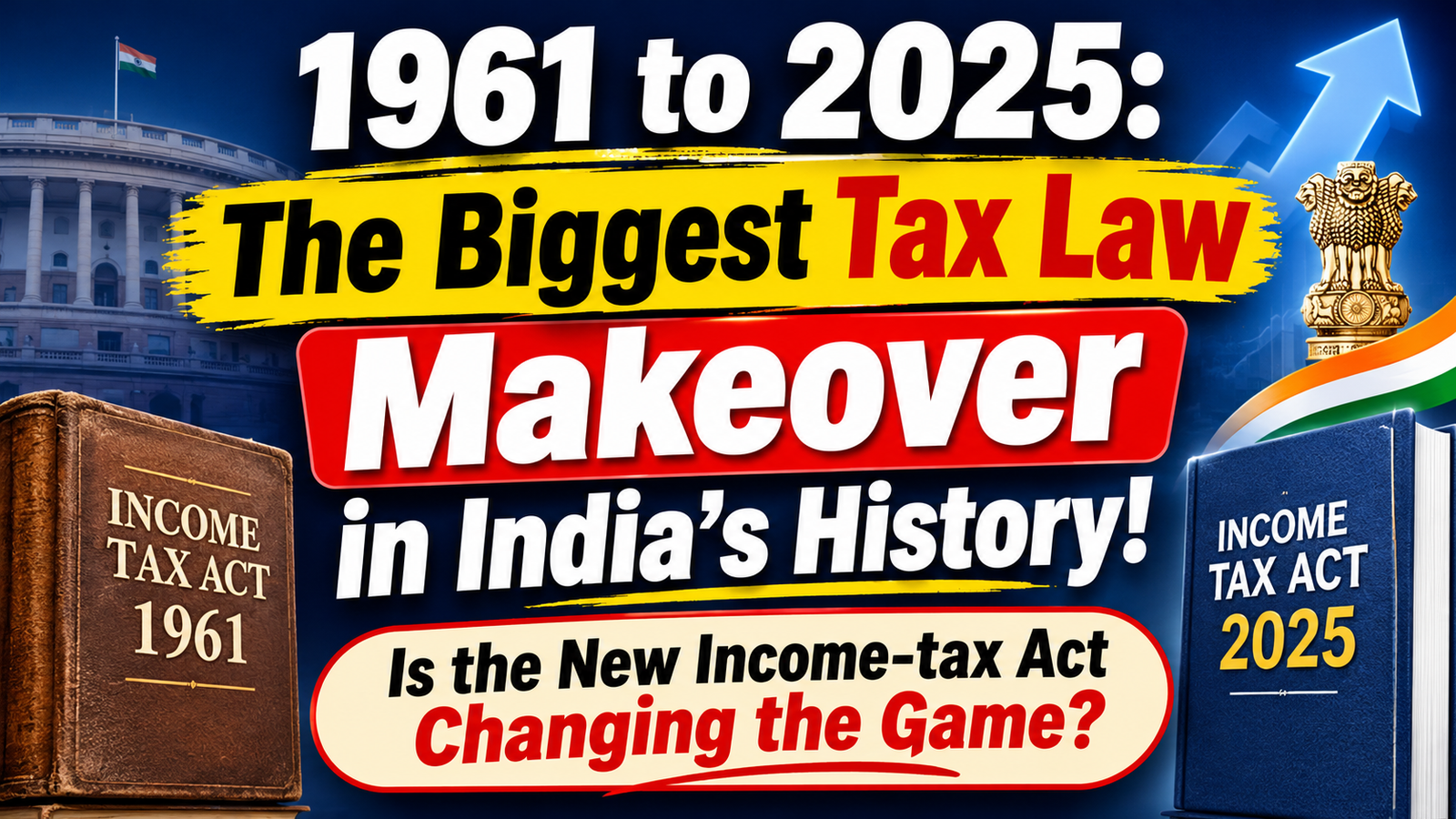
1961 to 2025: The Biggest Tax Law Makeover in India’s History!
Six decades. Thousands of amendments. Countless interpretations. One landmark transformation.
What happens when a tax law that has governed an entire country’s direct taxation system for more than six decades gets a complete legislative makeover?
India is entering a new chapter in its taxation journey with the introduction of the Income-tax Act, 2025, replacing the Income-tax Act, 1961. This marks a significant legislative transition for taxpayers, Chartered Accountants, tax professionals, businesses and students alike.
For generations, the Income-tax Act, 1961, has been the foundation of India’s direct taxation framework. It has shaped the way income is assessed, taxes are calculated, deductions are claimed and compliance is carried out.
But over the years, the economy has changed, businesses have evolved, financial transactions have become increasingly digital, and the tax legislation has grown through numerous amendments, explanations, provisos and additions.
Now, after more than six decades, India is moving towards a redesigned legislative framework.
But is this merely a change in section numbers, or does it represent a bigger shift in the way India’s tax law is structured and understood?
Let’s explore.
1. Why Was There a Need to Replace the Income-tax Act, 1961?
1961 to 2025: The Biggest Tax Law Makeover
The Income-tax Act, 1961, has served as India’s principal direct tax legislation for over 60 years. During this period, the country witnessed remarkable economic, technological and regulatory developments.
Naturally, the tax law evolved alongside these changes.
However, every new requirement often brought additional amendments, provisions, explanations, provisos and modifications. While these additions were necessary to address changing circumstances, they also contributed to making the legislation increasingly lengthy and complex.
For taxpayers, navigating the law could become challenging. For professionals, interpreting provisions, understanding their interconnections and identifying applicable requirements demanded considerable effort.
And for CA students? Memorising provisions, exceptions and section numbers was already a challenge!
The need for a more structured, readable and accessible legislation had therefore become increasingly evident.
The objective behind the Income-tax Act, 2025, is to reorganise and simplify the legislative framework, making it easier to read, understand and navigate while retaining the effectiveness of tax legislation.
2. Income-tax Act, 1961 vs Income-tax Act, 2025: What’s Changing?
1961 to 2025: The Biggest Tax Law Makeover
The most interesting aspect of this transition is not simply the replacement of the old Act, but the restructuring of the legislation itself.
Let’s look at some of the key changes and features that make the new framework significant.
A. A More Simplified Legislative Structure
1961 to 2025: The Biggest Tax Law Makeover :
One of the key objectives of the new Act is to improve the overall readability and organisation of tax provisions.
The legislation seeks to reorganise provisions, simplify drafting and reduce unnecessary complexity in the presentation of tax law.
The idea is to make it easier for taxpayers and professionals to locate relevant provisions and understand their applicability without having to navigate an unnecessarily complicated legislative structure.
<text> </text>
B. New Section Numbers, New References!
1961 to 2025: The Biggest Tax Law Makeover :
This is perhaps one of the most discussed aspects of the transition, especially among Chartered Accountants and CA students.
The familiar section numbers under the Income-tax Act, 1961, have been replaced with a revised numbering structure under the Income-tax Act, 2025.
For professionals and students who have spent years associating provisions with their old section numbers, this means getting accustomed to a new set of references.
However, a change in section number does not necessarily mean a change in the underlying tax treatment.
The real task is to understand which provisions have been retained, which have been modified, which have been reorganised and whether any substantive changes have been introduced.
C. Goodbye to Previous Year and Assessment Year? Understanding the Tax Year
1961 to 2025: The Biggest Tax Law Makeover :
Remember the terms Previous Year and Assessment Year?
These have been familiar concepts in Indian income-tax law for decades.
The Income-tax Act, 2025, introduces the concept of a Tax Year, replacing the earlier terminology and aiming to make the relevant taxation period more straightforward to understand.
For students, professionals and taxpayers accustomed to the old framework, this is an important terminological and conceptual transition that requires attention.
D. Simplified Language and Better Presentation
1961 to 2025: The Biggest Tax Law Makeover :
Another important focus of the new legislation is the presentation of tax provisions.
The Act aims to improve readability through simplified drafting and better organisation.
Tax legislation is not meant to be understood only by legal experts or tax professionals. Taxpayers themselves should be able to navigate the law and understand their financial obligations.
A more organised legislative framework can therefore play an important role in making tax law more accessible.
3. CA Students: A New Challenge or a New Opportunity?
1961 to 2025: The Biggest Tax Law Makeover
Now comes the part that deserves special attention!
For CA students, Direct Tax has always been a subject that demands conceptual clarity, consistent revision and a thorough understanding of provisions.
And when the legislation itself undergoes a major transition, preparation strategies naturally need to evolve.
But here’s the important part: You are not necessarily starting from scratch!
The fundamental concepts of income taxation continue to provide a foundation for understanding the new legislation.
Concepts relating to residential status, heads of income, deductions, exemptions, tax computation and other core principles remain essential to understanding the subject.
What changes is the legislative framework through which these concepts are presented and applied.
Instead of simply memorising the old section numbers, students need to focus on understanding the new provisions and identifying the actual changes.
How should CA students prepare?
- Understand before memorising: Focus on the underlying concepts instead of relying entirely on section numbers.
- Prepare comparative charts: Map important provisions of the 1961 Act with their corresponding provisions under the 2025 Act.
- Identify substantive changes: Distinguish between provisions that have merely been reorganised and provisions where the actual tax treatment has changed.
- Follow ICAI updates: Refer to the latest applicable study material, amendments and examination announcements.
- Revise strategically: Give additional attention to new provisions, revised terminology and areas where the tax treatment has changed.
The biggest mistake would be to assume that everything is entirely new or, conversely, that everything remains exactly the same.
A balanced approach is the key.
4. What Does the New Income-tax Act Mean for Practising Chartered Accountants?
1961 to 2025: The Biggest Tax Law Makeover
The transition is equally significant for professionals working in taxation, audit, finance and compliance.
Chartered Accountants and tax practitioners will need to familiarise themselves with the revised legislative framework and understand how it affects their professional responsibilities.
This transition may require professionals to:
- Update tax research tools, reference materials and working templates.
- Revisit existing interpretations and understand relevant changes.
- Adapt tax computation and compliance processes.
- Understand revised provisions applicable to clients.
- Stay updated with government notifications, rules and clarifications.
For professionals, continuous learning is not optional. It is an essential part of the profession.
The ability to adapt to changing regulations, interpret provisions accurately and apply them in real-world situations is what keeps a professional relevant in an evolving financial environment.
5. Will the New Act Make Taxation Easier for Ordinary Taxpayers?
1961 to 2025: The Biggest Tax Law Makeover
This is probably one of the most important questions.
After all, tax legislation ultimately affects individuals, businesses and organisations across the country.
A simplified legislative structure can make it easier for taxpayers to locate relevant provisions, understand their obligations and seek appropriate guidance.
Better organisation and readability may also improve the overall experience of tax compliance by making the legislation more accessible.
However, it is important to understand that simpler legislation does not automatically mean that every aspect of taxation becomes simple overnight.
Tax planning, interpretation, compliance and understanding individual circumstances will continue to require appropriate knowledge and professional guidance.
The real success of this transformation will depend on how effectively the new framework translates into easier understanding, smoother compliance and better accessibility.
6. The Bigger Picture: India’s Taxation System Is Evolving
1961 to 2025: The Biggest Tax Law Makeover
The transition from the Income-tax Act, 1961, to the Income-tax Act, 2025, reflects something much bigger than a legislative change.
India’s economy has transformed dramatically over the last six decades.
From traditional business structures to digital transactions, from conventional financial systems to an increasingly technology-driven economy, the taxation landscape has changed considerably.
A modern taxation framework must be capable of responding to these developments while remaining structured, effective and accessible.
The new Income-tax Act is an important step in that direction.
It also highlights a broader lesson for everyone in the finance and accounting profession: knowledge cannot remain static when the regulatory environment is constantly evolving.
Whether you are a student preparing for your CA examinations, a professional handling tax assignments or a taxpayer trying to understand your obligations, staying updated is more important than ever.
7. A Word for the CA Community
1961 to 2025: The Biggest Tax Law Makeover
For the CA fraternity, this transition brings a fresh learning experience.
The section numbers that once came naturally may now require revisiting. Familiar references may need to be replaced with new ones. Working papers, tax research and compliance practices may need to adapt.
But every major regulatory change also presents an opportunity to strengthen one’s understanding.
The new framework encourages professionals and students to revisit concepts, understand the legislative structure and develop a more comprehensive understanding of taxation.
And for CA students, this is another reminder that our profession is built on continuous learning.
The real skill is not merely remembering what the law says today, but being prepared to understand what it says tomorrow.
Conclusion: Six Decades of Legacy, A New Beginning for Indian Taxation!
1961 to 2025: The Biggest Tax Law Makeover
From the Income-tax Act, 1961, to the Income-tax Act, 2025, India is moving into a new chapter of direct taxation.
It is a transition from legislation that has shaped generations of taxpayers and professionals to a redesigned framework intended to make tax law more structured, organised and accessible.
For students, it means learning and adapting.
For professionals, it means updating and evolving.
And for taxpayers, it brings the promise of a more understandable legislative framework.
One thing is certain: the world of taxation never stands still.
The Act may change, the sections may change, the terminology may change, but the importance of understanding taxation will always remain!
1961 was the foundation. 2025 marks a new chapter. And the journey of learning continues.
Disclaimer: This article is intended solely for educational and informational purposes. Readers should refer to the official Income-tax Act, 2025, relevant rules, government notifications and applicable ICAI guidance for accurate and updated legal and examination-related information.