
7 Powerful Ways to Beat Exam Stress
CA Final and CA Inter exams can become extremely stressful as the exam dates come closer.
You may find yourself thinking:
- “My syllabus is still pending.”
- “Should I finish the remaining chapters or start revision?”
- “I studied this topic, but why can’t I remember it?”
- “What if the paper is difficult?”
- “What if I don’t pass this attempt?”
These thoughts can create so much pressure that you eventually spend more time worrying than studying.
But here’s the important thing: having a pending syllabus, struggling with recall, or feeling nervous before exams does not mean you are unprepared or incapable of clearing CA exams.
What you need at this stage is not panic—it is a clear and practical strategy.
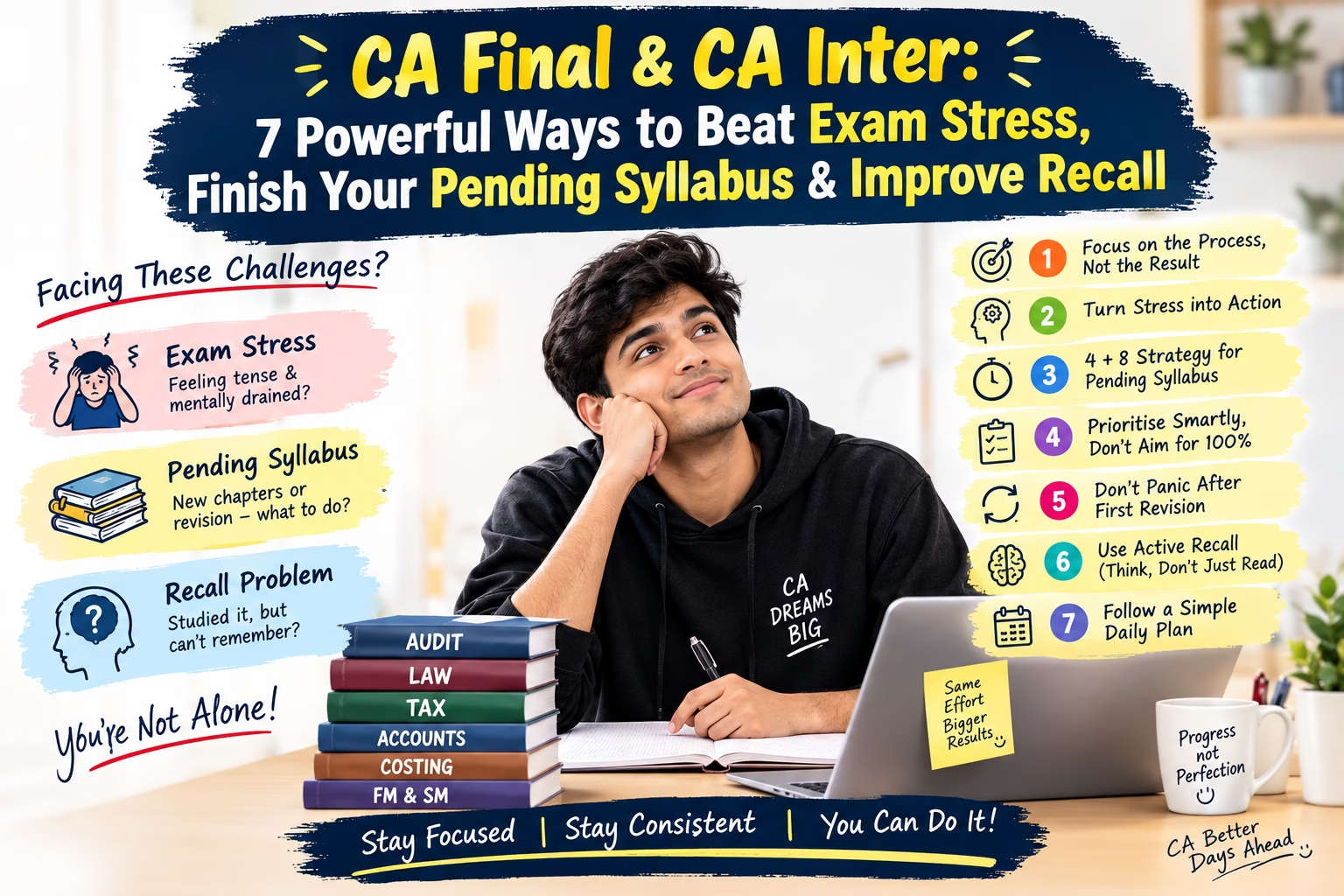
In this article, we will discuss 7 powerful ways to manage exam stress, complete pending portions, improve recall, and make your remaining preparation more productive.
1. Stop Focusing on the Result and Start Focusing on the Process
7 Powerful Ways to Beat Exam Stress :
One of the biggest reasons students feel stressed before CA exams is that their attention shifts from what they can control to what they cannot control.
You may constantly think:
- What if I fail?
- What if the paper is difficult?
- What if I don’t remember anything?
- What if the examiner asks something unexpected?
- What will happen after the result?
The problem is that none of these questions helps you study the next chapter.
Focus on your process instead.
You cannot control:
- The difficulty level of the paper
- The questions asked by ICAI
- The checking of your answer sheet
- The final result
But you can control:
- How many hours you study today
- Which chapter you revise
- How many questions you practise
- How many mock tests you attempt
- Whether you revise your mistakes
- How seriously you use the remaining days
Instead of thinking:
“Will I clear CA Final?”
Ask yourself:
“What can I complete in the next 3 hours?”
That simple shift can make your preparation much more manageable.
Remember: Focus on today’s work, not tomorrow’s result.
Your job is to prepare as effectively as possible. The result will come later.
2. Don’t Let Exam Stress Consume Your Study Time
7 Powerful Ways to Beat Exam Stress :
Some level of nervousness before CA exams is completely understandable.
However, there is a difference between being concerned about your preparation and spending hours worrying about it.
For example, imagine you have 10 hours available for studying.
If you spend two hours thinking:
“My syllabus is incomplete. I am definitely behind.”
you haven’t solved the problem—you have simply lost two valuable study hours.
Instead, convert anxiety into an action.
Whenever you feel stressed, ask:
“What is the next thing I need to do?”
If one chapter is pending → start the chapter.
If revision is pending → revise.
If recall is weak → practise active recall.
If question practice is pending → solve questions.
The goal is to continuously move from thinking about the problem → working on the problem.
3. Use the 4 + 8 Strategy for a Pending Syllabus
7 Powerful Ways to Beat Exam Stress :
One of the biggest problems students face close to CA exams is deciding between finishing the syllabus and revising completed portions.
Should you complete new chapters?
Or should you revise what you’ve already studied?
The practical answer can be: do both.
If you are studying around 12 hours a day, you can divide your study time into two broad blocks:
First 4 Hours → New/Pending Syllabus
Use your first focused study block to cover chapters or topics that are still pending.
Remaining 8 Hours → Revision & Practice
Use the remaining time for:
- Revision
- Question practice
- RTP/MTP/PYQs
- Short notes
- Recall practice
- Mock tests
- Weak areas
This creates a balance between coverage and retention.
| Study Block | Primary Objective |
|---|---|
| First 4 Hours | Complete pending/new topics |
| Next 8 Hours | Revision + Practice + Recall |
Of course, this is not a rigid rule. If your syllabus situation is different, adjust the ratio.
The important principle is:
Don’t completely stop revision just because your syllabus is pending.
And don’t completely stop covering new topics just because exams are approaching.
4. Don’t Try to Cover 100% at the Cost of Effective Preparation
7 Powerful Ways to Beat Exam Stress :
Ideally, every student should aim to cover the complete syllabus.
But sometimes the remaining time simply doesn’t allow perfect coverage.
At that point, panic can make things worse.
Suppose you have a few difficult chapters left and limited time.
You might spend an entire day trying to master one chapter while neglecting multiple chapters that you already know.
Instead, assess your situation realistically.
Ask:
- How much syllabus have I already covered?
- Which chapters are relatively strong?
- Which chapters require immediate revision?
- Which pending chapters can realistically be completed?
- Which topics have very high time requirements?
- How much time will remain for revision after completing them?
The objective is not merely “touching” every chapter.
The objective is to maximise your effective preparation with the time available.
If a particular topic is extremely time-consuming and realistically cannot be completed properly, you may have to prioritise other areas.
However, this does not mean assuming that a skipped chapter won’t appear in the exam.
In fact, you should prepare with the opposite mindset:
Any chapter you leave can still be tested.
So don’t skip a topic simply because you think ICAI won’t ask it.
Make such decisions only after considering your overall preparation and available time.
5. Don’t Panic If You Can’t Recall Everything After the First Revision
7 Powerful Ways to Beat Exam Stress :
This is one of the most common problems among CA students.
You complete your classes.
You study the chapter.
You revise it.
Then you open the book again and think:
“I don’t remember anything!”
This can be extremely discouraging.
But don’t immediately conclude that your entire preparation has disappeared.
First revision is not necessarily about achieving perfect recall.
When you study something for the first time after a long gap, the first revision often serves as a reconnection process.
You are reminding your brain:
- What was taught?
- What were the important concepts?
- What was the approach?
- Which formulas or provisions were relevant?
- How were questions solved?
You may feel that you are learning the chapter again.
That’s normal.
6. Understand How Revision Makes Recall Faster
7 Powerful Ways to Beat Exam Stress :
Think about revision as a process of compressing information.
Suppose you initially spend 200 hours studying a subject through classes, reading, notes and practice.
Your first revision may take a significant amount of time.
But after repeated revision, the same material becomes increasingly familiar.
For example:
First exposure → 200 hours
First revision → 100 hours
Second revision → 50–60 hours
Later revision → significantly less time
The exact numbers will vary from student to student, but the principle is important:
Revision gradually reduces the time required to retrieve information.
That is why CA students don’t revise merely because they are afraid of forgetting.
They revise so that the information becomes faster and easier to retrieve when the exam arrives.
7. Use Active Recall Instead of Constantly Re-reading
7 Powerful Ways to Beat Exam Stress :
If your major concern is:
“I understand everything when I see the book, but I can’t remember it without the book.”
then you need more active recall.
Instead of repeatedly reading the same page, close the book and ask yourself:
For Theory Subjects
- What were the main provisions?
- What are the important exceptions?
- Can I explain this concept without looking?
- What are the important keywords?
- Can I reproduce the answer structure?
For Practical Subjects
- What is the formula?
- What is the accounting treatment?
- What is the adjustment?
- What is the journal entry?
- Can I solve a similar question without seeing the solution?
For Audit
Try recalling:
- SA number
- Objective
- Key requirements
- Important procedures
- Reporting implications
- Relevant keywords
For Taxation
Try recalling:
- Section
- Conditions
- Exceptions
- Limits
- Rates
- Time limits
- Practical application
The more you practise retrieving information without looking at the answer, the more useful your revision becomes.
A Simple CA Final & CA Inter Revision Cycle
7 Powerful Ways to Beat Exam Stress :
Instead of expecting yourself to remember everything perfectly after one revision, think in cycles.
First Revision
Goal: Reconnect with the syllabus.
Don’t panic if recall isn’t perfect.
Second Revision
Goal: Strengthen concepts and identify weak areas.
You should start noticing that familiar topics require less time.
Third Revision
Goal: Fast recall + exam-oriented preparation.
Focus more on:
- Important concepts
- Questions
- Mistakes
- Formulas
- Provisions
- Short notes
- RTP/MTP/PYQs
Final Revision
Goal: Rapid retrieval before the exam.
At this stage, your preparation should become increasingly concise.
What If You Feel That You Have Forgotten Everything?
7 Powerful Ways to Beat Exam Stress :
Take a chapter you studied weeks or months ago.
Don’t immediately open the entire book and start reading from page one.
Instead:
Step 1: Close the book
Write down everything you remember.
Step 2: Open your notes
Compare your recall with your notes.
Step 3: Identify the gaps
Mark what you forgot.
Step 4: Revise only the weak areas
Don’t spend unnecessary time on information you already know.
Step 5: Test yourself again
Close the book and reproduce the important points.
This process gives you a much more accurate picture of your preparation than simply reading the chapter again.
A Practical Daily Plan for Students With a Pending Syllabus
7 Powerful Ways to Beat Exam Stress :
If you have around 12 effective study hours available, a day could look like this:
| Time | Activity |
|---|---|
| Block 1 | Pending/New Syllabus |
| Short Break | Refresh |
| Block 2 | Revision |
| Block 3 | Revision + Questions |
| Block 4 | Active Recall |
| Block 5 | RTP/MTP/PYQs or Mock Practice |
| Final 20–30 min | Quick revision of the day’s work |
The exact timing can be changed according to your routine.
The important thing is to ensure that every day contains both coverage and revision.
5 Things You Should Avoid During the Final Phase
7 Powerful Ways to Beat Exam Stress :
1. Constantly calculating your chances of passing
Your energy is better spent preparing.
2. Comparing your syllabus with other students
Someone else’s progress does not change your preparation.
3. Re-reading without testing yourself
Reading can create an illusion of familiarity.
4. Spending an entire day on one difficult chapter
Time allocation matters.
5. Changing your strategy every few days
Once you have a workable plan, execute it consistently instead of constantly searching for a new strategy.
The Most Important Mindset for CA Exams
7 Powerful Ways to Beat Exam Stress :
You don’t need to feel 100% confident before entering the examination hall.
Confidence is often a result of repeated preparation—not a prerequisite for starting preparation.
If you feel that you don’t remember something today, don’t panic.
Revise it.
If the syllabus is pending, don’t panic.
Prioritise it.
If you feel stressed, don’t spend the entire day worrying.
Return to the process.
If you cannot cover everything perfectly, maximise what you can realistically prepare.
Final Takeaway: Don’t Let Panic Become Another Pending Subject
7 Powerful Ways to Beat Exam Stress :
CA Final and CA Inter preparation can become overwhelming when three things happen together:
Pending syllabus + poor recall + exam anxiety.
But each problem can be addressed separately.
Feeling Tensed?
Focus on the process, not the result.
Syllabus Pending?
Divide your study time between new content and revision.
Recall Problem?
Use repeated revision and active recall instead of expecting perfect memory after one revision.
Most importantly, don’t confuse “I can’t recall it instantly” with “I have learned nothing.”
Your preparation improves through repeated exposure, retrieval and practice.
So, instead of asking yourself:
“Will I be able to clear the exam?”
ask:
“What can I do today to make my preparation better than yesterday?”
Then do that.
One chapter.
One revision.
One question.
One day at a time.
Your remaining preparation time is still valuable. Use it wisely, stay consistent, and give your best possible effort in the attempt.
🔗 Join 10,000+ CA Students using our Test Series to study smarter and create your own academic brand. Structured tests with detailed feedback.
Useful Resources