
CA Industrial Training Interview Preparation :
Industrial Training can be a game-changing opportunity for CA students. It offers exposure to real-world finance, business decision-making, valuation, taxation, FP&A, consulting, banking, and corporate finance functions that traditional articleship often cannot provide.
However, securing an industrial training offer from leading companies is becoming increasingly competitive. Candidates are expected to demonstrate not only technical knowledge but also business awareness, communication skills, Excel proficiency, analytical thinking, and a clear understanding of their chosen domain.
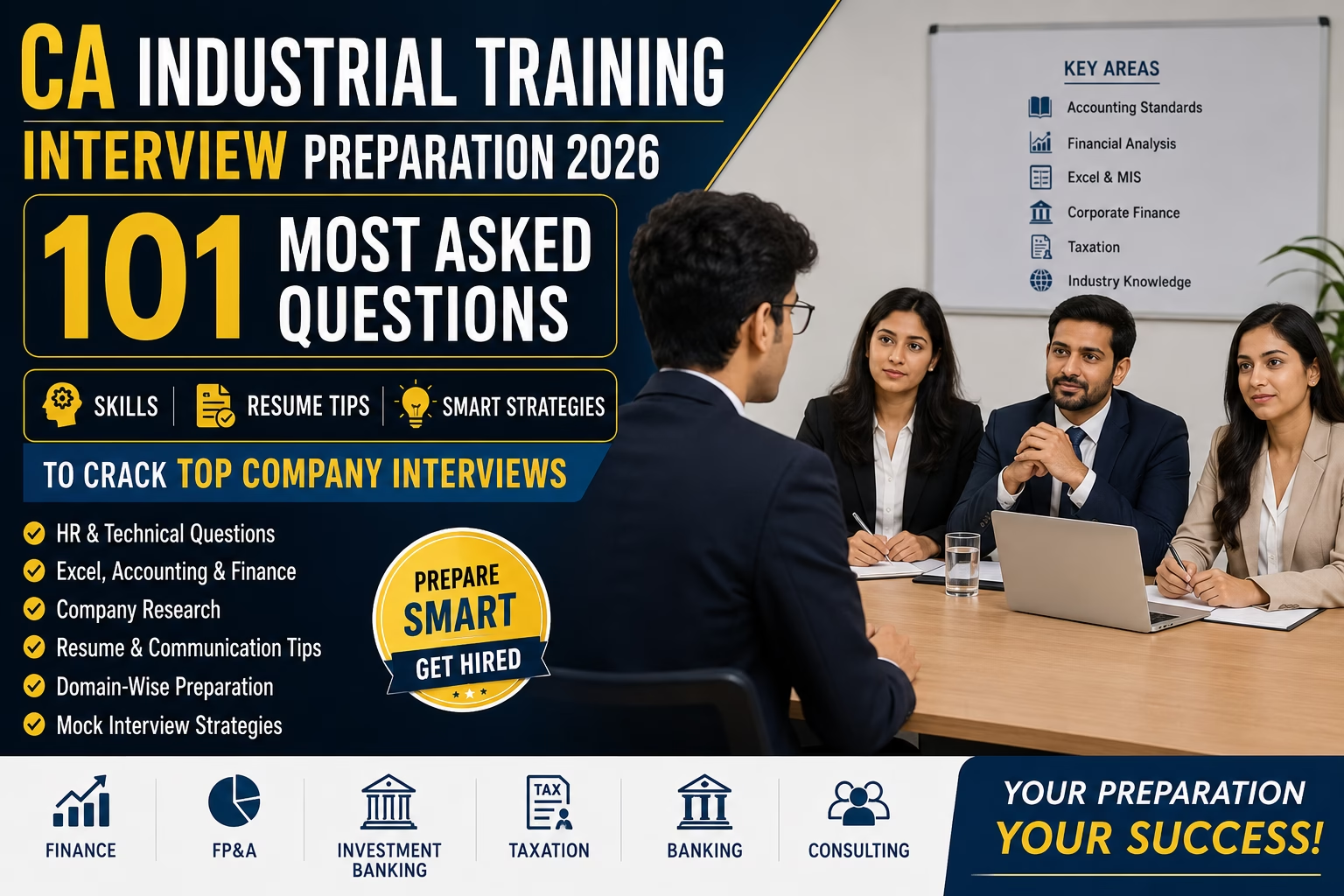
This comprehensive guide covers the most frequently asked industrial training interview questions, important technical areas, domain-wise preparation strategies, and practical tips to help you stand out in interviews.
CA Industrial Training Interview Preparation :
Why Industrial Training Matters More Than Ever
Industrial training allows CA students to:
- Gain corporate exposure before qualification
- Understand business operations from inside the organization
- Work with senior finance professionals
- Improve analytical and decision-making skills
- Build industry-specific expertise
- Increase employability after CA qualification
- Secure better campus placement opportunities
Many students who complete industrial training receive pre-placement offers (PPOs) or gain a significant advantage during final placements.
Top Domains Hiring CA Industrial Trainees
Before preparing for interviews, understand the major profiles where companies hire industrial trainees:
1. Corporate Finance
Responsibilities include:
- Financial reporting
- Budgeting
- Working capital management
- Cost analysis
- Business performance monitoring
- Treasury functions
2. FP&A (Financial Planning & Analysis)
Key activities:
- Budget preparation
- Forecasting
- Variance analysis
- Business performance review
- Management reporting
3. Investment Banking
Common work includes:
- Financial modeling
- Company valuation
- Pitch books
- M&A analysis
- Industry research
4. Equity Research
Focus areas:
- Financial statement analysis
- Valuation models
- Industry studies
- Investment recommendations
5. Banking & Credit Analysis
Roles may include:
- Credit assessment
- Financial analysis
- Relationship management
- Loan evaluation
6. Management Consulting
Work generally involves:
- Business problem-solving
- Strategy projects
- Market research
- Process improvement initiatives
7. Direct & Indirect Taxation
Students may work on:
- Corporate tax compliance
- GST matters
- Tax planning
- Litigation support
Most Frequently Asked HR Interview Questions
CA Industrial Training Interview Preparation :
Almost every industrial training interview begins with HR and personality-based questions.
Tell me about yourself.
A good answer should cover:
- Educational background
- Articleship experience
- Major assignments handled
- Skills acquired
- Career aspirations
Avoid narrating your entire life story.
Why do you want to pursue Industrial Training?
Interviewers want to understand:
- Your motivation
- Career goals
- Industry interest
- Long-term vision
Focus on:
- Corporate exposure
- Practical learning
- Business understanding
- Domain specialization
Why not continue in Articleship?
Avoid criticizing your current firm.
Instead, explain:
- Desire for corporate exposure
- Interest in business decision-making
- Opportunity to work on larger projects
What are your major learnings from Articleship?
Structure your answer in points:
Example:
- Time management
- Client handling
- Team collaboration
- Deadline management
- Technical expertise
What are your strengths?
Examples:
- Analytical thinking
- Attention to detail
- Problem-solving ability
- Quick learning
- Communication skills
Support every strength with an example.
What is your biggest weakness?
Choose a genuine but manageable weakness and explain how you are improving it.
Where do you see yourself in five years?
Discuss:
- Becoming a qualified CA
- Building domain expertise
- Taking leadership responsibilities
- Creating value for the organization
Company-Specific Questions You Must Prepare
CA Industrial Training Interview Preparation :
One of the most common reasons candidates get rejected is lack of company research.
Interviewers frequently ask:
Why do you want to join our company?
What do you know about our organization?
What are our major products or services?
Who is our CEO or CFO?
What recent developments have occurred in our company?
What challenges is our industry facing?
How to Research Any Company Effectively
Before every interview:
Read:
- Annual Report
- Investor Presentation
- Recent News
- Company Website
- Earnings Announcements
Understand:
- Business model
- Revenue streams
- Key competitors
- Financial performance
- Industry trends
This preparation alone can differentiate you from most candidates.
Excel Questions Frequently Asked in Industrial Training Interviews
CA Industrial Training Interview Preparation :
Excel has become a mandatory skill in corporate finance.
Interviewers commonly ask:
What Excel functions have you used?
Be comfortable explaining:
- VLOOKUP
- XLOOKUP
- HLOOKUP
- INDEX-MATCH
- SUMIFS
- COUNTIFS
- IF Statements
- Pivot Tables
- Conditional Formatting
What is a Pivot Table?
Difference between VLOOKUP and XLOOKUP?
How do you clean large datasets?
How would you analyze sales data in Excel?
How do you prepare management reports?
Practical understanding matters more than theoretical definitions.
Accounting Questions Asked in Industrial Training Interviews
These questions are extremely common.
Explain Revenue Recognition.
Important concepts include:
- Performance obligations
- Timing of recognition
- Contract consideration
Explain Inventory Valuation.
Know:
- FIFO
- Weighted Average
- NRV concept
What is Depreciation?
Difference between Capital and Revenue Expenditure?
What is Deferred Tax?
What are Accrued Expenses?
What are Prepaid Expenses?
Explain GST accounting entries.
Should GST be recorded as revenue?
Correct answer:
No. GST collected is a liability and not revenue.
Important Accounting Standards to Revise
CA Industrial Training Interview Preparation :
Interviewers frequently focus on:
- Ind AS 115 – Revenue
- Ind AS 116 – Leases
- Ind AS 109 – Financial Instruments
- Ind AS 16 – Property, Plant and Equipment
- Ind AS 2 – Inventories
- Ind AS 7 – Cash Flow Statement
Prepare:
- Objective
- Recognition criteria
- Measurement principles
- Major disclosures
Financial Statement Analysis Questions
Financial statement analysis is one of the most tested areas.
Interviewers may ask:
How do you analyze a company?
Which statements do you review first?
How do you identify red flags?
What is working capital?
What drives cash flow?
How do you evaluate profitability?
Key Ratios You Must Know
Liquidity Ratios
- Current Ratio
- Quick Ratio
Profitability Ratios
- Gross Margin
- EBITDA Margin
- Net Profit Margin
- ROE
- ROCE
Efficiency Ratios
- Inventory Turnover
- Receivables Turnover
- Fixed Asset Turnover
Market Ratios
- EPS
- PE Ratio
- Price-to-Book Ratio
Understand interpretation rather than memorization.
FP&A Interview Questions
CA Industrial Training Interview Preparation :
If interviewing for FP&A roles, expect questions on:
What is Budgeting?
What is Forecasting?
Difference between Budget and Forecast?
What is Variance Analysis?
How would you forecast next year’s sales?
How do you prepare MIS Reports?
What KPIs would you track for management?
Investment Banking & Valuation Questions
CA Industrial Training Interview Preparation : For IB and valuation profiles, prepare:
What is DCF Valuation?
What are Free Cash Flows?
What is WACC?
How do you calculate Terminal Value?
What is Enterprise Value?
Difference between Enterprise Value and Equity Value?
What valuation multiples are commonly used?
Examples:
- EV/EBITDA
- PE Ratio
- EV/Sales
Banking & Credit Analysis Questions
What is Credit Risk?
How do banks evaluate loan applicants?
What factors affect repayment capacity?
What financial ratios are important for lenders?
What is Debt Service Coverage Ratio (DSCR)?
What is Working Capital Assessment?
Internal Audit & Process Questions
CA Industrial Training Interview Preparation : Candidates often overlook process-based questions.
Common examples:
Explain Procure-to-Pay (P2P) Process.
Explain Order-to-Cash (O2C) Process.
What is Purchase Requisition?
What is Purchase Order?
Difference between PR and PO?
What controls should exist in procurement?
How would you audit a purchase process?
These questions test practical understanding rather than textbook knowledge.
Resume-Based Questions: The Biggest Interview Trap
Interviewers often spend most of their time discussing your resume.
If your resume states:
- Filed 100+ Income Tax Returns
- Conducted Statutory Audits
- Performed GST Compliance
- Prepared Financial Models
Expect detailed questioning.
For example:
If you mention filing ITRs, interviewers may ask:
- Difference between ITR-2 and ITR-3
- Filing deadlines
- Common tax deductions
- Tax audit applicability
Never exaggerate your experience.
Every line on your resume should be defensible.
Technical Skills That Give Immediate Advantage
Students with the following skills generally perform better:
Advanced Excel
Power BI
Financial Modeling
SAP
Tally
Data Analysis
Business Presentation Skills
Financial Statement Analysis
Communication Skills
Smart Preparation Strategy for Industrial Training Interviews
CA Industrial Training Interview Preparation :
Step 1: Master Your Resume
Prepare detailed explanations for every project and assignment.
Step 2: Learn Company Research
Study:
- Annual reports
- Investor presentations
- Recent news
- Industry trends
Step 3: Strengthen Excel
Practice:
- Lookups
- Pivot tables
- Dashboard preparation
- MIS reporting
Step 4: Revise Core Accounting
Focus on:
- Revenue
- Inventory
- Fixed Assets
- Leases
- Cash Flows
Step 5: Practice Financial Analysis
Analyze real listed companies.
Study:
- Balance Sheet
- Profit & Loss
- Cash Flow Statement
- Ratios
Step 6: Conduct Mock Interviews
Practice:
- HR Questions
- Technical Questions
- Domain-Specific Questions
- Case-Based Discussions
Mock interviews significantly improve confidence and communication.
Final Thoughts
CA Industrial Training Interview Preparation :
Industrial training interviews are no longer limited to basic accounting questions. Recruiters expect CA students to demonstrate technical competence, business understanding, analytical thinking, communication skills, and genuine interest in the organization.
The candidates who consistently succeed are those who:
- Know their resume thoroughly
- Understand financial statements
- Have strong Excel skills
- Research companies deeply
- Practice mock interviews
- Stay updated with business news
Start preparing early, focus on practical understanding rather than rote learning, and approach every interview with confidence and curiosity. With the right preparation strategy, securing industrial training in a top company becomes significantly more achievable.
🔗 Join 10,000+ CA Students using our Test Series to study smarter and create your own academic brand. Structured tests with detailed feedback.