

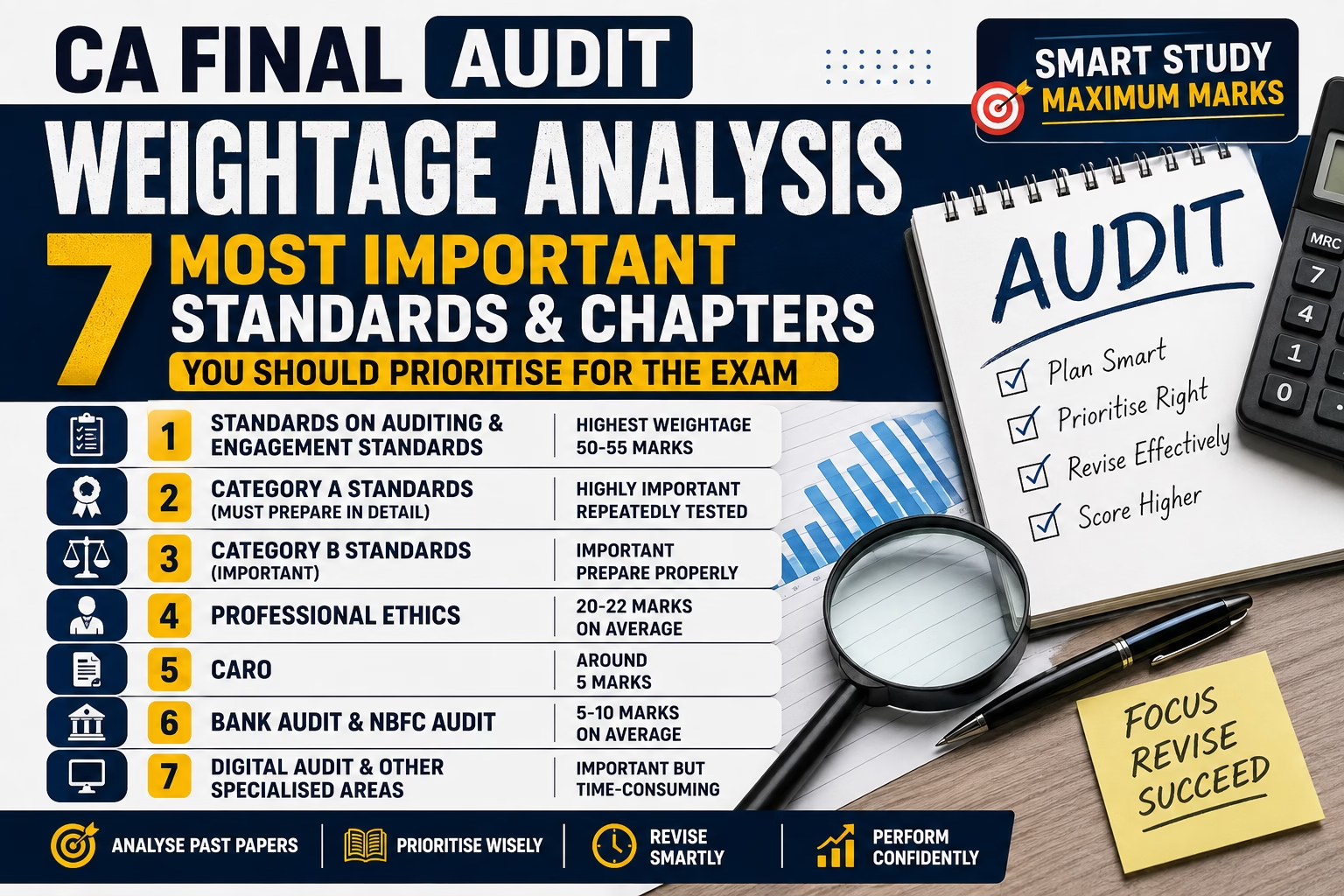
CA Final Audit Weightage Analysis:
CA Final Audit is one of those subjects where students often struggle with a simple question:
Do I really need to study every Standard on Auditing, SRS, SAE, Professional Ethics and every other chapter in equal depth?
The answer is no—not when your revision time is limited.
Of course, the ideal approach is to cover the entire syllabus because ICAI can ask questions from any area. However, if you are approaching the examination with limited time, a past-year weightage analysis can help you decide where to invest more time and where you can adopt a relatively lighter approach.
An analysis of recent CA Final Audit examinations shows that some Standards and chapters have been repeatedly tested, while others have appeared much less frequently.
The objective of this analysis is therefore not to predict the paper, but to help you create a smart priority-based revision strategy.
Why CA Final Audit Weightage Analysis Matters
CA Final Audit Weightage Analysis:
The Audit syllabus contains a large number of:
- Standards on Auditing
- SRS and other engagement-related standards
- Professional Ethics
- Bank Audit
- NBFC Audit
- Digital Audit
- Group Audit
- PSU Audit
- ESG-related areas
- Other specialised audit topics
Trying to study everything with exactly the same intensity can become inefficient.
Instead, divide your preparation into three broad categories:
Category A – Must Prepare in Detail
These are highly important and repeatedly tested areas.
Category B – Important
These areas should be properly prepared but can receive comparatively less time than Category A.
Category C – Lower Priority
These should not necessarily be skipped, but if you are extremely short on time, you can adopt a selective approach.
Remember: Category C does not mean “not important.” It means relatively lower priority based on past examination trends.
Standards on Auditing: The Most Important Area
CA Final Audit Weightage Analysis:
Standards on Auditing and other engagement-related standards form a significant portion of the CA Final Audit paper.
Based on the past-year analysis discussed in the source material, these areas can collectively contribute a substantial portion of the examination.
The key takeaway is:
Do not treat all Standards equally when allocating revision time.
Some standards have appeared repeatedly across examinations, while others have appeared rarely.
Category A: Standards You Should Study in Detail
Category A should receive your highest level of attention.
For these Standards, your preparation should include:
- Conceptual understanding
- Important provisions
- Definitions
- Practical application
- ICAI Study Material questions
- Past-year questions
- MCQs
- Case-based questions
- Question variations
Do not limit your preparation to memorising the wording.
ICAI has increasingly tested concepts through application-based and differently framed questions, particularly in recent examinations.
Therefore, the objective should be:
Understand → Recall → Apply → Practise
rather than simply:
Read → Memorise → Forget
Category B: Important Standards
Category B standards should also be prepared properly.
However, if your revision schedule is becoming tight, you can allocate comparatively less time to these areas after completing Category A.
A good approach is to:
- Understand the core provisions.
- Read the important concepts carefully.
- Practise ICAI questions.
- Solve past-year questions.
- Revise the marked portions again before the examination.
Category B can become particularly useful when you are trying to strengthen your score after completing the most important areas.
Category C: What If You Have Very Limited Time?
This is where students need to be careful.
The correct strategy is not:
“Category C is unimportant, so I will completely skip it.”
Instead, if you genuinely have very limited time, you can use a selective preparation strategy.
For Category C areas, at minimum:
- Read the basic concepts.
- Go through the important provisions.
- Solve the Question Bank.
- Review past-year questions.
- Revise important MCQs.
This gives you at least some exposure to the topic without spending the same amount of time that you would spend on Category A.
Don’t Ignore Standards Just Because They Have Not Appeared Recently
CA Final Audit Weightage Analysis:
One of the biggest mistakes students make is assuming that a topic that has not appeared recently will not be asked.
That is dangerous.
ICAI can change the trend at any time.
A Standard that has not been tested for several attempts can suddenly become the basis of:
- A descriptive question
- An MCQ
- A case scenario
- A practical application question
Therefore, past-year analysis should be used as a priority tool, not a prediction tool.
Engagement Standards: A Major Scoring Opportunity
CA Final Audit Weightage Analysis:
One of the strongest takeaways from the past-year analysis is the importance of Standards on Auditing and other engagement-related standards.
Collectively, these areas have contributed significantly to the examination paper across recent attempts.
This means students should not take them lightly.
If your preparation is incomplete, prioritise the high-frequency standards first and then gradually expand your coverage.
Your preparation should include:
- Understanding the objective of each Standard
- Important definitions
- Responsibilities of the auditor
- Key requirements
- Documentation requirements
- Reporting requirements
- Practical situations
- ICAI’s past questions
Professional Ethics: A High-Value Area
CA Final Audit Weightage Analysis:
Professional Ethics deserves a separate discussion because it has consistently contributed meaningful marks to the Audit paper.
Based on the trend discussed in the analysis, Professional Ethics can contribute around 20–22 marks on average, including MCQs and descriptive questions.
That makes it an area that students cannot afford to neglect.
Why Professional Ethics Is Important
Professional Ethics is not simply about memorising sections and clauses.
ICAI can frame questions around:
- Situations
- Ethical requirements
- Professional misconduct
- Specific provisions
- Practical scenarios
- MCQs
The questions can also be framed differently from the examples students have previously seen.
Therefore, Professional Ethics should be prepared in detail, particularly if you are targeting a high score.
Recommended Approach
For Professional Ethics:
Read the provision → Understand the situation → Solve ICAI questions → Practise MCQs → Revise repeatedly
CARO: Another Important Area
CA Final Audit Weightage Analysis:
CARO is another important component of CA Final Audit preparation.
Based on the past-year trend discussed, CARO has contributed around 5 marks on average.
Although the exact marks can vary from examination to examination, the recurring presence makes CARO an important scoring opportunity.
Students should therefore ensure that the major clauses and frequently tested requirements are properly prepared.
Focus On:
- Important clauses
- Applicability
- Reporting requirements
- Practical situations
- ICAI questions
- MCQs
CARO should not be left for the very last moment.
Bank Audit & NBFC Audit
CA Final Audit Weightage Analysis:
Bank Audit and NBFC Audit fall into an important category for selective revision planning.
Past examinations have included questions covering areas such as:
- Bank investments
- Miscellaneous bank audit areas
- NBFC prudential norms
- NBFC provisioning
- Tier 1 capital
- Acquisition of property in settlement of claims
- Other specialised audit requirements
The trend suggests that students should allocate dedicated time to these areas.
Recommended Priority
If your preparation is reasonably on track:
Study Bank Audit + NBFC Audit properly.
If your time is extremely limited:
Focus first on the repeatedly tested areas and the ICAI Question Bank.
Digital Audit: Important but Time-Consuming
CA Final Audit Weightage Analysis:
Digital Audit presents a slightly different challenge.
The chapter can be relatively extensive, and students may find it difficult to cover every concept in depth when they are revising multiple Audit chapters simultaneously.
The better strategy is to identify the high-yield concepts within Digital Audit rather than attempting to memorise everything at the last minute.
Topics that have appeared in different forms include areas related to:
- Cyber-related audit concerns
- Remote audit
- Metaverse
- Valuation-related areas
- Technology-driven audit considerations
The exact importance of individual sub-topics can change from one examination to another.
Therefore, if you are short on time, use the ICAI Question Bank and your marked important topics as the primary revision source.
Group Audit, PSU Audit and Other Chapters
CA Final Audit Weightage Analysis:
Other Audit areas also deserve attention, particularly:
- Group Audit
- PSU Audit
- ESG
- Sustainability-related areas
- Specialised audit topics
These can be placed into your second-level revision after you have completed the high-priority areas.
If sufficient time is available, complete them thoroughly.
If time is limited, use:
Concepts + Question Bank + Past-Year Questions
as your minimum preparation strategy.
The 70–80 Marks Strategy
CA Final Audit Weightage Analysis:
One of the most useful insights from this analysis is that a significant portion of the Audit paper can potentially be covered by focusing on:
1. Engagement Standards
2. Professional Ethics
3. CARO
The analysis suggests that these areas together can account for approximately 70–80 marks in some examination patterns, depending on the attempt and including MCQs.
This does not mean you should study only these areas.
Instead, it tells you where a significant amount of your revision effort should go.
Think of it as a foundation:
First secure the high-priority areas → then strengthen the remaining syllabus.
How to Divide Your CA Final Audit Preparation
CA Final Audit Weightage Analysis:
A practical priority structure could look like this:
| Priority | What to Do |
|---|---|
| Category A | Study in complete detail + multiple revisions + extensive question practice |
| Category B | Study properly + practise ICAI questions + revise at least twice |
| Category C | Cover basic concepts + Question Bank + important past-year questions if time is limited |
This approach prevents you from making the common mistake of spending several hours on a low-frequency topic while leaving repeatedly tested concepts underprepared.
What Should You Do If You Have Only a Few Days Left?
CA Final Audit Weightage Analysis:
If your Audit examination is approaching and you have very little time, do not panic.
Use a three-layer strategy.
Layer 1: Category A
Complete these areas thoroughly.
Focus on:
- Concepts
- Provisions
- Question Bank
- Past-year questions
- MCQs
- Case-based application
Layer 2: Category B
Cover the important concepts and solve the major ICAI questions.
Do not spend disproportionate time making perfect notes.
The objective is exam readiness.
Layer 3: Category C
If time permits, complete them.
If time does not permit:
- Read the important provisions
- Review the Question Bank
- Practise selected questions
- Revise MCQs
This is significantly better than completely ignoring the topic.
Why Question Bank Practice Is So Important
CA Final Audit Weightage Analysis:
For lower-priority topics, the Question Bank becomes particularly useful.
Suppose you do not have enough time to study an entire chapter in extreme detail.
Instead of completely skipping it:
Read the core concepts → Solve the Question Bank → Review past questions → Move on.
This gives you exposure to the way ICAI frames questions without consuming excessive revision time.
However, for Category A topics, Question Bank practice alone is not enough.
You should develop deep conceptual clarity.
Don’t Prepare Audit Like a Prediction Game
CA Final Audit Weightage Analysis:
The most important warning from this entire analysis is:
Do not treat weightage analysis as a paper prediction.
ICAI can:
- Repeat a topic
- Skip a frequently tested topic
- Introduce a new question
- Convert a descriptive question into an MCQ
- Combine two concepts
- Test an old concept in a completely new scenario
Therefore, statements like:
“This has not come for five attempts, so it will definitely come now.”
or
“This came recently, so it cannot come again.”
are not reliable preparation strategies.
The Smartest CA Final Audit Revision Strategy
CA Final Audit Weightage Analysis:
Your preparation should follow this sequence:
Step 1: Complete the Entire Syllabus
Do not initially depend on predictions.
Step 2: Categorise the Topics
Divide your revision into:
A → B → C
Step 3: Strengthen Category A
Give these topics the maximum time.
Step 4: Practise ICAI Material
Use:
- Study Material
- RTPs
- MTPs
- Previous-year papers
- Question Bank
- MCQs
Step 5: Revise Professional Ethics & CARO Repeatedly
These are high-value areas and should not be left for the last few hours.
Step 6: Use Selective Revision for Category C
If time is limited, Question Bank + important concepts can be your minimum approach.
Final Takeaway
CA Final Audit Weightage Analysis:
CA Final Audit is a vast subject, but you do not have to give equal time to every single topic.
A smart student understands the difference between:
“I have to study everything”
and
“I have to study everything with the same intensity.”
The first approach is necessary for complete preparation.
The second approach is inefficient.
Use past-year weightage analysis to identify the areas that deserve more attention, but never assume that a lower-priority topic is guaranteed to be skipped by ICAI.
Your ideal strategy should be:
Complete Syllabus → Identify Category A Topics → Master Them → Strengthen Category B → Selectively Cover Category C → Practise ICAI Questions → Revise Repeatedly
And if you are extremely short on time, remember:
Do not completely abandon a chapter just because it is lower priority. At the very least, cover its important concepts and Question Bank.
The ultimate goal is not to predict the Audit paper.
The goal is to be prepared for whatever ICAI puts in front of you.