
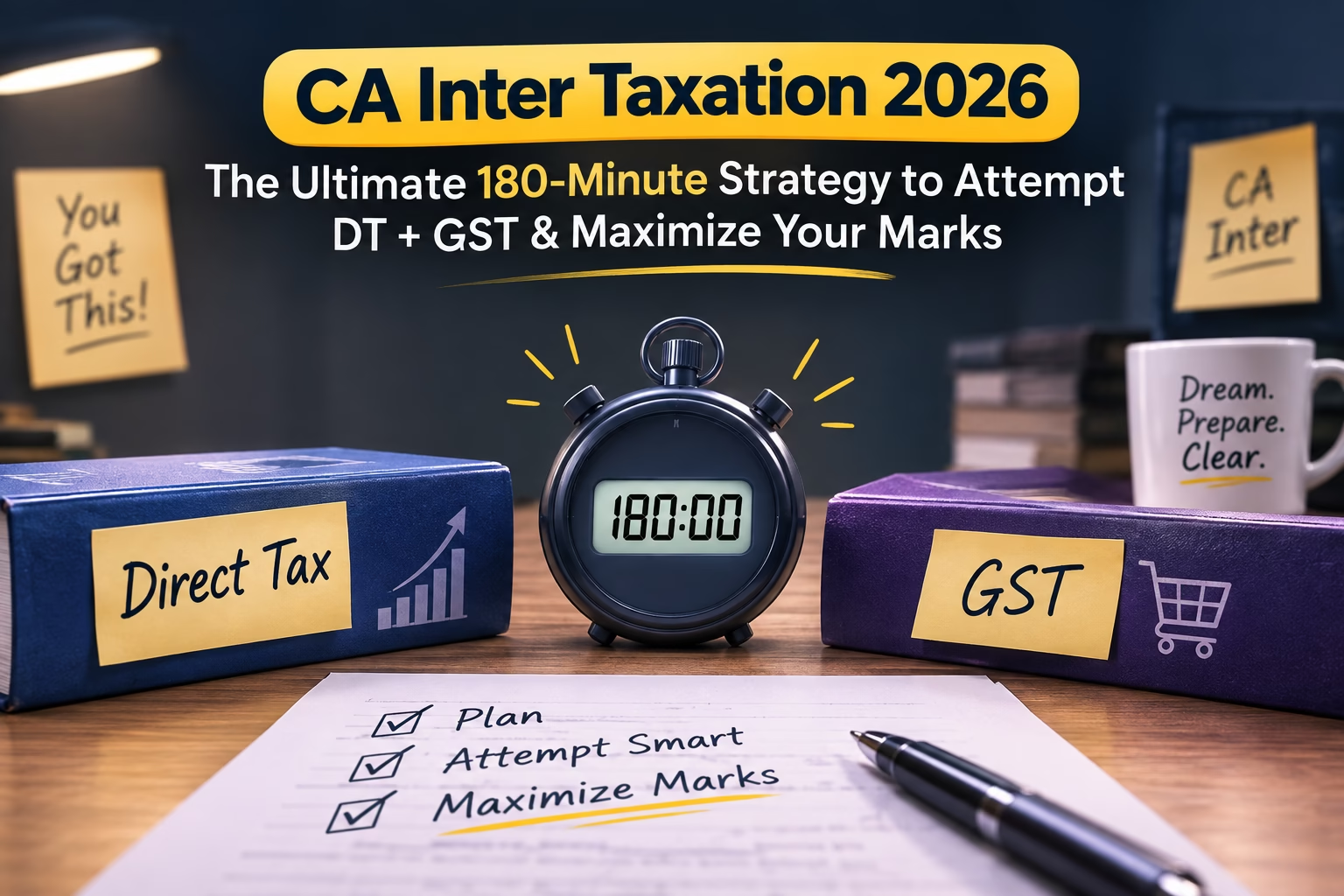
CA Inter Taxation 2026:
The CA Final Tax paper can feel overwhelming.
You may have revised Direct Tax (DT) and Indirect Tax (IDT) multiple times, solved RTPs, MTPs and past papers — yet when the question paper lands on your desk, one thought can still hit:
“Where do I start?”
And honestly, that first decision can make a huge difference.
The Tax paper isn’t just a test of knowledge. It’s also a test of selection, speed, accuracy and time management.
So instead of entering the examination hall with a fixed mindset like “I’ll definitely do IDT first” or “MCQs should be done first”, go in with a flexible 180-minute strategy.
First Rule: Don’t Decide Your Sequence Before Seeing the Paper
CA Inter Taxation 2026:
One of the biggest mistakes students make is deciding their sequence days before the exam.
“I’ll definitely start with GST.”
“I’ll do DT first.”
“I’ll finish MCQs first.”
Don’t lock yourself into one approach.
Once you receive the paper, spend the initial reading time understanding:
- Which section looks familiar?
- Which questions are scoring?
- Which questions can be completed quickly?
- Where are the tricky areas?
- Which questions should be avoided initially?
Your preparation may be 90%, but your paper-day strategy should remain 100% flexible.
The 180-Minute Tax Paper Strategy
CA Inter Taxation 2026:
A simple way to structure your three hours is:
| Section | Suggested Time |
|---|---|
| Other Questions | ~90 minutes |
| Compulsory Questions | ~50 minutes |
| MCQs | ~40–45 minutes |
| Buffer/Adjustment | Remaining few minutes |
The exact allocation can vary depending on the paper, but the key principle is:
Don’t let one section consume the time meant for another.
A difficult question can easily become a 20-minute trap.
If you’re still struggling after your planned time, move on.
You can always return later.
Priority No. 1: Other Questions
CA Inter Taxation 2026:
This is where the strategy becomes interesting.
Instead of automatically beginning with MCQs or compulsory questions, consider starting with the Other Questions section.
Why?
Because these are questions where you have a choice.
For example, if you have multiple DT and IDT questions and need to attempt a specified number, you can select the questions that play to your strengths.
Your first objective:
Find the questions you can score from.
Don’t select a question simply because it appears first.
Scan the options and ask:
“Which questions can I answer confidently and efficiently?”
That one decision can protect your marks and your confidence.
The 5–7 Minute Scanning Rule
CA Inter Taxation 2026:
Use the initial reading time strategically.
Instead of immediately writing answers, scan the available questions.
Within approximately 5–7 minutes, identify:
✅ Your strongest questions
✅ Your quickest questions
✅ Your familiar chapters
❌ Questions involving areas you’re unsure about
❌ Questions that appear unnecessarily time-consuming
Then start writing.
Remember:
Selection is also an exam skill.
Don’t Underestimate High-Confidence Chapters
CA Inter Taxation 2026:
During your initial scan, look for familiar areas such as:
IDT
- Exemptions
- Place of Supply
- TDS/TCS
- GST liability
- Computation-based questions
- Adjustment-based questions
If a question comes from a chapter you’ve revised thoroughly, it can become an excellent starting point.
The objective isn’t to prove that you can solve the hardest question.
The objective is to maximize marks within 180 minutes.
Confidence First, Complexity Later
CA Inter Taxation 2026:
This is one of the most underrated aspects of exam psychology.
Imagine you begin with a difficult question.
You spend 15 minutes.
You’re still unsure.
You make corrections.
You start doubting yourself.
Suddenly, the question that was worth a few marks has affected your confidence for the next two hours.
Instead, imagine starting with a question you know extremely well.
You solve it cleanly.
You move to another familiar question.
Then another.
Within the first few minutes, you’ve already built a rhythm.
Confidence → Speed → Better decision-making → Better paper
That’s why your first few questions matter.
A Practical 4:15 PM Rule
CA Inter Taxation 2026:
If your Tax examination runs from 2:00 PM to 5:00 PM, a useful target is:
By around 4:15 PM → Finish the descriptive portion and switch your complete focus to MCQs.
This gives you roughly 45 minutes for MCQs.
Don’t allow descriptive questions to stretch endlessly into the final portion of the exam.
The last 45 minutes should be protected.
What About the 15-Minute Reading Time?
CA Inter Taxation 2026:
This is where many students waste an opportunity.
Reading time is not writing time.
Don’t immediately start solving.
Instead, use it as your paper-mapping phase.
During reading time:
Step 1: Scan the paper.
Step 2: Identify your strongest questions.
Step 3: Compare DT vs IDT difficulty.
Step 4: Identify questions from familiar chapters.
Step 5: Decide your sequence.
Step 6: Start writing with confidence.
The goal is to enter the writing phase already knowing:
“I know exactly where I’m going.”
One Important Warning: Don’t Get Emotionally Attached to a Question
CA Inter Taxation 2026:
Sometimes a question looks familiar.
You start solving it.
Then you get stuck.
You think:
“I’ve studied this chapter. I should be able to solve it.”
And you keep fighting the question.
That’s dangerous.
Remember the 10-minute principle.
For regular descriptive questions, have a rough time budget in mind. If you’re significantly exceeding it, leave space and move ahead.
CA Final is not about solving every question perfectly.
It’s about converting your preparation into maximum marks within the available time.
Revise Smart Before the Exam
CA Inter Taxation 2026:
Your last revision shouldn’t be about reading every chapter from Page 1.
Focus on high-yield revision material.
For GST, revise:
- Important tricky provisions
- Exemptions
- Place of Supply
- TDS/TCS
- GST liability
- Computation adjustments
- Frequently tested concepts
- Past paper/MTP/RTP adjustments
For DT, focus on:
- Important adjustments
- Computation formats
- Rates and amendments
- TDS/TCS
- Frequently tested provisions
- Past examination adjustments
- RTP/MTP/model-test questions
The final revision should answer one question:
“If this concept appears tomorrow, can I recognize it and solve it quickly?”
Past Papers + RTP + MTP = Your Final Weapon
CA Inter Taxation 2026:
Don’t just read past questions.
Analyse them.
Look for recurring patterns.
Ask:
- What type of adjustment is being tested?
- What provision is repeatedly used?
- What traps are being created?
- Which chapters are generating computational questions?
- What mistakes do I repeatedly make?
Make a last-day adjustment sheet.
One compact sheet containing:
Adjustment → Provision → Treatment → Effect
That sheet can be far more useful before entering the exam hall than reopening the entire textbook.
The Golden Rule for the Tax Paper
CA Inter Taxation 2026:
You don’t need to solve the paper in the order in which ICAI printed it.
Read.
Analyse.
Select.
Attempt.
Move.
Return.
Review.
You are managing the paper — the paper should not manage you.
Final 180-Minute Mindset
CA Inter Taxation 2026:
Before entering the examination hall, remember these five things:
1️⃣ Don’t pre-decide DT vs IDT
Let the actual paper decide.
2️⃣ Protect your time
Don’t sacrifice 15 marks because one question took too long.
3️⃣ Start strategically
Build confidence with questions you know.
4️⃣ Use reading time intelligently
Planning for 15 minutes can save you much more time later.
5️⃣ Believe in your preparation
You’ve already done the hard work.
Now your job is to execute.
One Last Thing: Don’t Lose Confidence
CA Inter Taxation 2026:
The final days before an exam can be mentally exhausting.
You may suddenly feel:
“I don’t remember anything.”
That’s normal.
It doesn’t necessarily mean you aren’t prepared.
You’ve revised chapters. You’ve solved questions. You’ve made mistakes. You’ve corrected them. You’ve taken tests.
Now don’t let last-minute anxiety erase all that preparation.
Trust your preparation. Trust your strategy. Trust yourself.
The Tax paper may be unpredictable.
Your approach doesn’t have to be.
Go into the examination hall with one clear objective:
Stay calm. Choose smart. Write fast. Manage time. Maximize marks.
You’ve prepared for the paper. Now prepare to present it.