

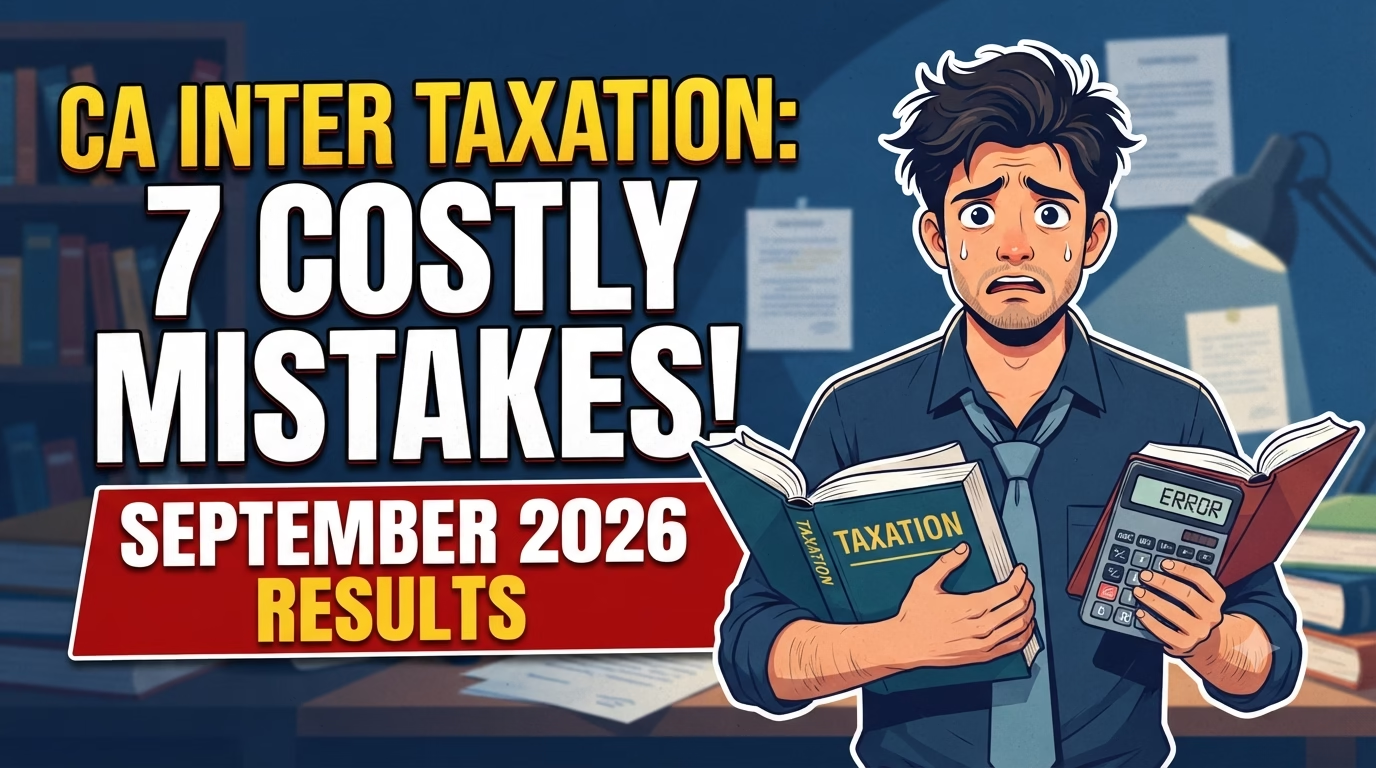
 Why Are CA Inter Students Failing in Taxation?
Studied for months, revised the syllabus, solved questions—and still couldn’t clear Group 1 because of Taxation? If this sounds familiar, you are not alone.
The September 2026 CA Inter results have left many students reflecting on their preparation, particularly those who struggled with Taxation. For some, Tax became the subject that stood between them and clearing Group 1. But why does this happen even after putting in so much effort?
Is Taxation genuinely difficult? Is the problem the vast syllabus, the changing provisions, the MCQs, the practical questions, or the way students prepare for the subject?
The truth is that Taxation is not just about remembering provisions. It is about understanding the law, identifying the correct provision, applying it to the facts, and presenting the answer accurately under time pressure.
In this blog, we will break down seven common reasons why students struggle with CA Inter Taxation, the mistakes that can cost you valuable marks, and a practical strategy to prepare more effectively for the January 2027 attempt.
Let’s understand what may be going wrong—and, more importantly, how to fix it.
1. First, Understand the September 2026 Result Reality
Why Are CA Inter Students Failing in Taxation?
ICAI declared the CA Intermediate September 2026 results on 22 October 2026. The reported Group 1 pass percentage was 23.14%, with 23,210 candidates passing out of 100,301 who appeared. https://www.icai.org/post/24558
That means a large number of candidates did not clear Group 1. However, the group-wise statistics alone do not establish how many students failed specifically because of Taxation. Each student’s marks and subject-wise performance need to be considered separately.
Still, if Taxation was your weakest paper, your result is an opportunity to identify the exact gaps in your preparation rather than simply studying harder in the same way again.
2. Why Do Students Fail in CA Inter Taxation?
Mistake No. 1: Studying Taxation Like a Theory Subject
Why Are CA Inter Students Failing in Taxation?
One of the biggest mistakes students make is treating Taxation as a subject that can be mastered through reading and memorisation alone.
You may remember a section number, a threshold limit, or an exemption, but can you apply it when the question presents an unfamiliar situation?
For example, a question may test your understanding of a provision through a case study rather than asking you to reproduce the provision directly.
The solution: After studying every concept, solve questions based on it. Learn the provision, understand its conditions, and practise applying it to different situations.
Mistake No. 2: Ignoring Amendments and Applicable Provisions
Why Are CA Inter Students Failing in Taxation?
Tax laws are technical, and the applicable provisions can depend on the examination’s prescribed Finance Act, assessment year, and syllabus guidelines.
Students sometimes prepare from outdated notes, old question-bank solutions, or material that does not match the applicable examination requirements.
This can lead to incorrect answers even when the underlying concept seems familiar.
The solution:
- Use ICAI’s study material applicable to your examination attempt.
- Check the prescribed Finance Act and relevant statutory updates.
- Revise important limits, conditions, exceptions, and effective dates.
- Avoid mixing provisions from different assessment years.
For January 2027, confirm the applicable statutory coverage from ICAI’s official announcements and study material before beginning your final revision.
Mistake No. 3: Memorising Solutions Instead of Understanding the Logic
Why Are CA Inter Students Failing in Taxation?
Have you ever solved a question correctly while watching a lecture but struggled when the same concept appeared in a different format in the examination?
This often happens when students memorise the steps of a particular question without understanding why those steps are necessary.
Taxation questions can change their facts while testing the same underlying provision.
The solution: Once you finish a question, ask yourself:
- Why does this provision apply?
- Which facts determine the tax treatment?
- What would change if one fact were different?
- Which condition or exception is relevant?
Practise variations of the same concept rather than relying exclusively on repeated questions.
Mistake No. 4: Giving Insufficient Attention to GST
Why Are CA Inter Students Failing in Taxation?
Some students devote most of their preparation time to Direct Tax and leave GST revision until the end. Others do the opposite.
An unbalanced approach can leave major gaps in either part of the paper.
GST requires students to understand the applicable provisions and apply them carefully to the facts. Simply remembering definitions may not be enough to solve a case-based question.
The solution: Build a balanced revision plan for both Direct Tax and GST. Allocate time according to your syllabus coverage, accuracy, and weak areas—not just according to your personal preference.
Practise questions from the relevant GST chapters and revise exceptions and conditions regularly.
Mistake No. 5: Not Practising Enough MCQs
Why Are CA Inter Students Failing in Taxation?
MCQs can look deceptively simple. Students may read a question quickly, recognise a familiar term, and select an answer without checking the full conditions.
In Taxation, a small change in the facts or wording can affect the correct option.
The solution:
- Read the complete question before selecting an answer.
- Identify the applicable provision.
- Check the relevant conditions and exceptions.
- Eliminate options that conflict with the facts.
- Review incorrect answers and record the reason for each mistake.
Do not practise MCQs merely to increase your question count. Practise to improve your accuracy.
Mistake No. 6: Poor Time Management in the Examination Hall
Why Are CA Inter Students Failing in Taxation?
Even a well-prepared student can lose marks by spending too much time on one lengthy computation or repeatedly revisiting difficult questions.
When time runs short, students may leave easier questions incomplete or rush through their calculations.
The solution:
- Solve timed practice papers before the examination.
- Allocate time according to the paper’s requirements and marks.
- Avoid getting stuck on a single question.
- Keep time for checking calculations and reviewing unanswered parts.
- Practise presenting answers clearly and logically.
Your goal is not merely to know the answer. It is to demonstrate that knowledge within the available time.
Mistake No. 7: Repeating the Same Revision Cycle Without Testing Yourself
Why Are CA Inter Students Failing in Taxation?
Watching lectures again and again can create a feeling of familiarity. But familiarity is not the same as being able to recall and apply a concept independently.
If you keep revising the same notes without solving questions, you may not discover your weaknesses until the examination.
The solution: Make active recall and testing a regular part of your preparation.
Close your book and recall the important provisions. Solve questions without looking at the solution. Attempt mock tests under exam conditions and analyse your mistakes afterwards.
Every test should tell you something about what needs improvement.
3. The Real Problem: Hard Work Without a Feedback System
Why Are CA Inter Students Failing in Taxation?
Many students genuinely work hard. They attend classes, make notes, complete lectures, and revise repeatedly.
But preparation becomes more effective when it includes a feedback system.
After every practice session, identify whether your error was caused by:
- A conceptual misunderstanding.
- Forgetting a provision or condition.
- Applying the wrong provision.
- Making a calculation mistake.
- Misreading the question.
- Poor time management.
- Incomplete presentation.
These are different problems, and each requires a different solution.
For example, if you understand a chapter but repeatedly make computational mistakes, watching the entire lecture again may not be the best use of your time. You may benefit more from targeted question practice and checking your workings.
Study smarter by identifying the reason behind every mistake.
4. CA Inter Taxation Strategy for January 2027: What Should You Do Now?
Why Are CA Inter Students Failing in Taxation?
If you are preparing for January 2027 after struggling with Taxation in September 2026, do not panic and restart everything blindly.
Begin with an honest assessment of your preparation.
Step 1: Analyse your previous attempt
Review your subject-wise marks and identify the areas in which you lost confidence or struggled during the examination.
If you have access to your evaluated answer book, use it to understand your presentation and answer-writing mistakes. Remember that the marks alone may not reveal every reason for your performance.
Step 2: Complete your conceptual preparation
Work through the relevant ICAI study material and ensure that you understand the prescribed provisions.
Avoid accumulating too many books, notes, and question banks. Select reliable resources and use them consistently.
Step 3: Practise questions immediately after studying a topic
Do not postpone all question practice until the syllabus is complete.
After learning a chapter, solve relevant illustrations, practice questions, and previous examination questions. This helps you identify gaps before moving to the next topic.
Step 4: Maintain a Taxation mistake notebook
Create a dedicated notebook containing:
- Frequently forgotten provisions.
- Important conditions and exceptions.
- Questions you solved incorrectly.
- Common computational errors.
- MCQs you answered incorrectly and why.
- Topics that need repeated revision.
Revise this notebook regularly instead of rewriting your entire syllabus.
Step 5: Take timed tests
Attempt chapter-wise tests during preparation and full-length mock tests when you have sufficient syllabus coverage.
After each test, analyse your performance. Identify the mistakes that cost you marks and practise those areas again.
Step 6: Revise repeatedly
Taxation requires repeated exposure to provisions and their application. Schedule multiple revision cycles, with each revision becoming more focused on recall, accuracy, and problem-solving.
Your final revision should not be the first time you test whether you can solve questions independently.
5. A Practical Daily Taxation Study Routine
Why Are CA Inter Students Failing in Taxation?
Here is a sample routine you can adapt to your preparation level.
| Activity | Suggested time |
|---|---|
| Revise previously studied provisions | 45 minutes |
| Learn or strengthen a concept | 90 minutes |
| Solve practical questions | 90 minutes |
| Practise MCQs | 30 minutes |
| Review mistakes and weak areas | 30 minutes |
| Total | 4 hours 45 minutes |
This is a sample, not a compulsory timetable. Adjust it according to your available study hours, remaining syllabus, and the time you need for your other CA Inter subjects.
Consistency and focused practice matter more than following a rigid schedule that you cannot sustain.
6. Should You Focus Only on Taxation If You Failed Group 1?
Why Are CA Inter Students Failing in Taxation?
No. If Taxation was your weakest subject, it deserves additional attention—but do not neglect the other Group 1 papers.
You need to meet the applicable minimum marks requirements in each paper and the aggregate requirement for the group.
A practical approach is to give Taxation more targeted practice while maintaining regular revision of the other subjects. This reduces the risk of improving one paper at the expense of another.
Prepare a weekly plan that includes:
- Dedicated Taxation practice.
- Regular revision of the other Group 1 subjects.
- Timed tests and error analysis.
- Buffer time for unfinished topics.
- Periodic review of your overall preparation.
Your objective is to clear the group, not merely to improve one subject in isolation.
7. If You Failed Taxation, Read This Before You Give Up
Why Are CA Inter Students Failing in Taxation?
A disappointing result can make you question your ability, especially when you invested months in preparation.
You may feel that you studied enough, attended classes, solved questions, and still did not get the result you wanted.
It is understandable to feel upset. But do not turn one examination result into a permanent judgment about your potential.
Instead, ask yourself three questions:
Did I understand the concepts?
If not, strengthen your fundamentals before increasing the volume of practice.
Could I solve questions independently?
If not, reduce dependence on solutions and practise active recall and application.
Could I perform under exam conditions?
If not, introduce timed tests and improve your question selection and time management.
Your next attempt does not need to be a repeat of the previous one. It can be an opportunity to prepare differently, with better feedback and a clearer strategy.
Final Words: Stop Fearing Taxation—Start Understanding It!
Why Are CA Inter Students Failing in Taxation?
The September 2026 CA Inter results are a reminder that clearing Group 1 requires preparation across all its papers. If Taxation was the subject that held you back, the answer is not necessarily to study for longer hours or collect more resources.
The better approach is to understand your weaknesses, strengthen your concepts, practise questions independently, revise the applicable provisions, and analyse every test you take.
Remember: Taxation rewards conceptual clarity, accurate application, regular revision, and disciplined exam practice.
If you are preparing for January 2027, start by correcting the mistakes that affected your previous attempt. Make a realistic plan, follow it consistently, and track your improvement.
Your previous result is a setback, not the end of your CA journey.
All the best to every CA Inter student preparing for January 2027!
Keep learning. Keep improving. And never let one result decide how far you can go.
🔗 Join 10,000+ CA Students using our Test Series to study smarter and create your own academic brand. Structured tests with detailed feedback.
Useful Resources