
CA Final FR November 2026:
If you are preparing for CA Final Financial Reporting (FR) for the November 2026 examination, you should not study every chapter with the same priority.
ICAI’s recent Financial Reporting webinar provided several important clues about chapter-wise weightage, important Ind AS topics, amendments, MCQ preparation, answer presentation, working notes, and common mistakes students make in the examination.
The webinar was lengthy, but the key takeaways can be condensed into one practical strategy:
Focus on the right topics, study connected Ind AS together, practise MCQs regularly, and present your answers exactly as required.
Here is a complete breakdown of the most important points discussed for the CA Final FR November 2026 exam.
CA Final FR November 2026:
1. The Biggest Takeaway: Focus on These 3 High-Weightage Areas
CA Final FR November 2026:
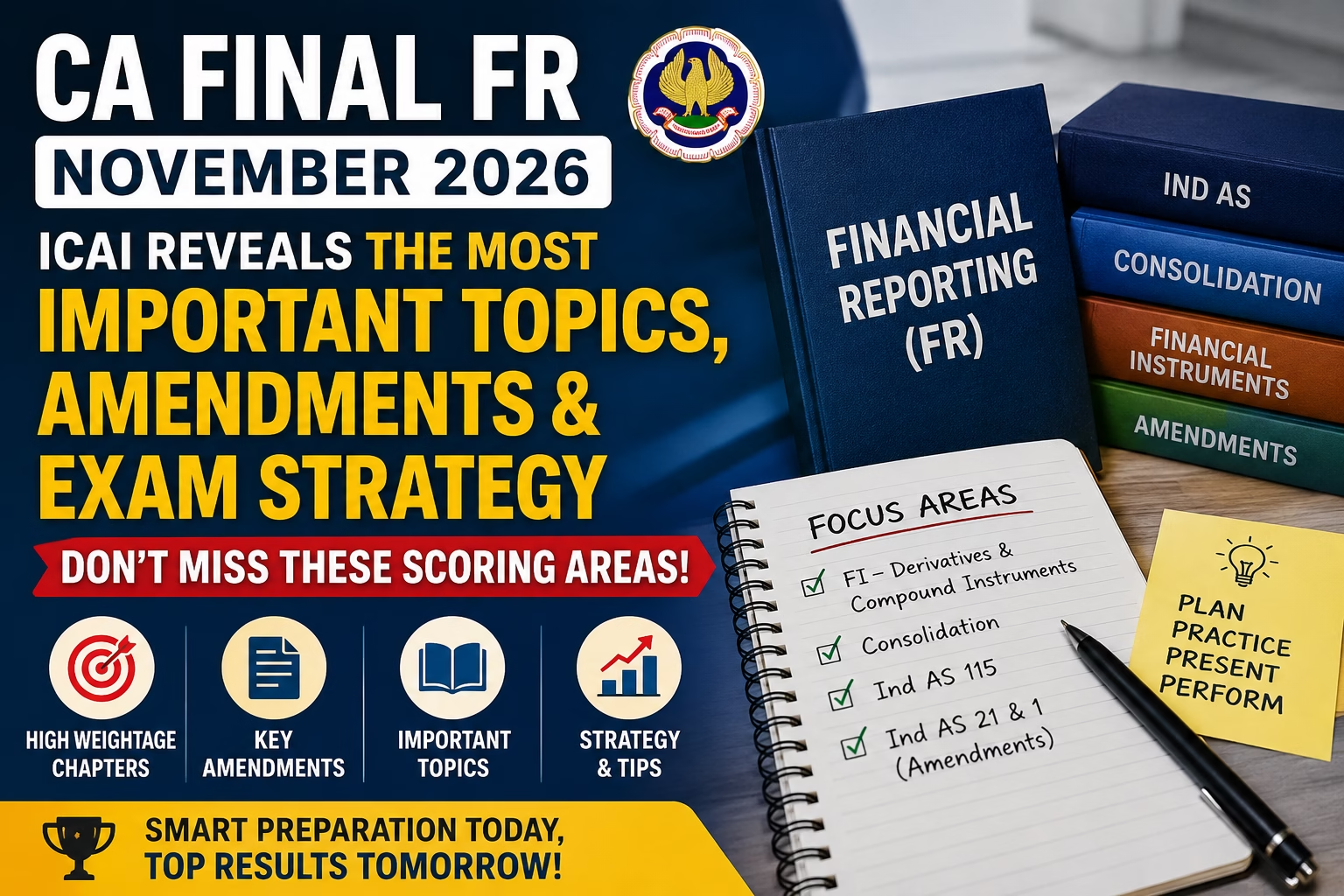
According to the guidance discussed in the FR webinar, three areas deserve particularly high priority:
- Financial Instruments
- Consolidation
- Ind AS 115 – Revenue from Contracts with Customers
Together, these areas can potentially cover a significant portion of your FR paper through both descriptive questions and MCQs.
Why are these three so important?
Financial Instruments can carry a substantial descriptive question along with MCQ coverage.
Consolidation is another recurring and important area, and students should not treat it as merely an MCQ-oriented chapter.
Similarly, Ind AS 115 is important from both conceptual and practical perspectives.
Therefore, if you are short on time, these three areas should be among your highest-priority preparation buckets.
2. FR Amendments for November 2026 — Pay Special Attention
CA Final FR November 2026:
One of the most important takeaways from the webinar was the discussion around amendments.
Whenever an amendment is introduced in an important Ind AS, that area automatically deserves additional attention because it provides ICAI with an opportunity to test whether students have studied the updated provisions.
For November 2026, the following amendments deserve special attention.
Ind AS 21 — Foreign Currency
The amendment relating to foreign currency under Ind AS 21 is particularly important.
More importantly, a related question has also been incorporated into the November 2026 RTP.
Your approach:
- Understand the amended treatment conceptually.
- Practise the related RTP question.
- Do not restrict preparation to memorising the amendment.
- Be prepared for both MCQ and descriptive applications.
Ind AS 21 should therefore be treated as a high-priority chapter for November 2026.
Ind AS 1 — Current and Non-Current Liabilities
Another important amendment relates to the classification of current and non-current liabilities under Ind AS 1.
This is particularly important because a question based on the amended area has also appeared in the November RTP.
What should you do?
Do not simply read the amendment once.
Instead:
- Understand the amended requirements.
- Study the practical implications.
- Solve the RTP question.
- Revise the amendment again before the examination.
Ind AS 7 — Supplier Finance Arrangements
Ind AS 7 also contains an amendment relating to supplier finance arrangements.
This is comparatively more theoretical.
It may not deserve the same priority as Ind AS 21 and Ind AS 1, but it should certainly not be completely ignored.
Read it once properly and revise the key disclosure requirements.
Ind AS 12 — Pillar Two
Another theoretical amendment discussed was the Pillar Two related amendment under Ind AS 12.
Again, this is not necessarily something to spend disproportionate time on, but it should be covered once during your amendment revision.
Priority hierarchy for amendments
If you are wondering where to start:
Priority 1: Ind AS 21
Priority 2: Ind AS 1
Priority 3: Ind AS 7
Priority 4: Ind AS 12
Most importantly, do not skip the RTP questions based on these amendments.
3. Financial Instruments — Two Topics You Should Not Skip
CA Final FR November 2026:
Financial Instruments is one of the most important areas in FR.
However, students often concentrate only on the larger practical questions and ignore smaller concepts that can appear in MCQs.
Two areas deserve special attention:
1. Compound Financial Instruments
Make sure you understand the accounting treatment and the logic behind the separation of components.
2. Derivative Accounting — Spot and Forward Rates
This is an area that many students tend to leave because they find it comparatively difficult.
That can be a mistake.
The webinar specifically highlighted derivative accounting involving spot and forward rates.
Therefore, make sure you:
- Understand the concept.
- Practise the calculations.
- Solve MCQs.
- Revise the treatment before the examination.
Don’t leave a topic simply because it looks small.
Small topics can become easy marks in MCQs.
4. Ind AS 102 — Don’t Forget the Journal Entries
CA Final FR November 2026:
Ind AS 102 is another area where students frequently lose marks.
A major mistake is assuming that journal entries are required only when the question explicitly asks for them.
That approach can cost you marks.
If the question asks you to:
- Explain the accounting treatment
- Discuss the treatment
- Calculate the relevant amount
- Analyse the transaction
you should consider incorporating the relevant journal entries wherever they form part of the accounting treatment.
Why?
Because journal entries demonstrate that you understand the actual accounting impact rather than merely remembering the theory.
For Ind AS 102, therefore:
Concept + Calculation + Journal Entry = Complete Answer
5. Ind AS 116 — Leaseback Deserves More Attention
CA Final FR November 2026:
Ind AS 116 is already an important area, but one specific topic students often underestimate is:
Sale and Leaseback
Students commonly focus on the general lease accounting provisions and spend comparatively less time on leaseback transactions.
That should change for November 2026.
Make sure you revise:
- Sale and leaseback
- Accounting treatment
- Recognition requirements
- Measurement
- Relevant calculations
- Practical illustrations
6. A Common Consolidation Mistake: Ignoring Deferred Tax
CA Final FR November 2026:
This is one of the most important practical points highlighted in the discussion.
Whenever there is a change in the fair value of assets or liabilities, students sometimes calculate the fair value adjustments but forget the corresponding deferred tax impact.
This can subsequently affect:
- Goodwill
- Capital Reserve / Gain on Bargain Purchase
- Net identifiable assets
- Consolidation calculations
The simple rule:
Whenever fair value adjustments arise, ask yourself:
“Is there a deferred tax impact?”
Don’t stop after calculating the fair value adjustment.
The tax effect must also be considered wherever applicable.
This is a common area where an otherwise correct consolidation solution can go wrong.
7. Ind AS 103 & Ind AS 110 — Don’t Panic If the Balance Sheet Doesn’t Tally
CA Final FR November 2026:
A common concern among students is:
“What if my final balance sheet doesn’t tally?”
The important takeaway is that step-wise marking is available.
Therefore, if you have made a mistake somewhere in the calculation, don’t leave the entire question incomplete.
Write whatever you can correctly establish:
- Working notes
- Calculations
- Adjustments
- Journal entries
- Relevant figures
- Final statements
Even if the final balance sheet does not tally, the correct workings can still earn marks.
Exam rule:
Never abandon a question just because the final figure is not matching.
Continue with your workings and present the answer systematically.
8. The Best Way to Study FR: Use “Buckets”
CA Final FR November 2026:
One of the most useful study strategies discussed in the webinar was to study FR in connected buckets rather than randomly jumping between chapters.
For example, instead of studying chapters in an arbitrary order, group related Ind AS together.
Asset-based Ind AS
Study the relevant asset-related standards together.
Liability-based Ind AS
Study the liability-related standards together.
Module-wise grouping
You can also create buckets according to your ICAI module structure.
The reason is simple:
FR is highly interconnected.
For example, when studying an asset-related Ind AS, you may need concepts from another standard to calculate cost, impairment, deferred tax, fair value, etc.
If you studied those standards months apart, the connection may not immediately come to mind.
9. Why Interconnectivity Matters
CA Final FR November 2026:
Consider the example discussed in the webinar involving Ind AS 105.
For initial recognition, concepts such as:
Lower of carrying amount and fair value less costs to sell
may require you to recall concepts from other standards.
If you studied those related standards long ago and have forgotten them, you may struggle even though you technically completed every chapter.
This is why FR should not be studied as:
Chapter 1 → Chapter 2 → Chapter 3 → Chapter 4
Instead, try:
Connected concept → Related Ind AS → Practical application → Revision
This approach improves both conceptual clarity and retention.
10. Category B Topics You Should Not Ignore
CA Final FR November 2026:
Not every important topic has to be a 10-mark practical question.
Some areas are important because ICAI can test your conceptual understanding.
Three standards specifically highlighted were:
- Ind AS 36
- Ind AS 33
- Ind AS 12
These deserve special attention for the November 2026 attempt.
Why?
The discussion indicated that these standards have appeared in alternate attempts and therefore deserve consideration when planning your preparation.
Do not rely on predictions alone, though.
“Important” does not mean “only this will be asked.”
Complete your syllabus while giving these areas additional priority.
11. Ind AS 37 — Learn the Keywords
CA Final FR November 2026:
Ind AS 37 is another area where students can lose marks despite knowing the basic concept.
The reason?
Students often write theoretical answers entirely in their own language.
While understanding the concept is essential, ICAI expects important terminology and conceptual keywords.
Therefore, when preparing theoretical Ind AS:
- Read the provision carefully.
- Identify the important keywords.
- Learn the terminology.
- Use those keywords in your answer.
Remember:
Conceptual understanding + ICAI terminology = Better presentation
Do not write unnecessarily complicated English.
But don’t replace important technical terminology with casual words either.
12. Ind AS 7 — Two Types of Questions You Should Practise
CA Final FR November 2026:
For Ind AS 7, the webinar highlighted two broad question areas:
1. Operating Activities
Practise questions involving classification and presentation of cash flows.
2. Total Income / Relevant Calculation
Make sure you understand the calculation-based requirements that can be tested.
These areas can appear in both descriptive questions and MCQs.
13. MCQ Pattern Has Changed — Your FR Strategy Must Change Too
CA Final FR November 2026:
This is one of the biggest changes students need to understand for the November 2026 examination.
The descriptive paper pattern remains broadly the same.
However, the MCQ structure has changed.
Previously, students had 15 MCQs of 2 marks each.
The revised pattern includes:
- 16 MCQs × 1 mark = 16 marks
- 7 MCQs × 2 marks = 14 marks
Total:
23 MCQs = 30 Marks
This means MCQs are no longer something you can casually prepare for at the end.
14. Speed Will Matter More Than Ever
CA Final FR November 2026:
With more individual MCQs, students need to develop both:
Accuracy + Speed
You may know the concept perfectly, but if you spend too much time on one MCQ, you can create pressure later in the paper.
Therefore, incorporate MCQ practice into your daily FR preparation.
A simple strategy:
After completing a chapter:
Study → Solve practical questions → Solve MCQs → Analyse mistakes → Revise
Don’t wait until the last week to start MCQ practice.
15. Use RTP, MTP, Model Test Papers and Summary Material Smartly
CA Final FR November 2026:
ICAI provides several resources that can help you identify the style of questions and revise efficiently.
Your preparation should include:
- RTP
- MTP
- Model Test Papers
- Summary / Revision material
- ICAI study material
These resources can help you identify:
- New question patterns
- Newly tested concepts
- Application-based questions
- Amendment-related questions
- MCQ patterns
Golden Rule:
Don’t merely read the RTP.
Solve it.
Especially for amendments and newly introduced concepts.
16. FR Is Not Only About Practical Questions
CA Final FR November 2026:
One of the biggest misconceptions students have is:
“FR means calculations, so I only need to write practical workings.”
Wrong.
FR answers can also require theory and explanations.
If the question asks you to:
- Discuss
- Explain
- Analyse
- Recommend
- Present
your answer needs to reflect what the question is actually asking.
17. Understand the Difference Between “Discuss”, “Explain”, “Recommend” and “Present”
CA Final FR November 2026:
This is a very important presentation tip.
If the question says “Discuss”
You should provide:
Relevant provision → Application to facts → Explanation / analysis → Conclusion
Don’t provide only calculations.
If the question says “Explain”
Again, provide the relevant conceptual explanation along with the practical treatment wherever required.
A calculation without explanation may not be sufficient.
If the question says “Analyse” or “Recommend”
Think of this like a case-based answer.
A good structure is:
Provision / Concept
↓
Application to the facts
↓
Analysis
↓
Conclusion / Recommendation
This makes your answer logical and examiner-friendly.
If the question says “Present”
Then focus on financial statement presentation.
For example:
- Where will the item appear?
- Under which heading?
- How will it be presented in the Statement of Profit and Loss?
- How will it appear in the Balance Sheet?
- What disclosures are relevant?
Don’t simply calculate the amount.
Show where and how it is presented.
18. Working Notes Are Part of Your Answer
CA Final FR November 2026:
This is perhaps one of the most important practical lessons.
Many students solve the calculation on rough paper and write only the final figure in the answer.
That is a mistake.
Working notes are part of the answer.
They help the examiner understand:
- How you arrived at the figure
- Which adjustment you considered
- What formula you used
- Which accounting treatment you applied
And importantly, marks can be allocated for workings.
Therefore:
Never hide your calculations. Present relevant working notes clearly.
19. Start Every New Question on a Fresh Page
CA Final FR November 2026:
This may look like a small presentation point, but it can make your answer sheet considerably more organised.
Whenever possible, start a new question on a fresh page.
This helps with:
- Clear identification of questions
- Better presentation
- Separation of answers
- Easier evaluation
Your goal should be to make the examiner’s job easier.
20. Your FR November 2026 Priority List
CA Final FR November 2026:
If you want a quick revision checklist, use this:
🔴 Very High Priority
- Financial Instruments
- Consolidation
- Ind AS 115
- Ind AS 21 amendment
- Ind AS 1 amendment
- Ind AS 102 journal entries
- Ind AS 116 Sale & Leaseback
- Deferred tax impact in consolidation
- RTP questions based on amendments
🟠 High Priority
- Ind AS 36
- Ind AS 33
- Ind AS 12
- Ind AS 37 theoretical keywords
- Ind AS 7 Operating Activities
- Ind AS 7 relevant calculation areas
- Derivative accounting
- Compound Financial Instruments
🟡 Must Read
- Ind AS 7 Supplier Finance Arrangements amendment
- Ind AS 12 Pillar Two amendment
- Remaining important topics from ICAI’s study material
21. A Practical FR Preparation Strategy for November 2026
CA Final FR November 2026:
Don’t simply make a chapter-completion checklist.
Instead, prepare every important chapter through four stages.
Stage 1 — Concept
Understand the Ind AS and its requirements.
Stage 2 — Practical Application
Solve ICAI illustrations and questions.
Stage 3 — MCQs
Practise chapter-wise and mixed MCQs.
Stage 4 — Revision
Revise:
- Formats
- Journal entries
- Important adjustments
- Working notes
- Technical keywords
- Amendments
This creates a much stronger preparation cycle than simply reading the chapter multiple times.
Final Takeaway
CA Final FR November 2026:
The biggest message from the FR webinar is not that you should try to predict the paper.
Instead, it is about prioritising intelligently.
For November 2026, students should pay particular attention to:
Financial Instruments + Consolidation + Ind AS 115
along with the important amendments under Ind AS 21 and Ind AS 1, while also covering the highlighted areas of Ind AS 7, 12, 33, 36, 37, 102, 103, 110 and 116.
But preparation does not end with completing the syllabus.
You also need to improve:
- MCQ speed
- Working notes
- Theoretical explanations
- ICAI keywords
- Journal entries
- Financial statement presentation
- Case-based analysis
And most importantly, solve RTPs, MTPs and ICAI material instead of merely reading them.
One final rule for your FR paper:
Don’t just solve the question. Show the examiner how you solved it.
A technically correct answer with poor presentation can lose marks. A well-structured answer with clear workings, relevant theory and proper presentation gives the examiner every reason to award you the marks you deserve.
So, if you are targeting a high score in CA Final FR November 2026, start prioritising these areas now—but don’t use them as a substitute for completing the entire syllabus.
🔗 Join 10,000+ CA Students using our Test Series to study smarter and create your own academic brand. Structured tests with detailed feedback.
Useful Resources