
 CA Final FR Paper Decode Nov 2026:
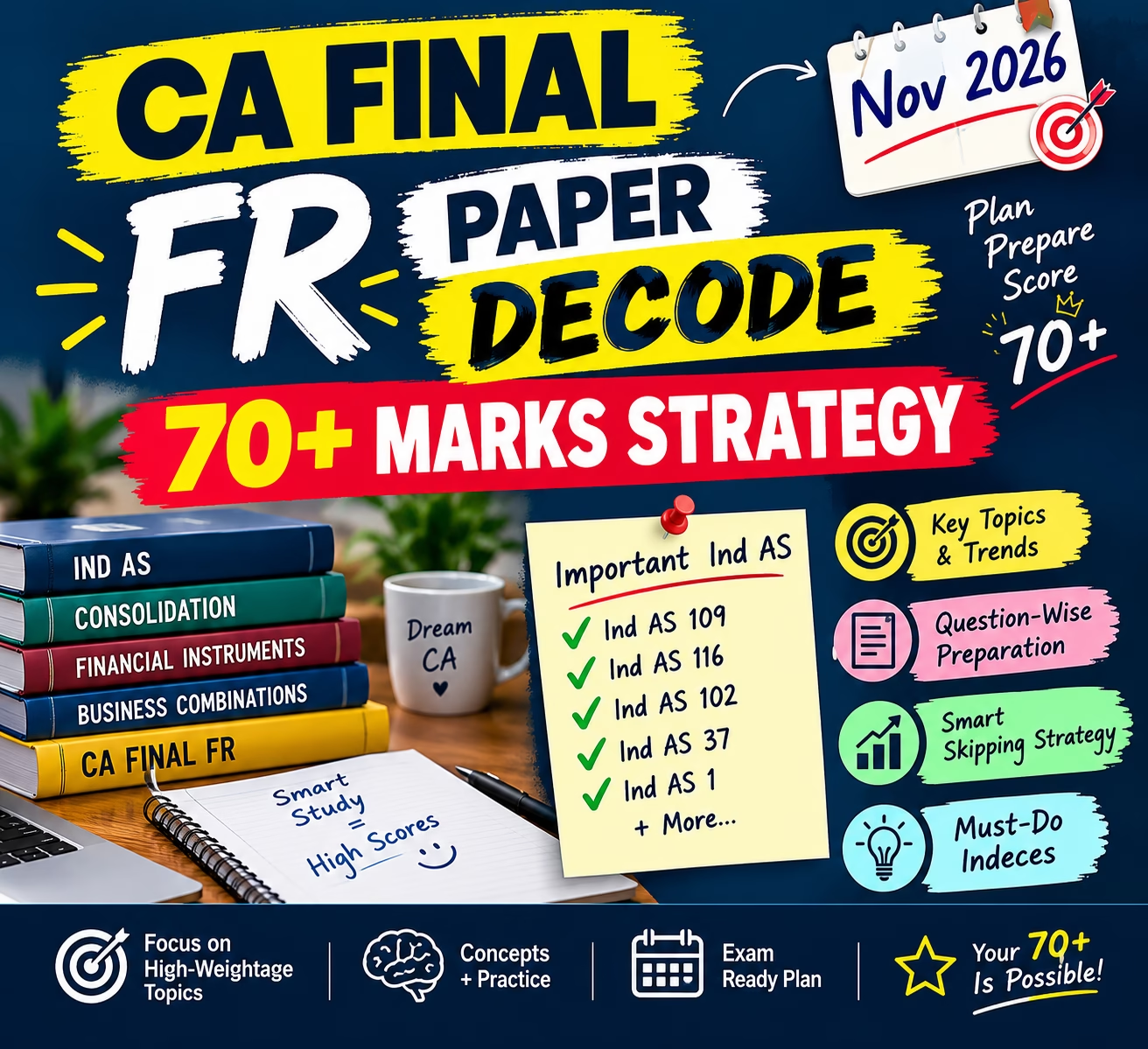
CA Final FR Paper Decode Nov 2026 is here! If Financial Reporting feels vast, unpredictable, and difficult to revise before the November 2026 exams, this guide will help you prepare smarter. By analysing past-paper trends from May 2024 to May 2026, you can prioritise important Ind AS, identify recurring question patterns, and build a practical strategy for descriptive questions as well as MCQs.
But remember: no chapter, question, or score is guaranteed. Your goal should be to use past-paper analysis to improve preparation—not to depend entirely on predictions.
Are you aiming for 70+ marks in CA Final Financial Reporting (FR)? Let’s decode the paper pattern, understand the chapter-wise priorities, and create a smart preparation strategy that helps you maximise your score.
Why CA Final FR Paper Analysis Matters for Nov 2026
CA Final FR Paper Decode Nov 2026:
Financial Reporting is not just about remembering accounting standards. It tests your conceptual clarity, practical application, journal entries, calculations, and ability to present answers logically.
A review of previous attempts can help you identify:
- Chapters and standards that have appeared repeatedly.
- Topics that may deserve greater revision priority.
- Areas where journal entries and practical adjustments are important.
- MCQ topics that students sometimes neglect while focusing on descriptive questions.
- Questions where you can prepare strategically without compromising your overall understanding.
The golden rule: Use trend analysis to prioritise your revision, but keep your preparation broad enough to handle unexpected questions.
1. Business Combinations & Consolidation: Prepare Strategically
CA Final FR Paper Decode Nov 2026:
Business Combinations and Consolidation deserve attention when planning your FR preparation.
Based on the historical pattern discussed in the source analysis, consolidation is an important area to practise, while Business Combinations should not be ignored simply because a related question appeared in a previous attempt.
What should you prepare?
- Ind AS 103 – Business Combinations: Understand the acquisition method, purchase consideration, goodwill or bargain purchase, and the basic calculation process.
- Consolidation: Practise comprehensive questions, including adjustments and the preparation of consolidated financial statements.
- MCQs: Revise the conceptual areas of Business Combinations even if you are prioritising other chapters for descriptive practice.
Smart preparation tip
If you struggle with lengthy questions, master the basic steps first. Learn how to identify purchase consideration, calculate goodwill or capital reserve, and organise the balance sheet workings. These steps can help you earn method-based marks where the question and marking scheme permit.
Do not assume that mastering only the basic calculations will be sufficient for every question. Practise complete questions as well.
2. Financial Instruments: A High-Priority Area
CA Final FR Paper Decode Nov 2026:
Financial Instruments is a major area to include in your FR revision strategy. It requires both conceptual understanding and practical application.
Key areas to revise
- Classification and measurement of financial assets and financial liabilities.
- Amortised cost and the effective interest rate method.
- Fair value measurement and related accounting treatment.
- Expected credit losses, where applicable.
- Recognition, measurement, and derecognition principles.
- Journal entries and subsequent measurement.
The source analysis highlights Financial Instruments as an important area in the question-wise paper pattern, including journal-entry-based questions.
Exam tip: Don’t stop after reading the standard. Practise the relevant adjustments, calculations, and journal entries. For lengthy practical questions, understand the complete accounting treatment rather than memorising only the year-end entry.
3. Asset-Based Ind AS: Build Your Practical Strength
CA Final FR Paper Decode Nov 2026:
Asset-based standards can be valuable areas for focused revision because they involve structured accounting treatments and practical adjustments.
The video analysis highlights the following standards for attention:
- Ind AS 116 – Leases: Lease liability, right-of-use assets, subsequent measurement, and journal entries.
- Ind AS 36 – Impairment of Assets: Recoverable amount, impairment loss, and relevant calculations.
- Ind AS 16 – Property, Plant and Equipment: Recognition, measurement, depreciation, and related adjustments.
These standards can involve calculations as well as explanations of accounting treatment.
How to prepare effectively
- Read the core concepts and recognition requirements.
- Practise illustrations from the ICAI study material.
- Revise important adjustments and journal entries.
- Solve past exam questions without looking at the solution.
- Review your mistakes and repeat difficult illustrations.
Important: Do not automatically skip a standard because it appeared in an earlier attempt. The ICAI may revisit a topic using a different adjustment, presentation, or application.
4. EPS, Foreign Exchange & Other Important Standards
CA Final FR Paper Decode Nov 2026:
The question-wise analysis also identifies several areas worth prioritising.
Recommended revision priorities
- Earnings Per Share (EPS): Revise the calculation of basic and diluted EPS and the relevant adjustments.
- Ind AS 21 – The Effects of Changes in Foreign Exchange Rates: Focus on foreign currency transactions and applicable exchange differences.
- Ind AS 12 – Income Taxes: Understand current tax, deferred tax, and the relevant accounting adjustments.
- Ind AS 41 – Agriculture: Revise the core recognition and measurement concepts and practise applicable illustrations.
EPS deserves particular attention in this preparation strategy because it is highlighted in the source analysis as a recurring area across earlier attempts.
However, treat these as revision priorities, not confirmed questions. Cover the applicable ICAI material and amendments for your examination attempt.
5. Ind AS 19 & Ind AS 102: Don’t Ignore the Question Pattern
CA Final FR Paper Decode Nov 2026:
The source analysis identifies Ind AS 19 and Ind AS 102 as important areas for question-wise preparation.
Ind AS 19 – Employee Benefits
Revise the relevant concepts and calculations relating to employee benefits, including the applicable accounting treatment and presentation.
Ind AS 102 – Share-Based Payment
Focus on the recognition and measurement principles, practical illustrations, and journal entries.
When solving a question, carefully read what the examiner is asking. If the requirement says to explain the accounting treatment, a final numerical answer alone may not be sufficient.
Where relevant, include the necessary workings, journal entries, and explanations supported by the facts of the question.
6. Ind AS 115, Ind AS 1001 & Financial Statement Analysis
CA Final FR Paper Decode Nov 2026:
Students often focus heavily on lengthy practical standards and leave theory-oriented chapters until the end. This can create avoidable gaps in revision.
The video analysis highlights three areas for the fifth-question strategy:
- Ind AS 115 – Revenue from Contracts with Customers
- Ind AS 1001, as referred to in the source analysis
- Analysis of Financial Statements
Verify the exact applicable standard or chapter numbering against your current ICAI study material before using any chapter-wise checklist.
The suggested strategy is to avoid spending all your time on lengthy descriptive questions from these areas if they are a personal weakness, while still revising the concepts for MCQs and shorter questions.
Smart revision approach: Use the ICAI material, revision resources, and MCQ practice to understand the fundamentals. Do not interpret a suggested descriptive-question skip as permission to ignore the entire topic.
7. Accounting Technology & Professional Ethics: Easy to Overlook
CA Final FR Paper Decode Nov 2026:
Accounting Technology and Professional Ethics should not be neglected merely because they appear different from the numerical portions of FR.
The source analysis recommends particular attention to Accounting Technology and highlights Professional Ethics as an alternative area in the relevant question pattern.
Your preparation checklist
- Revise the important keywords and core concepts.
- Review the applicable ICAI study material.
- Practise MCQs and short questions.
- Learn the relevant terminology instead of relying on vague recollection.
- Include these topics in your final revision schedule.
For theory-based questions, clear and precise language can make your answers easier to evaluate.
8. MCQ Strategy: Protect Your Marks in the Objective Section
CA Final FR Paper Decode Nov 2026:
A common preparation mistake is spending nearly all available time on descriptive questions and postponing MCQ revision until the last few days.
Your objective-section preparation should be planned separately.
Areas highlighted in the source analysis
- Financial Instruments.
- Business Combinations and Consolidation.
- Ind AS 7 – Statement of Cash Flows.
- Joint Ventures, including the areas referred to in the source analysis under Ind AS 111 and related chapters.
- Ind AS 115 – Revenue from Contracts with Customers.
- Ind AS 1001, subject to verification against the current study material.
- Professional Ethics.
- Other short standards and chapters, including the relevant areas under Ind AS 1, Ind AS 2, Ind AS 8, Ind AS 10, Ind AS 24, Ind AS 34, Ind AS 37, Ind AS 105 and Ind AS 108.
This list is a revision checklist derived from the provided video transcript, not an independently verified list of guaranteed MCQs. Confirm the applicable syllabus and amendments before finalising your plan.
How to improve MCQ performance
- Practise topic-wise MCQs after revising each standard.
- Understand why each option is correct or incorrect.
- Record recurring conceptual mistakes.
- Revise definitions, exceptions, recognition criteria, and measurement principles.
- Attempt mixed MCQ tests under time limits.
Do not rely on a predicted chapter list alone. An unfamiliar question can still test a concept you already know.
9. Should You Skip Question 5 in CA Final FR?
CA Final FR Paper Decode Nov 2026:
This is one of the most important strategic decisions discussed in the video.
The source analysis suggests that some students may prefer to prioritise other descriptive questions instead of investing excessive time in a difficult portion of Question 5.
However, skipping an entire question is a personal risk-management decision, not a universal recommendation.
Before deciding, ask yourself:
- Can I confidently attempt Questions 3, 4 and 6?
- Have I practised the alternatives available in the paper?
- Can I handle the relevant MCQs from the chapters I intend to skip descriptively?
- Have I tested my strategy through timed mock examinations?
- Will skipping this question leave me with enough choice and scoring opportunities?
If you are comfortable with Ind AS 115 and related theory, you may choose a different strategy from someone who struggles with that area. Make the decision based on your preparation, not someone else’s prediction.
Never leave an entire chapter unprepared simply because a question appeared in a previous attempt. The examiner can change the pattern, and the same topic may appear in a different format.
10. Your Final 5-Day FR Revision Strategy
CA Final FR Paper Decode Nov 2026:
If your preparation time is limited, organise the final days around revision, practical application, and exam readiness.
Day 1: Core practical standards
Revise Financial Instruments, Business Combinations, Consolidation, and the relevant asset-based standards. Solve selected questions and review your common errors.
Day 2: Important calculations
Focus on EPS, Foreign Exchange, Income Taxes, Employee Benefits, Share-Based Payment, and other standards that require calculations or structured adjustments.
Day 3: Theory and shorter chapters
Revise Revenue, Financial Statement Analysis, Accounting Technology, Professional Ethics, and the applicable conceptual chapters.
Day 4: MCQs and mixed practice
Attempt a timed MCQ set, revise incorrect answers, and revisit topics where your conceptual understanding is weak.
Day 5: Mock analysis and final revision
Review your summary notes, journal entries, common adjustments, important concepts, and mistakes from previous tests. If possible, attempt a timed paper or a representative set of questions.
Adapt this plan to your actual preparation level. If a major standard remains completely unfamiliar, allocate more time to understanding it instead of blindly following a fixed five-day schedule.
11. How to Target 70+ Marks in CA Final FR
CA Final FR Paper Decode Nov 2026:
A 70+ score is an ambitious target. It requires more than identifying important chapters: you need accurate concepts, practical question-solving ability, MCQ preparation, and effective time management.
Follow these principles:
1. Complete your conceptual preparation. Understand the applicable accounting standards rather than memorising predicted questions.
2. Practise ICAI questions. Use the relevant study material, question bank, RTPs, MTPs, and previous examination papers available for your attempt.
3. Master journal entries. Write the required entries and workings wherever the question calls for them.
4. Prepare for both sections. Give MCQs dedicated revision time instead of treating them as an afterthought.
5. Attempt mock tests. Identify whether your biggest issue is conceptual knowledge, calculation accuracy, presentation, or time management.
6. Use selective revision intelligently. Prioritise weaker and high-value areas, but do not confuse prioritisation with guaranteed predictions.
7. Analyse your mistakes. A question you solved incorrectly during revision is an opportunity to improve before the examination.
Final Words: Decode the Pattern, But Prepare for the Unexpected
CA Final FR Paper Decode Nov 2026:
CA Final Financial Reporting can feel overwhelming when you look at the syllabus as one enormous task. Break it down into manageable standards, practise the questions that matter for your understanding, and revise consistently.
The May 2024–May 2026 paper trends discussed in this analysis can help you organise your preparation for November 2026. But no paper analysis can guarantee an exact question, a fixed number of marks, or a 70+ score.
Your strongest strategy is to combine trend-based prioritisation, comprehensive conceptual understanding, repeated question practice, MCQ revision, and timed mocks.
Remember: the objective is not merely to predict the paper. It is to become prepared enough to handle the paper even when it surprises you.
All the best to every CA Final student preparing for November 2026. Stay consistent, revise smartly, practise sincerely, and give your best!
🔗 Join 10,000+ CA Students using our Test Series to study smarter and create your own academic brand. Structured tests with detailed feedback.
Useful Resources