
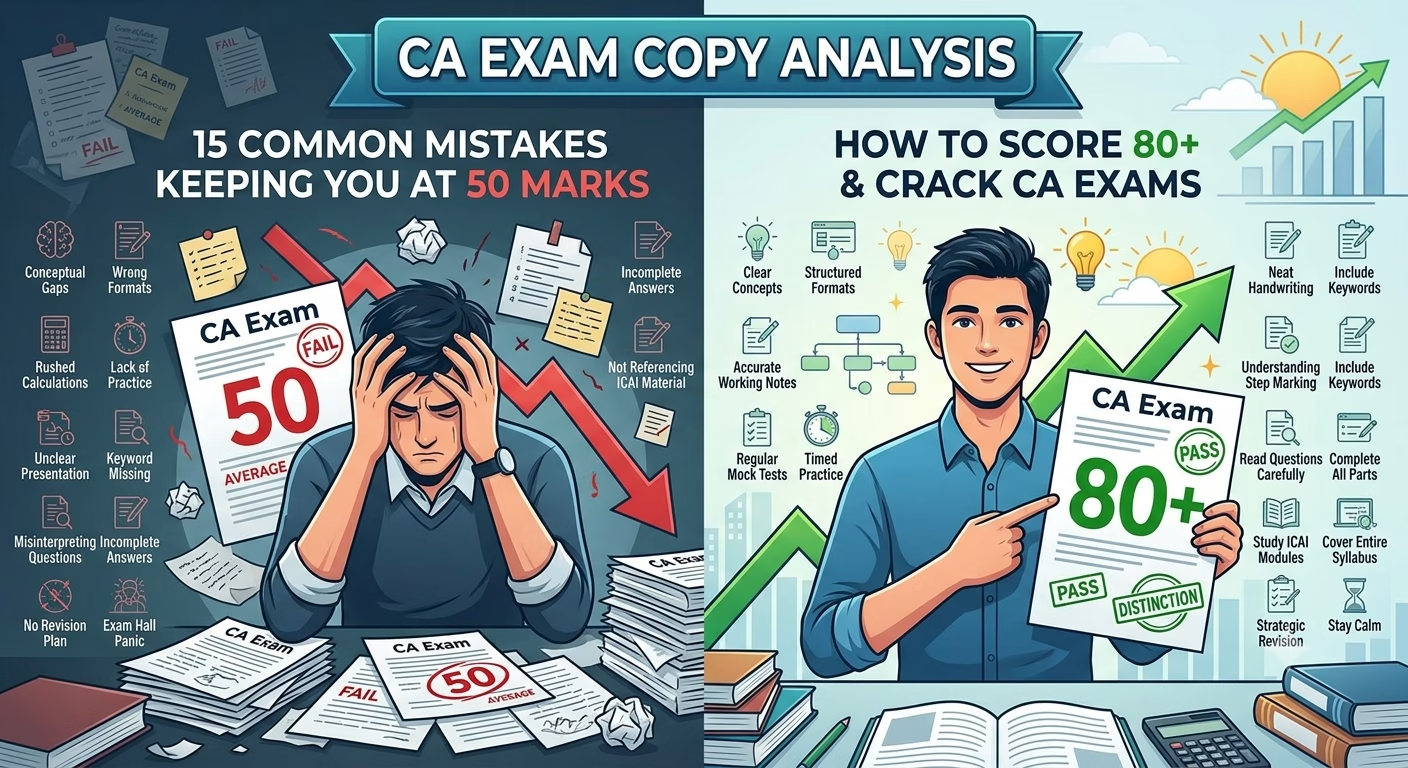
CA Exam Copy Analysis:
Scoring well in CA exams is not only about knowing the syllabus. How you present your answers, manage your time, use technical language and attempt the complete paper can make a significant difference to your final marks.
A recent All India Mock Test, where thousands of students participated and their evaluated copies were analysed, revealed several common mistakes that students continue to make under exam pressure.
These mistakes are not limited to one particular question or subject. They are especially relevant for Law, Audit and other theory-oriented papers, where presentation, keywords, structure and precise conclusions matter significantly.
Here are the most important mistakes CA students should avoid in their upcoming examinations.
CA Exam Copy Analysis:
1. Avoid Excessive Use of Short Forms
CA Exam Copy Analysis:
One of the most common mistakes observed in evaluated answer sheets was the excessive use of abbreviations and short forms.
Students often try to save time by writing things such as:
- “ROC” instead of Registrar of Companies
- “CG” instead of Central Government
- “MOA” instead of Memorandum of Association
- “Sec.” instead of Section
- “3x” instead of “three times”
While some commonly accepted abbreviations may be understandable, students should avoid making their answers look like personal notes.
In a professional examination such as CA, clarity and formal presentation matter.
Instead of unnecessarily shortening every term, write the complete terminology, particularly when it is being used for the first time or when the term is important to the answer.
The same principle applies to arrows, symbols and informal shortcuts. What may be convenient while making personal notes may not necessarily be appropriate in the final examination answer sheet.
2. Break Long Paragraphs into Smaller Ones
CA Exam Copy Analysis:
Another major problem found in evaluated copies was the use of very long paragraphs.
Imagine an examiner checking a large number of answer books. If an entire answer is written as one dense block of text, identifying the important points becomes unnecessarily difficult.
Instead, students should break lengthy answers into short, readable paragraphs of around 5–6 lines wherever appropriate.
Good spacing can make your answer much easier to evaluate.
Remember, you are not charged extra for using an additional page. If leaving some space makes the answer cleaner and more readable, use the space intelligently.
A neat answer does not mean leaving excessive blank pages. It simply means avoiding overcrowded writing.
3. Underline Keywords, Not Entire Sentences
CA Exam Copy Analysis:
Underlining can improve answer presentation—but only when it is done correctly.
A common mistake is to underline almost the entire answer. When everything is underlined, nothing stands out.
Instead, underline the important technical keywords.
For example, in a Law or Audit answer, you may underline terms such as:
- “Prohibited”
- “Permitted”
- “Not covered”
- “Misstatement”
- “Professional misconduct”
- Relevant section numbers
- Important technical requirements
The examiner should be able to quickly identify the key points of your answer.
The objective of underlining is not to decorate the answer sheet. It is to guide the examiner towards the important content.
4. Follow a Logical Structure in Case-Study Questions
CA Exam Copy Analysis:
For case-study based questions, students should maintain a proper flow.
A useful structure is:
Relevant Provision → Facts of the Case → Analysis/Application → Conclusion
You do not necessarily need to write these four headings explicitly.
Instead, your answer should naturally follow this sequence.
First, explain the relevant legal or professional provision. Then connect it with the facts given in the question. If calculations or further analysis are required, perform them clearly. Finally, provide a precise conclusion.
One of the mistakes observed in mock-test copies was that students knew the provision but did not properly analyse the facts or provide a clear conclusion.
Remember, a case study is designed to test application, not just memory.
5. Make Your Conclusion Precise
CA Exam Copy Analysis:
A weak conclusion can reduce the effectiveness of an otherwise good answer.
Students often write generic statements such as:
- “Yes, this is correct.”
- “No, this is wrong.”
- “Yes, it is valid.”
Such statements do not demonstrate sufficient technical understanding.
Instead, use appropriate professional terminology.
For example:
- “The transaction is permissible.”
- “The activity is prohibited.”
- “The provision is applicable.”
- “The contention is not tenable in law.”
- “The director’s contention is tenable in law.”
The conclusion should directly answer what the question actually asked.
A useful habit is to read the question once again after completing the answer. Ask yourself:
“Have I answered exactly what was asked?”
If not, correct the conclusion before moving ahead.
6. Use Technical and Professional Language
CA Exam Copy Analysis:
CA examinations require professional language.
Students should develop the habit of using the terminology provided in the ICAI study material and relevant provisions.
There can be a significant difference between ordinary language and professional terminology.
For example, “the director is wrong” is much less precise than explaining that “the contention of the director is not tenable in law.”
Similarly, words such as restricted, prohibited, permissible, covered and not covered should be used carefully because they may have different meanings in a legal or professional context.
The final revision should therefore include not only concepts but also the important vocabulary used in the subject.
7. Be Careful with Sections, Forms and Timelines
CA Exam Copy Analysis:
Another recurring mistake was confusion regarding section numbers, form numbers and statutory timelines.
Students do not necessarily need to memorise every form number in the syllabus. However, important and frequently tested forms should be known.
Similarly, basic form-related concepts should be clear.
Students should also revise frequently confused timelines such as 7 days, 15 days, 30 days and other statutory periods.
A simple way to handle this is to maintain a dedicated summary page for sections, forms, approvals and timelines and revise it repeatedly during the final preparation.
8. Calculate the Amount Instead of Only Writing the Percentage
CA Exam Copy Analysis:
A very important mistake occurs when students know the applicable percentage but fail to perform the actual calculation.
Suppose a question gives:
- Paid-up share capital
- Free reserves
- Securities premium
- An applicable percentage
Writing only the percentage does not necessarily answer the question.
If the question asks for the maximum amount, calculate the actual amount.
Students must understand the difference between:
Maximum Rate ≠ Maximum Amount
If the question asks for a maximum amount, provide the amount after performing the necessary calculation.
This is particularly important in practical questions where the examiner expects the student to apply the percentage to the figures provided.
9. Maintain Proper Question-Wise Sequence
CA Exam Copy Analysis:
You are free to decide which question you want to attempt first.
For example, if you are more comfortable with Question 5, you can start with Question 5.
However, once you start Question 5, try to maintain the sequence:
5(a) → 5(b) → 5(c)
If you want to attempt 5(c) before 5(b), leave sufficient space for 5(b) and return to it later.
The objective is to make your answer book easy to navigate.
It is also advisable to clearly mention question numbers such as:
4(a), 4(b), 4(c)
rather than creating confusion through unclear numbering.
10. Double-Check Your Question Numbers
CA Exam Copy Analysis:
This is a small mistake with potentially serious consequences.
Suppose you have actually answered Question 4(a), but accidentally write 4(b) on the answer sheet.
Do not assume that the examiner will automatically correct your mistake.
Therefore, keep the last few minutes of the examination exclusively for checking:
- Question numbers
- Sub-question numbers
- Whether every attempted answer is properly marked
- Whether any question has been accidentally skipped
- Whether pages are properly arranged
These two minutes can prevent an avoidable mistake.
11. Do Not Leave Questions Unattempted
CA Exam Copy Analysis:
One of the biggest issues identified in the mock test was that many students attempted only around 80 marks out of 100.
This severely limits the possibility of scoring exceptionally high marks.
If your target is 80+, you need to give yourself the opportunity to score those marks.
That means your preparation should include writing-speed practice and time management.
Do not enter the examination hall with the mindset that you will attempt only the questions you are completely confident about.
Plan your time so that you can attempt the complete paper as far as reasonably possible.
12. MCQs Deserve Serious Attention
CA Exam Copy Analysis:
MCQs are not merely a warm-up before the descriptive section.
Students aiming for high scores need to take them seriously.
Strong performance in MCQs can significantly improve the overall score. In the analysed mock-test results, high scorers were also able to secure excellent marks in the objective section.
Therefore, during the examination:
- Read every option carefully.
- Do not rush through familiar-looking questions.
- Pay attention to small words and exceptions.
- Eliminate clearly incorrect options.
- Avoid changing an answer without a valid reason.
The objective section can become an important differentiator between an average score and an excellent score.
13. Start with Good Presentation and Maintain It Till the End
CA Exam Copy Analysis:
A common pattern in examinations is that students begin with excellent handwriting and presentation but become increasingly rushed towards the final questions.
This happens because of poor time management.
The solution is to practise writing full-length mock papers before the examination.
Your objective should be to develop a writing speed that allows you to complete the paper without sacrificing readability in the final hour.
Do not spend excessive time making the first few answers perfect and then rush through the remaining questions.
Consistency throughout the paper is more important than perfection in the first few pages.
14. Practise the Way You Intend to Write in the Exam
CA Exam Copy Analysis:
One of the most important lessons from the mock-test analysis is that your practice habits eventually appear in your examination answer sheet.
If you routinely use excessive short forms while practising, you may continue doing the same thing in the exam.
If you never practise underlining keywords, you may forget it under pressure.
If you have never completed a 100-mark paper within the required time, the real examination may feel significantly more difficult.
Therefore, mock tests should not only be used to test knowledge. They should be used to develop your actual examination technique.
Final Takeaway
CA Exam Copy Analysis:
Scoring high marks in CA examinations requires more than completing the syllabus. Students must also learn how to present what they know.
Avoid excessive abbreviations, write in a readable format, underline only important keywords, follow a logical structure in case studies, use technical terminology and make your conclusions precise.
At the same time, pay attention to sections, forms, timelines and calculations, maintain proper question numbering and, most importantly, attempt the complete paper within the available time.
Your final few mock tests should therefore focus on more than just marks. Analyse your answer sheet and ask:
Did I use the right keywords?
Was my presentation readable?
Did I complete the paper?
Were my conclusions precise?
Did I make avoidable mistakes?
Fixing these small issues before the actual examination can make a significant difference.
Knowledge gets you into the examination hall. Good presentation, accuracy and time management help convert that knowledge into marks.