
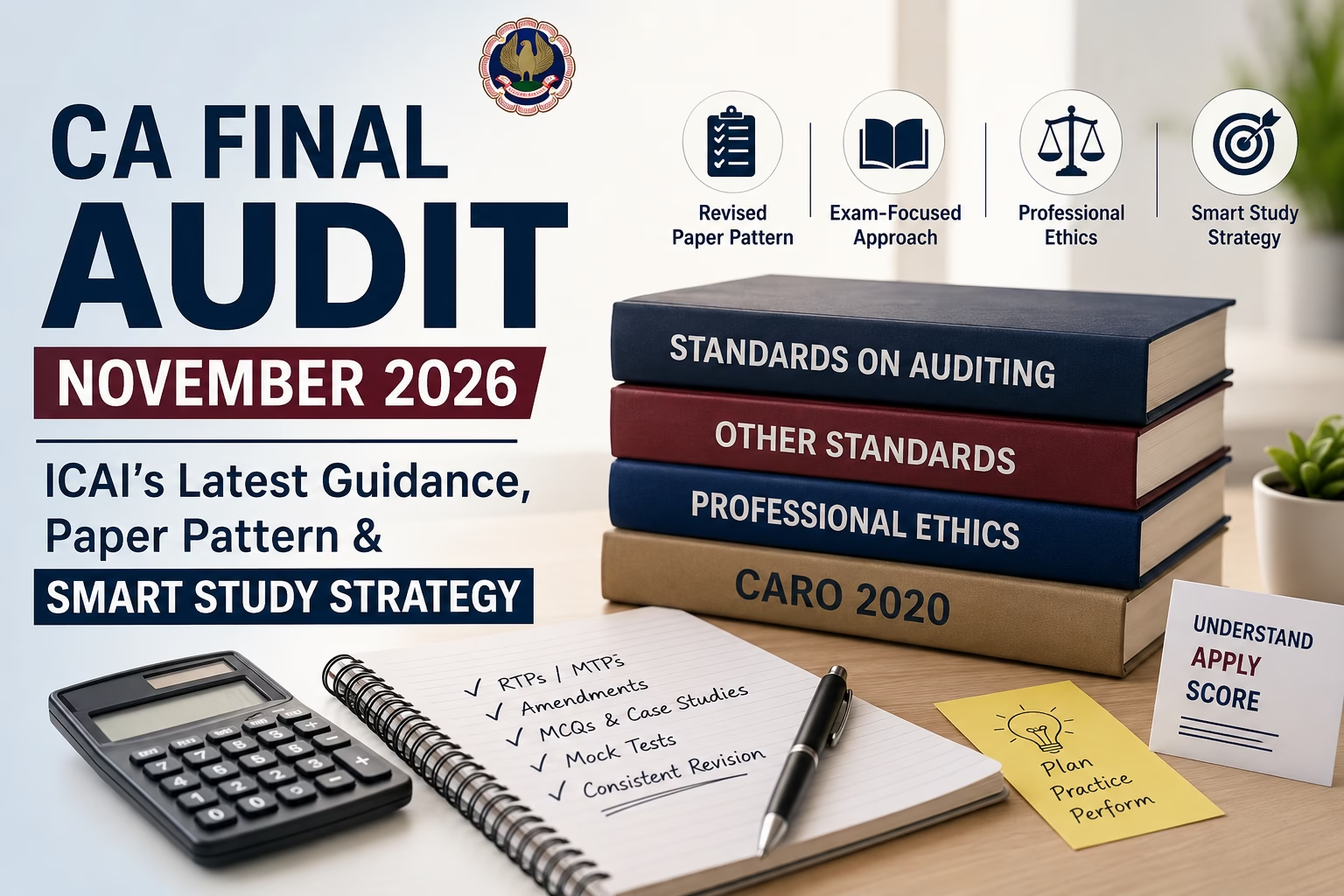
CA Final Audit November 2026: ICAI’s Latest Guidance, Paper Pattern & Smart Study Strategy
The ICAI Board of Studies (BoS) recently conducted an important session on CA Final Audit for the November 2026 examinations and onwards. The nearly two-hour session covered several important areas, including the revised examination pattern, answer-writing approach, case-study questions, Professional Ethics, Other Standards, study material, mock tests, amendments and the priority areas students should focus on.
For CA Final students preparing for November 2026, the session provides useful direction on what to study, how to study and how to present answers in the examination.
Here are the major takeaways from the session.
CA Final Audit November 2026 :
1. CA Final Audit Paper Pattern Is Being Revised
CA Final Audit November 2026 :
One of the biggest updates discussed was the change in the MCQ pattern.
Earlier, students were accustomed to 15 MCQs. However, from the revised pattern, students should prepare for 23 MCQs.
The expected structure discussed is:
- 16 MCQs carrying 1 mark each
- 7 MCQs carrying 2 marks each
This makes conceptual preparation even more important because students cannot rely only on preparing descriptive answers. The increase in the number of MCQs means that the entire study material can potentially become relevant from an objective-question perspective.
Therefore, students should avoid selectively memorising only the questions they expect to appear in the descriptive section.
2. Answer Writing: You Do Not Need to Copy the Suggested Answer Word-for-Word
CA Final Audit November 2026 :
A very important clarification from the BoS session was regarding suggested answers and answer presentation.
Students often believe that they need to reproduce the ICAI Suggested Answer exactly as it is written. That is not necessary.
For a 4 or 5-mark direct question, if you provide four to five relevant and complete points, you can score the marks corresponding to those points.
However, this does not mean that students should write vague or informal answers.
The answer should contain the right technical meaning and important ICAI keywords.
For example, if ICAI uses a specific technical term such as “misstatement”, replacing it with a casual alternative such as “mistake” may weaken the technical accuracy of the answer.
Therefore, the ideal approach is:
Understand the concept → Remember the key points → Use ICAI keywords → Frame the answer in your own words.
Students should read all the points given in their study material because any of them can potentially become relevant for an MCQ, even if they do not intend to reproduce every point in a descriptive answer.
3. How to Attempt Case Study-Based Questions in Audit
CA Final Audit November 2026 :
Case-study questions are an important component of CA Final Audit, and students need to understand how to approach them systematically.
A strong answer should generally follow this structure:
Relevant Provision → Facts of the Case → Application/Analysis → Conclusion
The first step is to identify and mention the relevant Standard, provision, clause or requirement.
Next, briefly explain the relevant facts of the case. Even if the marking scheme does not separately allocate marks for writing the facts, mentioning them in one or two lines demonstrates that you have understood the situation.
After that, connect the provision with the facts and provide the appropriate conclusion.
This becomes particularly important in Professional Ethics.
Simply reading the facts and concluding that a Chartered Accountant is “guilty” or “not guilty” is not sufficient. The examiner needs to see whether the student knows which clause or provision applies and why it applies to the given situation.
Therefore, students should avoid writing only:
“The member is guilty.”
Instead, identify the relevant clause, explain the applicable provision, connect it with the facts and then arrive at the conclusion.
4. Professional Ethics: Focus on Clauses and Keywords
CA Final Audit November 2026 :
Professional Ethics continues to be one of the most important scoring areas in CA Final Audit.
Students should make a conscious effort to remember important clause numbers, wherever possible. Knowing the clause number can make an answer more precise and can also create a positive impression through accurate technical presentation.
At the same time, students do not necessarily need to memorise every provision word-for-word.
The focus should be on understanding:
- What the clause deals with
- What activity is prohibited or permitted
- The important technical terms
- How the provision applies to practical situations
- The relevant clause number
For example, technical words such as solicitation, advertisement, personal communication and professional misconduct should be used appropriately wherever relevant.
The goal is not to reproduce a textbook paragraph. The goal is to demonstrate that you understand the provision and can apply it correctly.
5. Other Standards Can Be a Scoring Opportunity
CA Final Audit November 2026 :
Another major takeaway from the session was the importance of Other Standards.
Students often spend most of their time studying Standards on Auditing and overlook the other standards. However, these standards can be extremely useful from an examination perspective because questions from them are often relatively direct.
The session highlighted that students should pay attention to standards such as the 800 series, SREs, SRSs and related standards.
These areas should not be treated as optional simply because they appear shorter or less prominent than the major Standards on Auditing.
Students should particularly focus on:
- Important reporting requirements
- Key definitions and provisions
- Important examples
- Audit procedures
- Client acceptance-related factors
- Questions from recent RTPs and MTPs
The idea is simple: do not leave easy marks behind because a topic looks less important.
6. ABC Analysis Can Help Students Prioritise Audit
CA Final Audit November 2026 :
Audit has a large syllabus, and one of the biggest problems students face is deciding where to start.
The ABC approach discussed during the session can help students divide the syllabus according to priority.
Category A: Highest Priority Areas
Some of the important areas highlighted include:
- SQC 1 / SA 220
- SA 520
- SA 540
- SA 600
- SA 610
- SA 620
- 700 Series – Audit Reporting
- Professional Ethics
- CARO 2020
The 700 Series deserves particular attention because reporting standards are relatively structured and can become highly scoring when prepared properly.
Professional Ethics should also be treated as a major scoring area, with significant examination weightage.
CARO 2020 is another recurring area and students should be prepared for both MCQ-based and descriptive questions.
Category B: Important but Second Priority
After completing the highest-priority areas, students can move towards:
- 200 Series
- SA 402
- Initial standards of the 500 Series
- ESG and SDG
- PSU Audit
- Due Diligence
- Forensic Audit
- Investigation
- Group Audit
- Bank Audit
- NBFC Audit
- SA 560
- SA 570
The Group Audit topic deserves attention because of its connection with the consolidation concepts students study in Financial Reporting.
Similarly, NBFC Audit may require additional attention for November 2026 because of the amendments relevant to the examination.
7. Amendments Should Be a Major Focus for November 2026
CA Final Audit November 2026 :
The November 2026 RTP already contains the relevant amendments for the examination, making them an important part of preparation.
Students should not simply read amendments once and move on.
A better approach would be to:
- Understand what has changed.
- Identify the old and new provisions.
- Note the important keywords.
- Practise questions based on the amendments.
- Revise them repeatedly before the examination.
Amendments are particularly important because they provide scope for both MCQs and descriptive questions.
8. Stick to One Comprehensive Study Source
CA Final Audit November 2026 :
Another useful recommendation was to avoid continuously switching between multiple sources.
Using several books simultaneously can create unnecessary confusion. Different materials may present the same concept in different sequences or wording, making recall more difficult during the examination.
Instead, students should select one comprehensive and reliable study source and revise it multiple times.
The source should ideally cover:
- ICAI Study Material
- Important examples
- RTPs
- MTPs
- Amendments
- Recent questions
- Relevant Question Bank coverage
The reason behind this approach is simple: repeated exposure to the same material helps develop a stronger visual and conceptual memory of where a particular point appears.
9. RTPs, MTPs and Question Bank Should Not Be Ignored
CA Final Audit November 2026 :
Students preparing for November 2026 should give proper attention to ICAI RTPs, MTPs and the Question Bank.
These resources help students understand:
- The type of questions ICAI is asking
- The level of conceptual application expected
- The style of case studies
- Important recurring areas
- The way technical concepts are tested through MCQs
Students should particularly analyse recent questions instead of merely reading their answers.
Ask yourself:
Why was this provision tested? What concept is being examined? Could ICAI ask the same concept through a different case?
This approach makes preparation much more effective.
10. Mock Tests Are Essential Under the New Pattern
CA Final Audit November 2026 :
With the revised examination pattern, students should practise writing answers and attempting MCQs under exam-like conditions.
The BoS session also emphasised the importance of giving mock tests according to the latest pattern.
Students should ideally attempt ICAI’s own mock tests and use them to assess:
- Time management
- Answer presentation
- Coverage of points
- Use of keywords
- Case-study application
- MCQ accuracy
Simply solving questions at home is not enough. Students should occasionally sit for a complete mock test with a proper time limit.
11. Study Audit for 2–3 Hours Every Day
CA Final Audit November 2026 :
Perhaps one of the most practical suggestions from the session was to maintain daily contact with Audit.
Students may have dedicated Audit revision phases closer to the examination, but Audit should not completely disappear from their routine before that.
Spending around 2–3 hours daily on Audit can help students gradually become comfortable with:
- Audit terminology
- Technical language
- Standards
- Case-study application
- Answer framing
- Professional Ethics clauses
This is especially useful because Audit is not a subject that can always be mastered through one final reading.
Regular exposure makes the language increasingly familiar.
Final Takeaway for CA Final November 2026 Students
CA Final Audit November 2026 :
The most important message from the ICAI Audit session is that students should stop treating the entire Audit syllabus as one huge, frightening subject.
Instead, divide it into manageable sections, prioritise important areas and revise them systematically.
For November 2026, students should focus particularly on:
Amendments + 700 Series + Professional Ethics + CARO 2020 + Other Standards + Important Standards on Auditing + RTPs/MTPs + Case Study Practice.
You do not need to memorise every answer word-for-word. What matters is whether you understand the provision, identify the relevant technical points, use ICAI keywords and apply them correctly to the facts of the case.
Most importantly, do not wait until the final few days to become comfortable with Audit. Stay in touch with the subject every day, even for 2–3 hours.
With the right priority order and consistent revision, CA Final Audit can become one of the most scoring papers of the November 2026 attempt.
Understand the provision. Learn the keywords. Practise application. Revise consistently. And most importantly, prepare according to the latest ICAI pattern.