
 CA Exam Revision Tips
Feeling Unconfident After Revision? Here’s Why It Happens and What CA Students Should Do
You have completed an entire chapter. You revised it carefully. You even spent several hours going through your notes and solving questions.
But two days later, you open the same chapter again—and suddenly, it feels as if you have forgotten everything.
You start wondering:
- Why can’t I remember what I studied?
- Why is my revision taking so long?
- Why don’t I feel confident even after completing the syllabus?
- Am I actually prepared for the CA exam?
- Should I watch revision lectures or solve questions myself?
- Am I wasting too much time on revision?
If you are facing these problems, you are not alone.
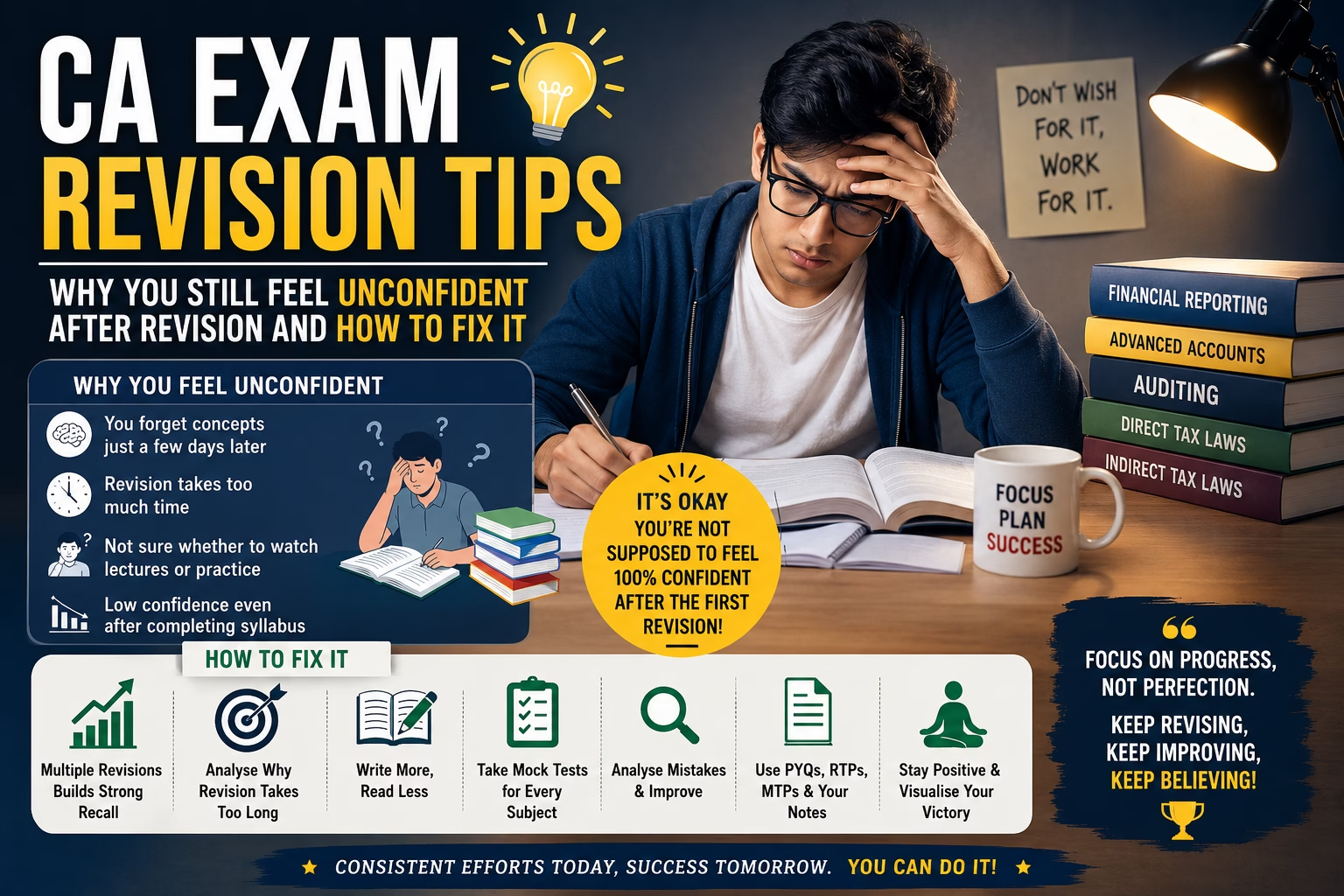
This is one of the most common challenges faced by CA students during exam preparation. In fact, feeling less confident after your first revision does not necessarily mean that your preparation is poor. It is often a normal part of the learning and revision process.
The real question is not whether you feel 100% confident after your first revision. The real question is whether you are progressively improving with every revision.
Let’s understand how you can make your CA exam revision more effective, faster, and more productive.
CA Exam Revision Tips :
1. Don’t Panic If You Don’t Feel Confident After Your First Revision
One of the biggest mistakes CA students make is expecting complete confidence immediately after their first revision.
You study a chapter for the first time and feel that you understand it. Then, after a few weeks or months, you revise it again and realise that you don’t remember everything.
This is completely normal.
As human beings, we cannot remember every concept permanently after studying it once. That’s precisely why revision is an essential part of CA exam preparation.
Your first revision is not necessarily meant to make you perfect.
Instead, it is meant to:
- Reconnect you with the concepts.
- Identify what you have forgotten.
- Refresh your understanding.
- Help you recognise important topics.
- Build a foundation for your next revision.
Think of your preparation as a gradual improvement process.
Your first revision may bring back roughly 40–50% of your familiarity with the subject.
Your second revision can significantly strengthen that knowledge and improve your recall.
Your final revision before the exam is where you aim to bring everything together—concepts, practical questions, formulas, provisions, adjustments, and exam-oriented presentation.
The Key Lesson
Don’t judge your preparation based on how you feel after just one revision.
Instead, ask yourself:
“Am I better prepared than I was before my last revision?”
If the answer is yes, you are moving in the right direction.
2. Why Multiple Revisions Are Necessary for CA Exams
CA Exam Revision Tips :
CA Final and CA Intermediate are not exams that can usually be conquered by reading the syllabus once.
The syllabus is vast, and the subjects require different types of preparation. Some require conceptual understanding, while others demand repeated problem-solving, writing practice, memorisation, and application.
That is why a multiple-revision strategy is so powerful.
A practical revision cycle can look like this:
Revision 1: Rebuild Your Understanding
The objective is to cover the entire syllabus and reconnect with the concepts.
Focus on:
- Understanding the chapter.
- Revising important concepts.
- Identifying weak areas.
- Solving selected questions.
- Marking difficult topics for later revision.
Revision 2: Strengthen Recall
The second revision should be faster and more active.
Focus on:
- Recalling concepts without looking at the book.
- Practising important questions.
- Revising marked areas.
- Improving speed.
- Identifying recurring mistakes.
Final Revision: Exam-Oriented Recall
The final revision should be highly focused.
Prioritise:
- Important concepts.
- Formulas and adjustments.
- Practical questions.
- Amendments and updates, wherever applicable.
- Previous Year Questions.
- RTPs and MTPs.
- Your personal revision notes.
- Mistakes identified during mock tests.
The goal is not to learn everything from scratch during the final revision.
The goal is to quickly recall what you have already studied.
3. Revision Is Taking Too Long? Find Out Why
CA Exam Revision Tips :
Another common problem among CA students is:
“I thought this chapter would take one day, but four days have passed and I still haven’t completed it.”
Before panicking, analyse why the revision is taking longer than expected.
There are usually two major possibilities.
Reason 1: You Underestimated the Chapter
Not every chapter deserves the same amount of time.
Some chapters are naturally more time-consuming because they involve:
- Complex concepts.
- Multiple adjustments.
- Lengthy practical questions.
- Difficult accounting treatments.
- Extensive problem-solving.
For example, a complex chapter in Financial Reporting or Advanced Accounting may require significantly more time than a relatively straightforward chapter.
If your initial estimate was unrealistic, don’t force yourself to finish the chapter within that deadline just because it was written on your timetable.
Quality of Revision Matters More Than the Number of Revisions
Suppose you initially planned to complete four revisions.
However, rushing through your syllabus means you will only superficially revise everything.
In that case, it may be better to complete three high-quality revisions than four ineffective ones.
The same principle applies if your plan was for three revisions but you can realistically complete only two thorough revisions.
A well-executed revision is more valuable than a rushed revision that gives you a false sense of completion.
Reason 2: Your Revision Process Is Inefficient
CA Exam Revision Tips :
Sometimes revision takes longer not because the chapter is difficult, but because the student is not studying efficiently.
For example:
- Spending one hour solving a simple question.
- Reading the same paragraph repeatedly without understanding it.
- Watching long lectures unnecessarily.
- Rewriting notes that are already available.
- Constantly switching between books and resources.
- Spending excessive time making “perfect” notes.
- Checking social media between every study session.
If you are sitting in front of your book for six hours but achieving only two hours of productive study, the problem is not the chapter.
The problem is your study efficiency.
Ask Yourself This Question
“Am I spending more time because the topic genuinely requires it, or because my study process is inefficient?”
This simple question can help you identify where your time is actually going.
4. Don’t Confuse Sitting for Long Hours with Studying Effectively
CA Exam Revision Tips :
One of the biggest traps in CA preparation is measuring productivity by the number of hours spent at the desk.
Studying for 12 hours does not automatically mean you have studied effectively for 12 hours.
Instead, track:
- Chapters completed.
- Questions solved.
- Concepts recalled.
- Mock tests attempted.
- Mistakes identified.
- Weak areas improved.
Your goal should be productive hours, not merely clocked hours.
A focused 8-hour study day can be more valuable than a distracted 12-hour day.
5. Should You Watch Revision Lectures or Practise Questions?
This is a common dilemma among CA students.
The answer is simple:
If you can recall the concept → Practise
If you remember the concept and understand the approach, don’t waste excessive time watching another lecture.
Instead:
- Solve questions.
- Practise writing answers.
- Apply the concept.
- Test your recall.
If you cannot recall the concept → Watch a Revision Lecture
If you have completely forgotten a topic or cannot understand how to approach a question, a concise revision lecture can help you quickly rebuild your understanding.
The key is to use revision videos strategically.
Don’t turn every revision into another complete first-time learning session.
Your revision should gradually become more active and less dependent on lectures.
6. Stop Only Reading—Start Writing
CA Exam Revision Tips :
One of the most important CA exam preparation tips is:
You are not appearing for an oral examination. You are appearing for a written examination.
Therefore, your preparation must include writing practice.
Reading a solution and thinking, “Yes, I know how to solve this,” is not the same as actually solving it.
During your revision, practise writing:
- Practical solutions.
- Journal entries.
- Calculations.
- Working notes.
- Audit answers.
- Tax provisions.
- Case-study-based answers.
- Theoretical answers wherever relevant.
Writing practice helps you improve:
- Speed.
- Presentation.
- Answer structure.
- Concept application.
- Time management.
- Accuracy.
It also reveals gaps in your preparation that passive reading often hides.
7. Take at Least One Mock Test for Every Subject
If you have limited time remaining before your CA exams, mock tests become extremely important.
Ideally, try to attempt at least one full-length mock test for each subject.
You can use:
- ICAI Mock Test Papers.
- Relevant MTPs.
- Previous Year Question Papers.
- Other reliable test series.
The most important part, however, is not simply writing the mock test.
It is evaluating it honestly afterwards.
8. Self-Evaluation Is Where the Real Learning Happens
CA Exam Revision Tips :
After completing a mock test, don’t simply calculate your marks and move on.
Analyse your paper.
Ask yourself:
Conceptual Mistakes
Did you misunderstand the concept?
Memory Gaps
Did you know the concept but forget the provision or formula?
Calculation Errors
Did you make avoidable mistakes?
Presentation Issues
Could your answer have been presented more clearly?
Time Management
Did you leave questions unanswered because you ran out of time?
Question Selection
Did you spend too much time on one difficult question?
Your mock test analysis can help you identify exactly where marks are being lost.
A student who scores 45 in a mock test but thoroughly analyses mistakes may improve significantly.
A student who scores 60 but never analyses the paper may continue making the same mistakes in the actual exam.
The purpose of a mock test is not just to predict your marks. It is to improve your final exam performance.
9. Use Previous Year Questions as a Reality Check
Previous Year Questions can help you understand:
- How ICAI frames questions.
- Which concepts are repeatedly tested.
- How practical questions are structured.
- How much time you need.
- How to present answers.
- Whether you can apply concepts under exam conditions.
Don’t just read the answers.
Try solving questions yourself first.
Then compare your approach with the suggested answer or solution.
This will help you identify whether you are genuinely exam-ready or simply recognising the solution because you have seen it before.
10. Don’t Let Revision Become an Endless Cycle
CA Exam Revision Tips :
A major problem among perfectionist CA students is that they never feel “ready.”
They keep saying:
“I’ll revise once more before moving ahead.”
As a result, one subject consumes too much time while other subjects remain untouched.
Remember:
Revision is meant to improve retention—not to achieve perfection before you move forward.
You don’t need to remember every single line perfectly before proceeding.
Instead:
- Revise the chapter.
- Identify weak areas.
- Mark them.
- Move forward.
- Return to them during the next revision.
This creates an efficient incremental learning cycle.
11. Focus on Progress, Not Perfection
CA Exam Revision Tips :
Your confidence will not suddenly appear overnight.
It usually develops gradually.
At the beginning, you may feel:
“I don’t remember anything.”
After the first revision:
“Okay, I remember some of it.”
After the second revision:
“I can recall most concepts.”
During the final revision:
“I have seen this before and I know how to approach it.”
That is how confidence is built.
Confidence is often the result of repeated exposure, active recall, and practice—not something you must have before you start studying.
12. Stay Positive and Visualise Your Goal
CA Exam Revision Tips :
CA preparation can become mentally exhausting.
There will be days when you feel:
- You are behind schedule.
- Your revision is too slow.
- Everyone else is ahead.
- You are forgetting everything.
- You won’t be able to complete the syllabus.
Don’t allow temporary emotions to define your final result.
Instead, focus on what you can control:
- Your daily study hours.
- Your revision schedule.
- Your question practice.
- Your mock tests.
- Your mistakes.
- Your consistency.
You cannot control the difficulty of the paper.
You cannot control the questions that appear in the exam.
You cannot control the result once the exam is over.
But you can control your preparation today.
So instead of repeatedly asking:
“What if I fail?”
Ask:
“What can I do today to increase my chances of clearing?”
That shift in mindset can make a significant difference.
A Simple CA Exam Revision Strategy to Follow
CA Exam Revision Tips :
If you are currently struggling with revision, follow this simple framework:
Step 1: Complete Your First Revision
Don’t expect perfection. Focus on understanding and reconnecting with the syllabus.
Step 2: Identify Weak Areas
Mark chapters and concepts that require additional attention.
Step 3: Start Active Revision
Reduce passive reading and increase recall-based learning and question practice.
Step 4: Practise Writing
Solve practical questions and write theoretical answers under time constraints.
Step 5: Attempt Mock Tests
Try to complete at least one full-length mock test for each subject.
Step 6: Analyse Your Mistakes
Maintain a mistake log and revise it regularly.
Step 7: Complete Your Final Revision
Focus on high-yield areas, weak topics, formulas, provisions, amendments, PYQs, RTPs, MTPs, and your personal notes.
Step 8: Trust Your Preparation
Don’t allow temporary lack of confidence to convince you that you are not prepared.
Final Thoughts: It’s Okay If You Don’t Feel Confident Yet
CA Exam Revision Tips :
If you have completed your first revision and still don’t feel confident, don’t panic.
If your revision is taking longer than expected, analyse the reason.
If you have forgotten concepts you studied weeks ago, revise them again.
If you know the concepts but cannot solve questions, start practising.
If you are only reading, start writing.
If you have never attempted a mock test, take one now.
And most importantly, remember that CA exam preparation is a journey of incremental improvement.
You don’t have to become 100% perfect after your first revision.
You just need to become better with every revision.
Your first revision builds familiarity.
Your second revision strengthens retention.
Your final revision builds exam readiness.
So, don’t measure your preparation only by how confident you feel today. Measure it by how much you have improved compared with yesterday.
Stay consistent. Revise smartly. Practise writing. Attempt mock tests. Analyse your mistakes. Focus on your daily targets—and keep moving forward.
Your job is to give your best effort. The result will take care of itself.
Keep studying. Keep revising. Keep believing. Your CA journey is worth the effort.
🔗 Join 10,000+ CA Students using our Test Series to study smarter and create your own academic brand. Structured tests with detailed feedback.
Useful Resources