
Gain 10 to 15 Extra Marks
If you are preparing for the CA Final November 2026 exams, there is a good chance that you already know most of what you need to score well. Yet, many students lose valuable marks—not because they lack knowledge, but because they fail to present that knowledge in the way the examiner expects.
A student may know the correct provision, remember the relevant section or clause, and even arrive at the right conclusion. Still, marks can be lost because the underlying provision or reasoning is not properly explained.
This is where effective answer writing and mock test practice can make a significant difference.
The good news? You don’t necessarily need to study an entirely new chapter to improve your score. Sometimes, correcting a few recurring answer-writing mistakes can help you recover Gain 10 to 15 Extra Marks across a paper.
Gain 10 to 15 Extra Marks :
The Real Reason Why CA Final Students Lose Marks
Imagine a student who has excellent knowledge of Professional Ethics. They remember the relevant clause numbers, understand the situation given in the question and reach the correct conclusion.
However, their answer looks something like this:
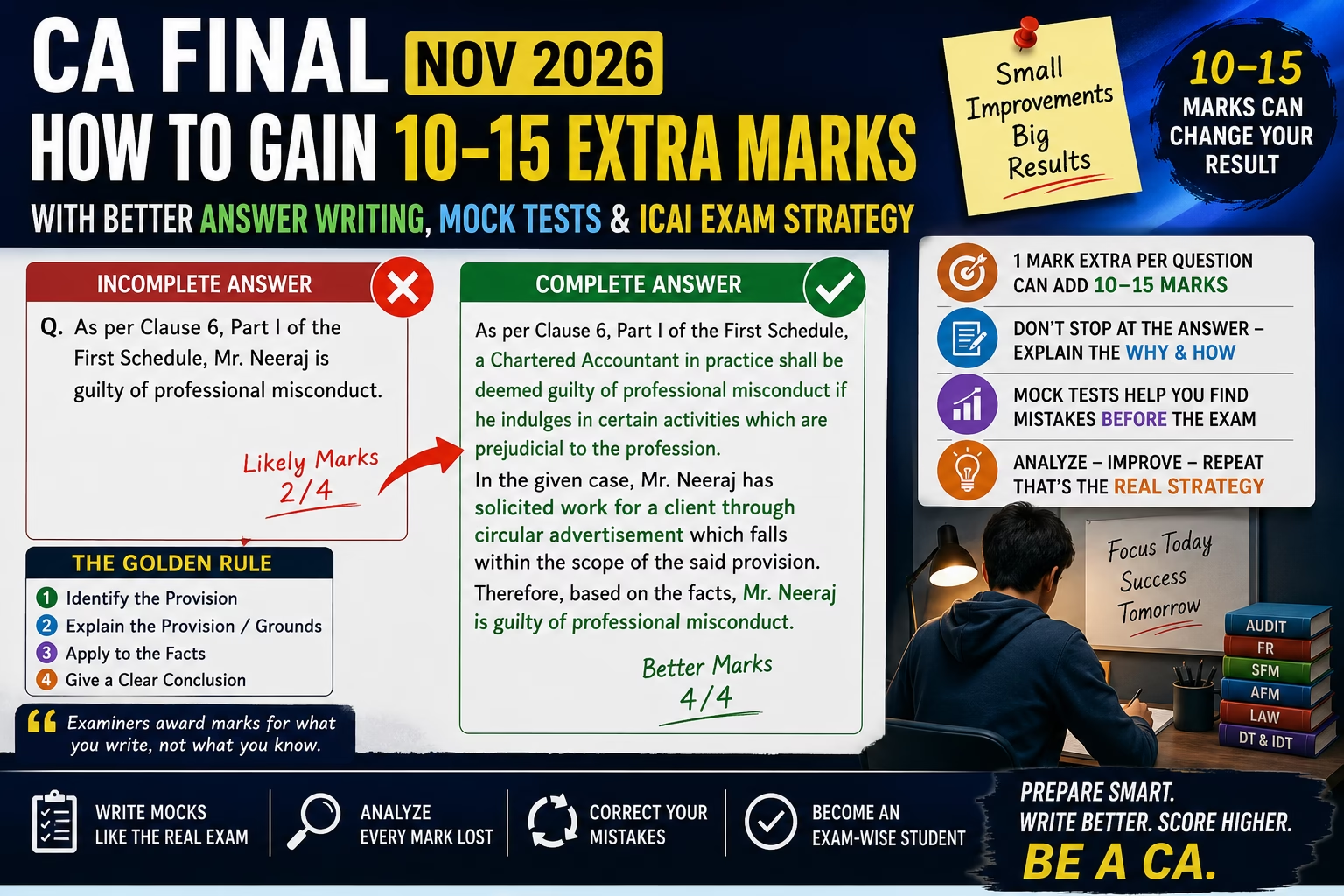
“As per Clause 6, Part I of the First Schedule, the Chartered Accountant is guilty of professional misconduct.”
The conclusion may be correct.
The clause may be correctly identified.
But is this enough for a 4-mark CA Final question?
Usually, the answer needs more.
The student should also explain what the provision actually says and how the facts of the question satisfy the requirements of that provision.
In other words:
Knowing the provision is not enough. You must demonstrate your knowledge through your answer.
This is one of the most important lessons that CA Final students need to understand before entering the examination hall.
The 10–15 Marks You May Be Losing Without Realising It
Let’s take a simple example.
Suppose a 4-mark question requires you to:
- Identify the relevant provision.
- Explain the provision or grounds.
- Apply the provision to the given facts.
- Give a clear conclusion.
A student may write only:
“As per Clause 6, Part I of the First Schedule, Mr. Neeraj is guilty of professional misconduct.”
This answer may show that the student knows the relevant clause.
But the examiner also wants to see whether the student understands why the clause applies.
A better answer would follow this structure:
Provision → Explanation → Application → Conclusion
For example:
“As per Clause 6, Part I of the First Schedule, a Chartered Accountant in practice shall be deemed guilty of professional misconduct if he undertakes certain prohibited activities as specified under the provision. In the given case, the actions of Mr. Neeraj fall within the scope of the said provision because ________. Therefore, based on the facts given in the question, Mr. Neeraj shall be held guilty of professional misconduct.”
The exact wording will obviously depend on the question and applicable provision. The important point is that the answer should explain the grounds on which the conclusion is based.
That additional explanation can potentially make the difference between an incomplete answer and a well-supported answer. thus helps you to Gain 10 to 15 Extra Marks.
The Golden Rule: Don’t Stop at the Correct Conclusion
Gain 10 to 15 Extra Marks :
One of the biggest mistakes CA Final students make is writing the correct conclusion too early.
They identify the section, standard, provision or clause.
They apply it briefly.
Then they stop.
But the examiner is not checking only whether you know the final answer.
The examiner is also assessing whether you can:
- Identify the relevant provision.
- Recall the applicable rule.
- Explain the requirement.
- Apply the rule to the facts.
- Reach a logical conclusion.
Therefore, your answer should ideally demonstrate the entire thought process in a concise and structured manner.
A simple framework to follow:
1. Provision
Mention the relevant section, clause, standard, regulation or principle.
2. Explanation
Briefly explain what the provision actually states.
3. Application
Connect the provision with the facts given in the question.
4. Conclusion
Clearly state the final answer.
This is particularly important in case-study-based and descriptive questions.
Why Mock Tests Are More Important Than You Think
Gain 10 to 15 Extra Marks :
Many students consider mock tests to be just another way of checking their preparation.
That is a mistake.
A good mock test is not merely an assessment of how many marks you can score today.
It is a diagnostic tool that helps identify mistakes before the actual examination.
Suppose you make an answer-writing mistake in your mock test.
That’s actually good news.
You have discovered the mistake before the real exam.
You can then:
- Identify the mistake.
- Understand why you made it.
- Learn the correct approach.
- Practise the improved format.
- Avoid repeating the same mistake in the final examination.
Now compare this with discovering the same mistake after your CA Final result.
At that point, the opportunity to correct it has already passed.
This is why mock tests should be treated as rehearsals for the actual examination, not simply as tests.
Your First Mock Test Is a Learning Experience
Don’t expect your first mock test to be perfect.
In fact, it is completely normal to make mistakes in your initial tests.
You may discover that:
- Your answers are too short.
- You are not explaining provisions properly.
- You are spending too much time on certain questions.
- Your answers lack structure.
- You are missing important keywords.
- You are writing unnecessary information.
- You are not applying provisions to the facts.
- Your conclusion is correct but your reasoning is incomplete.
- You are unable to complete the paper within the required time.
The purpose of your mock test is to identify these issues while there is still time to fix them.
The Difference Between “Knowing” and “Scoring”
Gain 10 to 15 Extra Marks :
This is perhaps the most important lesson for CA Final students.
There is a difference between:
I know the answer.
and
I can write an answer that earns marks.
These two things are not always the same.
A student may have studied the entire syllabus multiple times but still struggle to score because their knowledge is not being converted into marks effectively.
Your preparation therefore needs to have two components:
Knowledge Preparation
This includes:
- Reading the study material.
- Understanding concepts.
- Revising provisions.
- Memorising important points.
- Practising questions.
Examination Preparation
This includes:
- Answer writing.
- Time management.
- Presentation.
- Application of provisions.
- Using relevant keywords.
- Writing complete answers.
- Analysing evaluated papers.
- Learning from mistakes.
CA Final success requires both.
How to Analyse Your Evaluated Mock Test
Gain 10 to 15 Extra Marks :
After completing a mock test, don’t just look at your total score.
That number alone doesn’t tell you enough.
Instead, analyse every lost mark.
Ask yourself:
1. Did I know the answer?
If you didn’t know it, the problem is a knowledge gap.
You need to revise the concept.
2. Did I know the answer but fail to explain it?
If yes, the problem is an answer-writing gap.
You need to improve how you present your knowledge.
3. Did I identify the provision but fail to apply it?
Then you need to practise case-based application.
4. Did I write the correct answer but miss important points?
This could be a content or keyword gap.
5. Did I run out of time?
Then your issue is time management.
6. Did I make a silly mistake?
Identify exactly why it happened and create a strategy to prevent it.
This analysis is far more valuable than simply saying:
“I scored 55. I need to study more.”
The real question is:
Where did the remaining 45 marks go?
Once you know the answer, you can work specifically on those areas.
Don’t Let One Subject Cost You Your Entire Group
Gain 10 to 15 Extra Marks :
One of the most painful situations for any CA Final student is clearing multiple subjects but missing the group because of one paper.
Imagine being just 5 or 6 marks short in one subject.
You may have prepared well.
You may have known the concepts.
You may have performed well in the other subjects.
But a few avoidable marks lost through incomplete answers, poor presentation or ineffective time management can ultimately affect your result.
This is why every mark matters.
If you can identify and correct even small answer-writing mistakes before the exam, those improvements can accumulate across the entire paper.
A single additional mark in several questions can make a meaningful difference.
The 10–15 Mark Improvement Strategy
If you want to target those additional marks in your CA Final November 2026 preparation, focus on these areas:
1. Write the Provision
Don’t simply mention the section or clause number.
Explain the relevant provision wherever required.
2. Explain the Grounds
If the question asks you to determine whether a person is liable, guilty, eligible or otherwise, explain why.
3. Apply the Provision
Connect the rule with the facts of the question.
Avoid writing a generic theoretical answer when the question is case-based.
4. Give a Clear Conclusion
End your answer with a direct and unambiguous conclusion.
5. Practise Full-Length Papers
Don’t limit your preparation to chapter-wise questions.
Attempt complete papers under exam conditions.
6. Get Your Answers Evaluated
Self-evaluation can help, but external evaluation can reveal mistakes you may not notice yourself.
7. Maintain a Mistake Book
Record recurring mistakes such as:
- Missing provisions.
- Incomplete explanations.
- Weak conclusions.
- Poor time allocation.
- Incorrect formats.
- Missing keywords.
- Calculation errors.
Revise this mistake book before every mock test.
8. Repeat the Process
The real value of mock tests comes from the test → evaluation → correction → reattempt cycle.
The Power of 37 Mock Tests
Gain 10 to 15 Extra Marks :
If you are attempting multiple mock tests across all six CA Final subjects, you get multiple opportunities to identify and correct your mistakes.
Consider this:
Your first FR mock test reveals a problem with your answer writing.
You correct it.
Your second test reveals another issue.
You correct that.
Then you move to the next subject.
By the time you reach the actual examination, you have already encountered and fixed several mistakes that could otherwise have cost you marks.
This is the real value of a comprehensive mock-test journey.
The goal isn’t simply to write 37 papers.
The goal is to become a better exam-taker with every paper you write.
CA Final November 2026: Start Thinking Like an Examiner
Gain 10 to 15 Extra Marks :
Before submitting every answer, ask yourself:
“If I were checking this answer, would I be able to identify the exact reason for my conclusion?”
If the answer is no, your response may need more explanation.
Don’t assume that the examiner will fill in the gaps in your answer.
Your job is to make your answer self-explanatory, structured and logically complete.
Remember:
The examiner can only award marks for what you have written.
Your knowledge inside your head has no value in the examination unless you successfully communicate it on paper.
Final Takeaway
Gain 10 to 15 Extra Marks
Scoring an additional Gain 10 to 15 Extra Marks is not necessarily about discovering a magical shortcut or studying 10 new chapters overnight.
Sometimes, the marks are already within your reach.
You simply need to stop losing them.
A student who knows the provision but doesn’t explain it may lose marks.
A student who reaches the right conclusion but doesn’t provide the grounds may lose marks.
A student who never attempts mock tests may discover these mistakes only in the real examination.
But a student who regularly writes mock tests, gets them evaluated, analyses every lost mark and corrects their mistakes has a significant advantage.
So, as you prepare for CA Final November 2026, don’t focus only on:
“How much more do I need to study?”
Also ask:
“How many marks am I currently losing because of the way I write my answers?”
That question could completely change your preparation strategy.
Study hard. Revise smart. Write mocks. Analyse your mistakes. And most importantly, make sure that the knowledge you already have actually gets converted into marks.
Your goal for November 2026 should not just be to know the answer.
It should be to write an answer that earns every mark you deserve.