
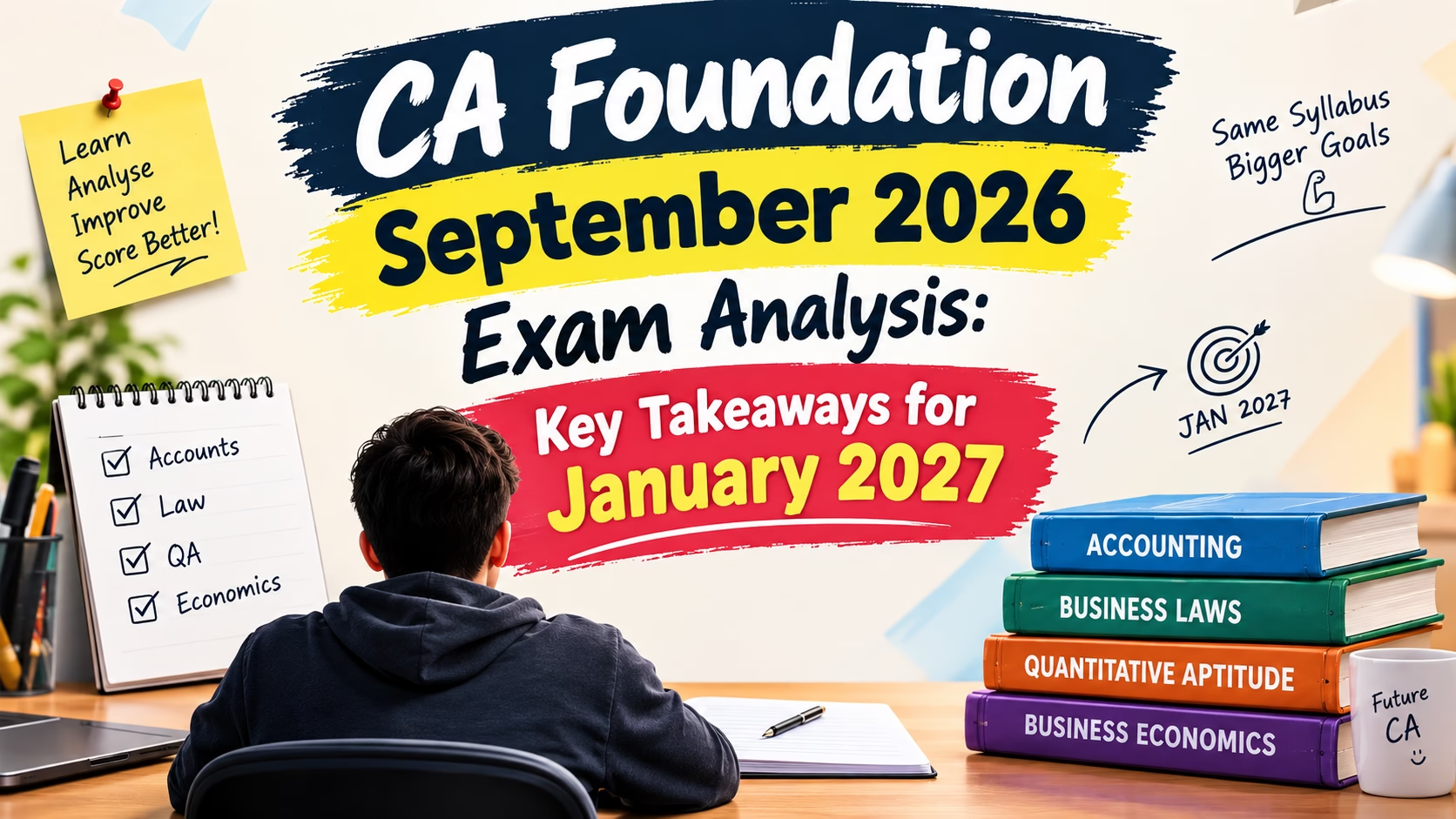
 CA Foundation September 2026 Exam Analysis:
The CA Foundation September 2026 exams are over — but for students preparing for the January 2027 attempt, the real learning starts now.
The September attempt gave CA Foundation students several important lessons about how ICAI can frame questions, how lengthy papers can affect performance, why selective preparation is becoming risky, and why conceptual clarity + complete syllabus coverage + mock-test practice are more important than ever.
The four CA Foundation papers — Accounting, Business Laws, Quantitative Aptitude and Business Economics — each had their own learning points. ICAI’s Foundation structure includes two descriptive papers and two objective papers, making both conceptual preparation and exam-time strategy important.
So, if you’re appearing for CA Foundation January 2027, don’t just look at September 2026 as someone else’s attempt.
Use it as your preparation blueprint.
🔥 The Biggest Lesson from CA Foundation September 2026
If there’s one message that students should take from this attempt, it is:
Don’t prepare for the paper you expect. Prepare for the paper ICAI can actually give you.
January may be easy.
It may be moderate.
It may be lengthy.
It may contain unfamiliar-looking questions.
You simply cannot build your preparation around predicting the difficulty level.
Instead, build your preparation so that whatever paper comes in front of you, you can handle it.
1. Accounts: Stop Depending on Direct Questions
One of the biggest takeaways from the September 2026 Accounts paper was that students could not simply expect questions to be lifted directly from the Study Material.
The concepts were familiar, but the questions and adjustments could be presented differently.
And that’s an important distinction.
Knowing the question ≠ knowing the concept.
If you’ve memorised a particular Study Material question, you may struggle when ICAI changes the numbers, adjustments or presentation.
But if you’ve understood the underlying concept, you can still solve it.
What should January 2027 students do?
Don’t prepare Accounts selectively.
Your preparation should include:
- Complete Study Material
- Study Material question practice
- Previous-year questions
- RTPs
- MTPs
- Multiple revisions
- Full-length mock papers
The biggest mistake would be thinking:
“September was difficult, so January will probably be easy.”
Don’t make that assumption.
Prepare for 100% of the syllabus.
2. An Unexpected Question Should NOT Destroy Your Paper
CA Foundation September 2026 Exam Analysis:
Another major lesson from the Accounts paper was how to deal with an unfamiliar question.
Suppose you open the paper and suddenly see a question that you don’t recognise.
Your first reaction may be:
“Yaar, ye toh maine kabhi padha hi nahi!”
And then panic begins.
This is exactly what you need to avoid.
If a question appears unfamiliar, move on.
Don’t allow one question to consume your time and confidence.
You have an entire paper to attempt.
Remember:
One difficult question does not mean the entire paper is difficult.
The students who manage their emotions and time effectively can still score well even when the paper contains surprises.
3. One-Shot Videos Are for Revision — Not Your Entire Preparation
CA Foundation September 2026 Exam Analysis:
This is another important takeaway for January 2027.
One-shot lectures can be extremely useful.
They can help you:
- Revise quickly
- Recall concepts
- Cover a chapter before a mock
- Refresh your memory before the examination
But they cannot automatically replace detailed preparation.
If your entire preparation is:
“I’ll watch one shot and everything will be done.”
you may miss several questions and concepts.
For CA Foundation, especially when questions are not always direct, you need to understand the concepts rather than simply remember selected questions.
Use one-shots strategically.
First learn → then practise → then revise through one-shots.
4. Quantitative Aptitude: Question Selection Is a Superpower
CA Foundation September 2026 Exam Analysis:
The September 2026 QA paper also highlighted an important exam skill:
You don’t have to solve every question in the order it appears.
When you see several lengthy or complicated questions together, it can be tempting to start solving them immediately.
That can be dangerous.
You may spend several minutes on one complicated question while leaving easier questions untouched.
Instead, learn to identify:
Easy → Moderate → Difficult
Your first priority should be maximising marks, not proving that you can solve the hardest question.
5. Don’t Ignore the “Easy” Chapters
CA Foundation September 2026 Exam Analysis:
A very important lesson from the QA discussion is that students often overlook chapters because they don’t consider them important enough.
But topics such as:
- Probability
- Permutation & Combination
- Sets and Relations
- Equations
- Theoretical concepts
can contain relatively manageable questions.
So don’t make the mistake of thinking:
“This chapter is small, so I’ll skip it.”
Those few marks can become extremely valuable in the examination.
Complete the syllabus.
Then decide where to allocate additional revision time.
6. PYQs Are Essential — But Don’t Use Them to Predict the Paper
CA Foundation September 2026 Exam Analysis:
Previous-year questions are extremely important.
But there’s a difference between:
Using PYQs for practice
and
Using PYQs to predict the next paper.
The first is smart.
The second is risky.
Use PYQs to understand:
- Question patterns
- Difficulty
- Application
- Repeated concepts
- Time required
- Common mistakes
But don’t assume that only those questions or chapters will appear.
Your target should be:
Study Material + PYQs + RTPs + MTPs + Revision
—not PYQs alone.
7. Law: Read the Question VERY Carefully
CA Foundation September 2026 Exam Analysis:
The September 2026 Law paper provided one of the clearest lessons for future students:
Read the complete question before writing the answer.
A student may know the correct provision but still lose marks because the question was misunderstood.
You might know the chapter.
You might remember the section.
You might even know the correct legal principle.
But if the question asks A and you answer B, your preparation won’t help much.
So before starting your answer, identify:
What is the situation?
What provision is applicable?
What exactly has the question asked?
What conclusion is required?
Only then start writing.
8. Don’t Get Scared by a Long Law Question
CA Foundation September 2026 Exam Analysis:
A long question can look terrifying.
You may see a huge case-study-style paragraph and immediately think:
“Bhai, itna bada question kaise karunga?”
But don’t judge the difficulty simply by the number of lines.
Sometimes a huge question ultimately asks for a very specific provision or conclusion.
The September discussion highlighted this exact problem: students can psychologically panic before reaching the actual requirement of the question.
So follow one rule:
Don’t judge the question until you’ve read it completely.
The question may look like a mountain at first — but the actual requirement may be surprisingly small.
9. Economics: Easy Doesn’t Mean You Can Take It Lightly
CA Foundation September 2026 Exam Analysis:
Business Economics can become a major aggregate booster for CA Foundation students.
But there is a common trap.
Students see relatively direct questions and assume:
“Economics toh easy hai. Baad mein kar lenge.”
That’s dangerous.
Even when questions look easy, you need sufficient conceptual and detailed preparation to answer them accurately.
Focus on:
- Conceptual clarity
- Study Material
- Regular revision
- MCQ practice
- RTPs
- MTPs
- PYQs
Don’t confuse an easy paper with an easy subject that requires no preparation.
10. Conceptual Clarity Is the Real Game
CA Foundation September 2026 Exam Analysis:
This is perhaps the most important lesson from all four subjects.
Imagine ICAI gives you a question you’ve never seen before.
If your preparation is based entirely on memorised questions, you may get stuck.
But if your concepts are clear, you can think:
“I’ve never seen this exact question, but I know the concept behind it.”
And that’s exactly what you want.
The goal isn’t to memorise every possible question.
The goal is to become capable of solving unfamiliar questions.
That’s why conceptual clarity matters in:
Accounts + Law + QA + Economics.
11. Full-Length Mocks Are NOT Optional
CA Foundation September 2026 Exam Analysis:
Another common problem highlighted by the September attempt was paper completion.
Students may have studied everything.
They may have solved hundreds of questions.
But have they actually sat for a complete examination simulation?
That’s different.
Before January 2027, try to attempt at least 2–3 full-length mocks under proper examination conditions.
Don’t pause.
Don’t check your notes.
Don’t use your phone.
Don’t take unnecessary breaks.
Actually simulate the exam.
Then analyse:
- Where did I lose time?
- Which questions took too long?
- Did I panic?
- Did I make silly mistakes?
- Did I attempt questions in the right order?
- Could I complete the paper?
A mock test isn’t just a test of knowledge.
It’s a test of execution.
12. Complete Your Classes — Don’t Wait Until the Last 10–15 Days
CA Foundation September 2026 Exam Analysis:
One of the strongest messages from the discussion was also about consistency.
Some students join batches but don’t complete them.
Then, when only a few weeks remain, they start asking:
“Sir, ye chapters nahi hue hain. Ab kya karun?”
CA Foundation cannot ideally be approached as a 10–15 day crash course if your goal is strong conceptual preparation and a comfortable attempt.
You need time for:
Learning → Practice → Revision → Mock Tests → Error Correction
If you eliminate the first stages and leave everything for the last few days, you’re putting unnecessary pressure on yourself.
CA Foundation January 2027: Your New Preparation Formula
CA Foundation September 2026 Exam Analysis:
After the September 2026 attempt, the preparation strategy for January 2027 should be simple:
📚 1. Complete the syllabus
Don’t leave major chapters simply because you think they are unlikely to appear.
🧠 2. Build conceptual clarity
Understand why something works instead of memorising the answer.
✍️ 3. Practise questions
Especially Study Material, PYQs, RTPs and MTPs.
🔄 4. Revise multiple times
One reading is not preparation.
⏱️ 5. Practise under time pressure
Learn how much time you actually need.
📝 6. Write full mocks
At least 2–3 proper simulations can make a huge difference.
🎯 7. Learn question selection
Especially for lengthy papers.
🚫 8. Stop predicting ICAI
Don’t decide your preparation based on what you think will come.
September 2026 vs January 2027: What Should Students Learn?
CA Foundation September 2026 Exam Analysis:
| September 2026 Learning | What You Should Do for January 2027 |
|---|---|
| Questions may not be direct | Focus on concepts |
| Paper can be lengthy | Practise full mocks |
| Unexpected questions can appear | Don’t panic; move ahead |
| Long questions can intimidate | Read the complete requirement |
| Easy questions can be missed | Develop question-selection skills |
| Selective study is risky | Cover 100% syllabus |
| PYQs alone aren’t enough | Combine Study Material + PYQs + RTP/MTP |
| One-shot isn’t complete preparation | Use one-shots mainly for revision |
| Easy Economics can still cost marks | Build conceptual clarity |
| Knowing concepts isn’t enough | Practise applying them under time pressure |
Final Takeaway for CA Foundation January 2027
CA Foundation September 2026 Exam Analysis:
The September 2026 attempt wasn’t just another examination.
It was a lesson for the next batch of CA Foundation aspirants.
The biggest takeaway is simple:
Don’t prepare according to predictions. Prepare according to possibilities.
You don’t know whether January will be easy or difficult.
You don’t know whether Accounts will be direct or application-based.
You don’t know whether Law will be lengthy.
You don’t know whether QA will test your speed.
And you don’t know whether Economics will give you the straightforward questions you’re expecting.
But you can control your preparation.
Complete your syllabus.
Understand your concepts.
Practise the Study Material.
Solve PYQs, RTPs and MTPs.
Revise again and again.
Attempt full-length mocks.
And learn how to stay calm when the paper doesn’t look exactly like your expectations.
September 2026 showed you what can happen. January 2027 is your chance to be ready for it.
Don’t prepare for an easy paper.
Don’t prepare for a difficult paper.
Prepare so well that the difficulty of the paper doesn’t decide your result.