

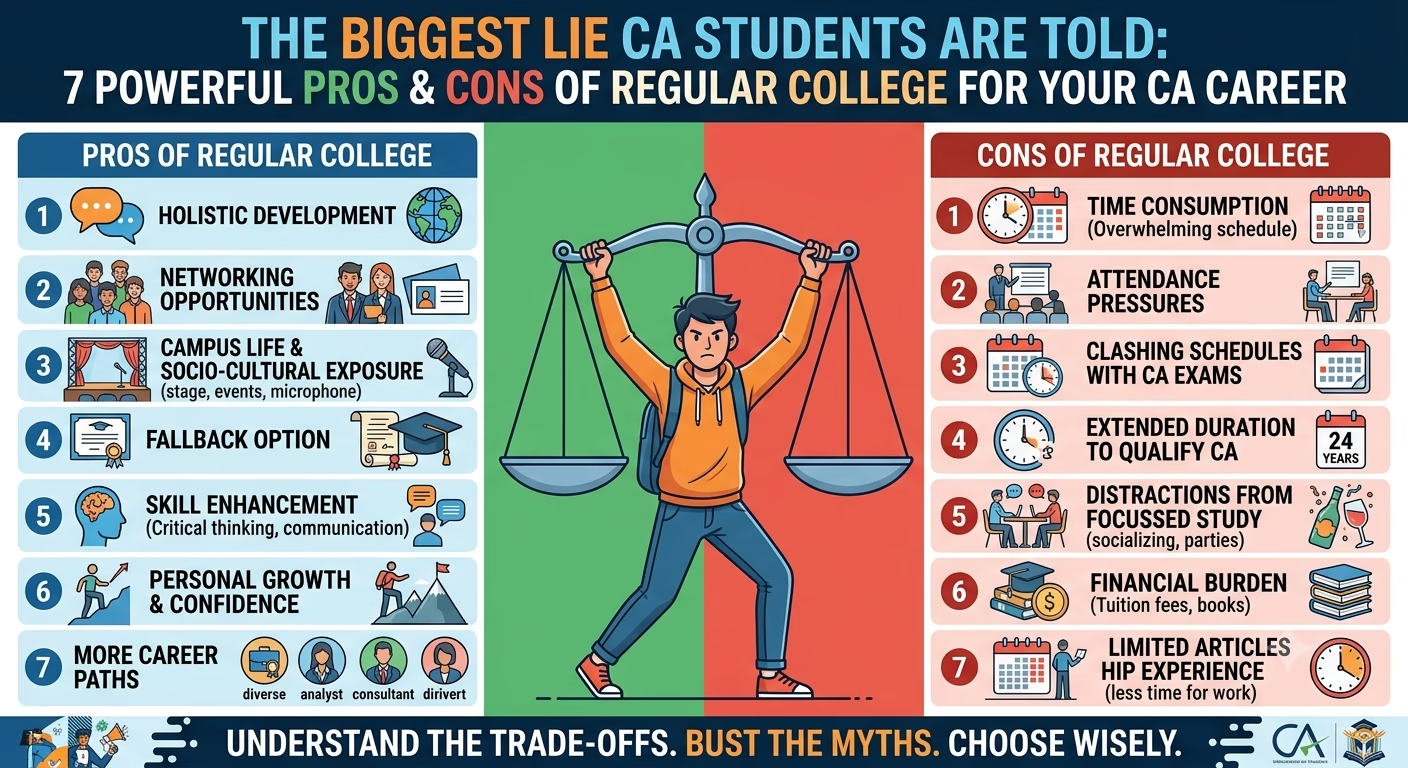
 The Biggest Lie CA Students Are Told:
If you are pursuing Chartered Accountancy after Class 12, chances are you have heard this advice:
“Don’t waste time on regular college. Just focus completely on CA.”
For many CA aspirants, this sounds logical. After all, CA is already a demanding course. Why add college lectures, assignments, exams, societies and other commitments to the workload?
But is avoiding regular college always the smarter choice?
Not necessarily.
The real question is not simply “Should a CA student go to college?” The better question is:
“Does the college I have access to add meaningful value to my personal and professional development?”
A good regular college can provide exposure, networking, communication skills, confidence, leadership opportunities and even a valuable alternative career path alongside CA.
At the same time, regular college also comes with genuine challenges, particularly when you are simultaneously preparing for one of the toughest professional courses in India.
So, let’s break down both sides.
The Biggest Lie CA Students Are Told
One of the most common pieces of advice given to CA aspirants is that regular college is a waste of time.
The argument usually goes something like this:
- CA itself requires enormous preparation.
- College will consume additional time.
- Attendance and internal examinations will create unnecessary pressure.
- You could use those three years exclusively for CA preparation.
- A CA degree matters more than a graduation degree.
There is some logic behind these concerns.
However, the problem begins when this advice becomes a universal rule.
A student getting into a strong college with good academic exposure, societies, networking opportunities, extracurricular activities and placement support may be giving up a significant learning environment simply because they have been told that “CA is enough.”
And that’s where students need to think independently.
Regular College + CA: What Can You Actually Gain?
A regular college isn’t valuable merely because you receive another degree.
Its bigger value can come from the environment and exposure you receive during those years.
Here are some of the major benefits.
1. Personality Development
Biggest Lie CA Students Are Told:
CA preparation can involve spending long hours studying alone.
Regular college, on the other hand, naturally puts you around different kinds of people.
You interact with:
- classmates from different backgrounds
- professors
- seniors and juniors
- students pursuing different careers
- society members
- event organizers
- professionals visiting campus
This environment can gradually improve the way you communicate and present yourself.
Of course, college doesn’t automatically develop your personality. You need to participate and engage with the opportunities available.
But it can provide the platform.
2. Better Communication and Soft Skills
Biggest Lie CA Students Are Told:
Technical knowledge is important for a CA.
But professional life involves much more than knowing accounting standards, taxation provisions or auditing procedures.
You also need to communicate.
College can give you opportunities to participate in:
- group discussions
- presentations
- debates
- seminars
- competitions
- cultural activities
- student societies
- public-speaking events
These experiences can help you become more comfortable expressing your thoughts in front of others.
That confidence can later become useful during articleship interviews, job interviews, client interactions and professional presentations.
3. Networking Opportunities
Biggest Lie CA Students Are Told:
One of the biggest advantages of a good college is the peer network.
Your classmates may eventually become:
- entrepreneurs
- lawyers
- engineers
- consultants
- investment professionals
- civil servants
- business owners
- MBA graduates
- professionals working overseas
You don’t know where your classmates will be five or ten years from now.
And that’s precisely why networking matters.
Your professional network doesn’t have to consist only of CAs.
Sometimes, knowing people from completely different fields can open doors to opportunities you wouldn’t have discovered otherwise.
4. Leadership Opportunities
Biggest Lie CA Students Are Told:
College societies and student organizations can provide something that textbooks cannot:
real responsibility.
You might organize an event, manage a team, handle sponsorships, coordinate with speakers or represent your college.
These experiences teach practical skills such as:
- delegation
- teamwork
- coordination
- communication
- problem-solving
- time management
- leadership
And these are transferable skills that can remain useful long after college ends.
5. Discovering Interests Beyond CA
Biggest Lie CA Students Are Told:
This may be one of the most underrated advantages.
When you’re completely immersed in CA preparation, your world can gradually become:
Classes → Study → Tests → Revision → Exams → Repeat.
College can expose you to completely different areas.
You might discover an interest in:
- writing
- public speaking
- marketing
- entrepreneurship
- finance
- technology
- consulting
- content creation
- event management
- research
You may even discover that you enjoy something you had never considered before.
And that’s valuable.
Because choosing a career isn’t only about asking:
“What am I capable of doing?”
It’s also about discovering:
“What do I actually want to do?”
6. Regular College Can Give You a Plan B
Biggest Lie CA Students Are Told:
This is another important consideration.
A CA student may eventually decide that CA isn’t the career they want.
That decision doesn’t necessarily mean failure.
Perhaps the student discovers an interest in:
- finance
- management
- consulting
- entrepreneurship
- government services
- higher education
- international education
- an MBA
A strong graduation degree can provide additional options.
This doesn’t mean every CA student needs a “Plan B” because they expect to fail.
It simply means that having multiple career pathways can provide flexibility.
Your career is bigger than one examination.
But Regular College Isn’t Automatically the Right Choice
Biggest Lie CA Students Are Told:
This is where the discussion needs some balance.
The argument shouldn’t become:
“Everyone pursuing CA must attend regular college.”
That’s not necessarily true either.
The quality of the college matters enormously.
If a college provides little meaningful exposure but consumes substantial time and energy, the calculation changes.
For example, consider two situations:
College A
- Strong academic reputation
- Active societies
- Good peer group
- Placement opportunities
- Competitions and events
- Networking opportunities
- Opportunities for leadership
- Meaningful extracurricular exposure
College B
- Limited exposure
- Minimal student activities
- Weak peer interaction
- Significant commuting time
- Heavy administrative burden
- Little professional value
Calling both simply “regular college” misses the real issue.
The value proposition is different.
The Biggest Disadvantage: Your CA Journey May Take Longer
Biggest Lie CA Students Are Told:
This is probably the biggest practical concern.
Depending on your college schedule, examinations and other commitments, your CA preparation may become more difficult to manage.
It can potentially affect:
- CA preparation time
- examination attempts
- articleship scheduling
- revision cycles
- mock tests
- study consistency
For some students, the CA journey may therefore take longer.
But an additional year or two isn’t automatically a bad outcome if the experience is adding meaningful long-term value.
The important thing is to make that decision consciously, rather than treating every additional year as wasted time.
The Second Disadvantage: You Are Managing Two Demanding Worlds
Biggest Lie CA Students Are Told:
This is where things can become difficult.
On one side:
College
Lectures
Assignments
Internal examinations
Projects
Societies
Events
On the other:
CA
Classes
Self-study
Mock tests
RTPs
MTPs
Revision
Examinations
And sometimes both schedules collide.
Your college may have an internal examination exactly when you have a CA test.
Your CA classes may coincide with college commitments.
Your friends may be going out while you need to revise.
There will be moments when you wonder:
“Why did I choose to do both?”
That’s a genuine possibility.
So if you choose this path, you need strong planning and time management.
Can CA and Regular College Actually Be Managed Together?
Biggest Lie CA Students Are Told:
Yes, many students do manage both.
But “possible” doesn’t mean “effortless.”
You need to understand the trade-off before committing.
A student pursuing both may have to sacrifice some things:
- fewer social outings
- less free time
- stricter scheduling
- better prioritization
- advance preparation before exams
The key is not trying to do everything equally.
During CA exam season, CA preparation may need to take priority.
During college examinations, you may need to temporarily shift some attention toward college.
The ability to plan around both calendars becomes crucial.
So, Who Should Choose Regular College?
Biggest Lie CA Students Are Told:
Instead of following someone else’s blanket advice, ask yourself these questions:
Question 1: Is the college genuinely good?
Does it offer meaningful exposure, networking, activities and opportunities?
Question 2: Can you realistically manage the workload?
Look at the actual timetable, attendance requirements, commute and examination schedule.
Question 3: What are you giving up by choosing it?
Would college delay your CA journey significantly?
Would the time investment produce meaningful value?
Question 4: What alternatives do you have?
If you aren’t choosing regular college, are you replacing that exposure with something else?
For example:
- internships
- professional networking
- public speaking
- competitions
- volunteering
- leadership activities
- writing
- relevant certifications
- practical work experience
Simply not going to college doesn’t automatically create an advantage.
You need to use the additional time productively.
Regular College vs No Regular College: The Real Difference
Biggest Lie CA Students Are Told:
The debate shouldn’t be reduced to:
College = Good
No College = Bad
or
College = Waste of Time
No College = Smart
The reality is much more nuanced.
| Factor | Regular College | No Regular College |
|---|---|---|
| Personality exposure | Potentially higher | Depends on self-created opportunities |
| Networking | Built into college environment | Needs deliberate effort |
| Soft skills | Opportunities through activities | Can be developed elsewhere |
| CA preparation time | Potentially lower | Potentially higher |
| Flexibility | Lower due to college commitments | Generally higher |
| Alternative career options | Graduation + CA pathway | Depends on alternative qualification |
| Leadership opportunities | Societies/events can help | Must be created elsewhere |
| Time pressure | Higher | Comparatively lower |
| Career exploration | Multiple environments | Requires conscious exploration |
The important word throughout this table is “potentially.”
Going to college doesn’t guarantee success.
Not going to college doesn’t guarantee failure.
What you do with the environment available to you matters.
Don’t Let Someone Else Make a Career Decision for You
Biggest Lie CA Students Are Told:
This may be the biggest takeaway.
Your parents, teachers, seniors and coaching mentors may genuinely want the best for you.
But they may also be looking at your situation through their own experiences.
The career environment today is different from what it was a decade ago.
Students have access to:
- online education
- professional communities
- internships
- global opportunities
- AI tools
- online certifications
- networking platforms
So don’t blindly accept:
“Everyone pursuing CA should do this.”
Instead, research.
Talk to students.
Talk to CAs.
Look at the career paths of professionals.
Understand the opportunities available at your particular college.
And then make an informed decision.
Final Takeaway: Don’t Choose Based on Fear
Biggest Lie CA Students Are Told:
Regular college can be a valuable addition to a CA journey when the college provides meaningful exposure and the student can realistically manage both commitments.
It can help develop communication, networking, leadership, confidence and career awareness.
At the same time, it can increase workload and potentially extend the CA timeline.
Therefore, the right question isn’t:
“Should every CA student go to regular college?”
It is:
“Will this particular college add enough value to justify the additional time and effort alongside my CA journey?”
If the answer is yes, regular college can become much more than just a graduation requirement.
It can become an opportunity to build the person behind the CA qualification.
And if the answer is no, skipping regular college isn’t automatically a mistake either—provided you consciously use that time to build exposure, skills, networks and practical experience elsewhere.
Don’t let a coaching slogan decide your career. Research, evaluate your options, understand the trade-offs, and then choose what fits your own circumstances.
🔗 Join 10,000+ CA Students using our Test Series to study smarter and create your own academic brand. Structured tests with detailed feedback.
Useful Resources