
CA Intermediate Jan 2027:
If you are preparing for CA Intermediate January 2027, the thought of having roughly 100 days left can be both motivating and stressful. The real question is not simply “How many hours should I study?” but:
How should you use these remaining days so that your preparation becomes structured, revision-focused and exam-oriented?
A strategy discussed in a recent preparation session focuses on three pillars:
Complete the syllabus → Revise repeatedly → Attempt full-syllabus mock tests.
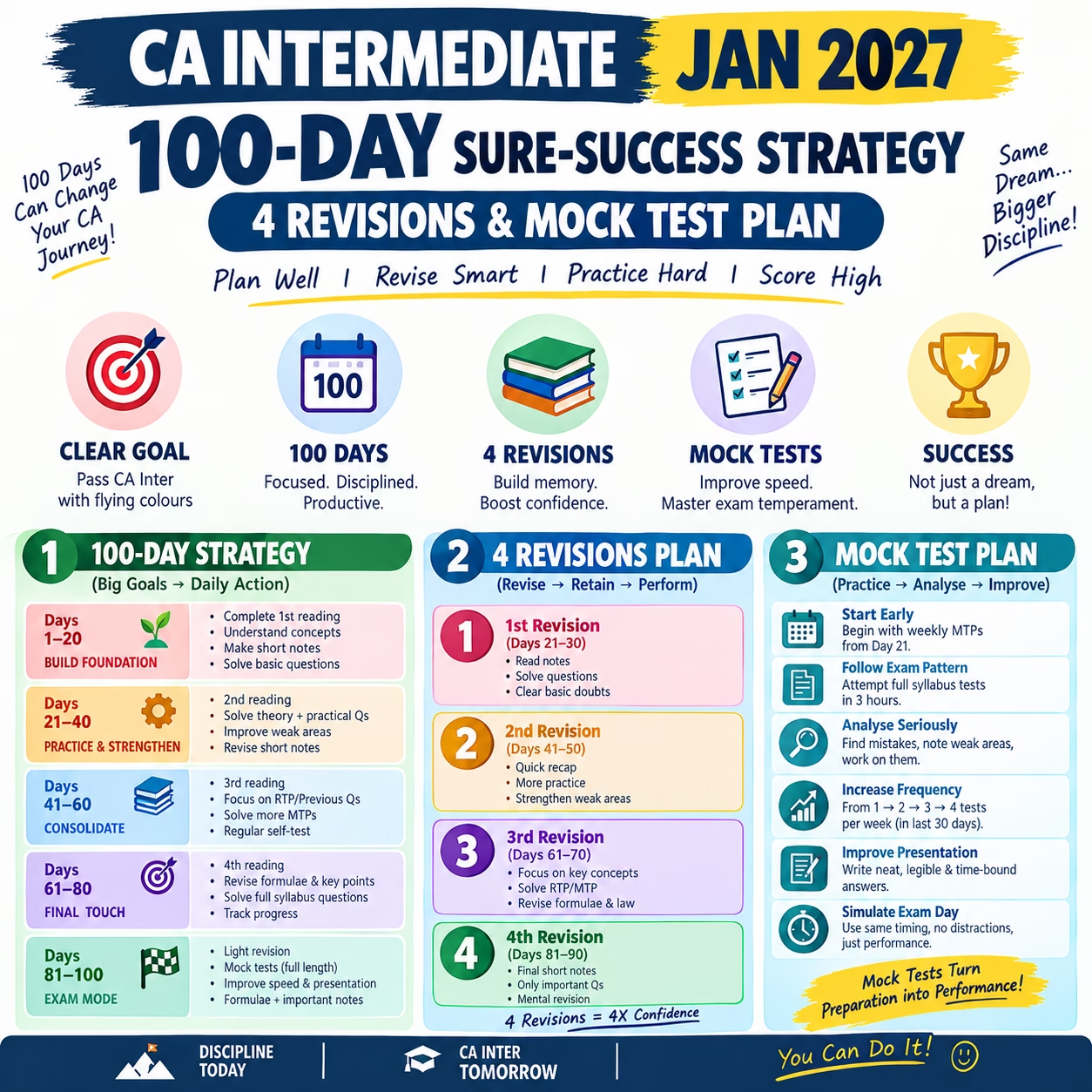
The approach recommends four rounds of revision and three full-syllabus mock tests, along with daily targets, selective written practice, regular recall and proper sleep.
Important: No strategy can guarantee a rank or a particular result. Your outcome will depend on your preparation, consistency, exam performance and several other factors. The plan below should therefore be treated as a structured preparation framework rather than a guarantee.
The 3 Golden Rules for CA Inter Jan 27 Preparation
The entire strategy can essentially be reduced to three major principles:
- Complete the syllabus as early as possible.
- Revise the entire syllabus multiple times.
- Practise full-syllabus mock tests under actual exam conditions.
The idea is simple: completing the syllabus once is not enough. Repeated revision helps improve recall, while mock tests expose weaknesses in time management, presentation and question selection.
1. How Many Revisions Should CA Inter Students Do?
CA Intermediate Jan 2027 :
The suggested approach is:
4 Revisions + 3 Full-Syllabus Mock Tests
The first three revisions are combined with mock-test practice, while the final revision is kept for the period immediately before the examination.
For Both Groups
| Stage | Approx. Time | Approach |
|---|---|---|
| First Revision | 54 days | About 9 days per paper |
| Second Revision | 30 days | About 5 days per paper |
| Third Revision | 12 days | About 2 days per paper |
| Final Revision | Before exam | Rapid recall & marked topics |
| Mock Tests | 3 per paper | Full-syllabus, exam-like practice |
The important point is not merely the number of revisions. Each revision should become faster and more selective than the previous one.
2. First Revision: Build Complete Coverage
CA Intermediate Jan 2027 :
The first revision is the most detailed one.
If you are preparing for both groups, the suggested framework allocates approximately 54 days, averaging nine days per paper.
Instead of spending all your time rereading everything passively, divide every paper into daily targets.
For example:
- Day 1 → Targeted chapters/topics
- Day 2 → Next set of chapters
- Day 3 → Next target
- Continue until the complete syllabus is covered
- Final day → Full-syllabus mock test
Why Daily Targets Matter
A common problem during revision is studying without a defined endpoint.
You may start with:
“Today I’ll revise Advanced Accounting.”
But that is not a measurable target.
Instead, define:
“Today I will complete these specific chapters, practise selected questions and revise my marked concepts.”
This creates accountability.
3. Use the Right Study Material
CA Intermediate Jan 2027 :
One of the most important principles in CA preparation is avoiding unnecessary material overload.
During revision, your objective should not be to collect ten different books or PDFs.
Your core material should primarily include:
- ICAI Study Material
- ICAI Illustrations
- Previous Year Questions
- RTPs
- MTPs
- Your class notes/revision notes
- Your marked questions and concepts
The transcript also recommends using revision lectures where a concept has been forgotten instead of going back through an entire lengthy regular lecture.
A Practical Rule
If you remember the concept:
Revise → Practise → Move ahead.
If you have forgotten the concept:
Revision lecture → Concept revision → Question practice.
This can save considerable time during the first revision.
4. The First Revision Should Be a Filtering Exercise
CA Intermediate Jan 2027 :
You cannot realistically rewrite every question in every revision.
Instead, create your own revision filter.
While studying, mark:
⭐ Important concepts
⭐ Difficult adjustments
⭐ Important formulas
⭐ Frequently forgotten provisions
⭐ Special steps
⭐ Questions where you made mistakes
⭐ Questions that require repeated written practice
Later revisions can then focus heavily on these marked areas.
This is particularly useful for subjects such as:
- Law
- Taxation
- Audit
- Costing
- Strategic Management
5. Don’t Completely Skip Written Practice
CA Intermediate Jan 2027 :
One major mistake students make is confusing reading with preparation.
Reading a solution and actually writing an answer are two different things.
However, writing every question during every revision is also inefficient.
A balanced approach is better.
During First Revision
Focus on broader coverage and selective written practice.
For example:
- Solve/write important questions properly.
- Practise difficult practical questions.
- Write selected theory answers.
- Audit the remaining questions mentally.
- Mark questions that require another attempt.
The goal is to develop both:
Coverage + Answer-writing ability.
6. The 30-Minute Daily Recall Technique
CA Intermediate Jan 2027 :
One of the most useful techniques from the strategy is the same-day + next-day recall system.
Suppose you study a topic today.
At the end of the day
Spend around 30 minutes revising:
- Important concepts
- Formulas
- Keywords
- Adjustments
- Your marked questions
- Difficult points
Before starting the next day’s study
Spend another short session recalling the previous day’s material.
So one topic gets reinforced through:
Main study → Same-day recall → Next-day recall
This repeated retrieval can make revision more active than simply rereading the chapter.
7. Second Revision: Reduce the Time
CA Intermediate Jan 2027 :
The second revision should be considerably faster.
For a six-paper preparation, the suggested framework gives approximately:
30 days
That means around 5 days per paper.
At this stage, don’t treat the syllabus as if you are studying it for the first time.
Focus on:
- Concepts you previously marked
- Important questions
- Formulas
- Adjustments
- Mistakes
- ICAI material
- PYQs
- RTPs
- MTPs
Revision lectures should now be used only when genuinely required.
8. Third Revision: Rapid Recall
CA Intermediate Jan 2027 :
The third revision is much shorter.
The suggested framework gives approximately:
12 days for both groups
That works out to roughly 2 days per paper.
At this stage, your preparation should become highly selective.
Focus on:
- Marked concepts
- Difficult questions
- Formulas
- Amendments
- Important provisions
- Previously incorrect questions
- Frequently forgotten points
The objective is no longer detailed learning.
It is rapid recall and retention.
9. Final Revision Before the Examination
CA Intermediate Jan 2027 :
The fourth revision is the final round immediately before your paper.
This is not the time to start learning large new portions of the syllabus.
Your final revision should primarily consist of:
Practical Subjects
- Formulae
- Adjustments
- Standard formats
- Marked questions
- Common mistakes
Theory Subjects
- Keywords
- Provisions
- Headings
- Exceptions
- Case-law points where applicable
- Your short revision notes
The closer you get to the examination, the more important recall becomes than passive reading.
10. Single-Group Strategy for CA Inter Jan 27
CA Intermediate Jan 2027 :
If you are appearing for only one group, the timeline becomes relatively more manageable.
The suggested approach is:
| Stage | Approx. Duration |
|---|---|
| Course Completion | By 31 October |
| First Revision | 30 days |
| Second Revision | 15 days |
| Third Revision | 9 days |
| Final Revision | Before exams |
For each three-paper group, the first revision can be divided into approximately:
10 days per paper.
The second revision:
5 days per paper.
The third revision:
3 days per paper.
Again, these are planning benchmarks, not rigid rules. Adjust them according to your actual syllabus status.
11. Full-Syllabus Mock Tests Are Essential
CA Intermediate Jan 2027 :
Revision tells you what you know.
A mock test tells you how well you can reproduce it under examination conditions.
The suggested strategy recommends:
3 Full-Syllabus Mock Tests per Paper
That means your mock-test practice should resemble the actual examination rather than simply taking small chapter-wise quizzes.
Why?
Because the real examination requires you to:
- Manage the entire syllabus.
- Decide which questions to attempt.
- Manage time.
- Write continuously.
- Maintain presentation.
- Handle unfamiliar questions.
- Avoid spending too much time on one problem.
12. Attempt Mock Tests Like the Real Exam
CA Intermediate Jan 2027 :
Don’t turn your mock test into an open-book exercise.
Create an actual examination environment:
Keep the prescribed time limit.
Keep your books away.
Don’t check solutions midway.
Attempt the complete paper.
Write your answers properly.
Evaluate the paper afterwards.
The objective is not simply to find out:
“I scored 65.”
The more important question is:
“Why did I lose the remaining marks?”
13. Maintain a Mock-Test Error Log
CA Intermediate Jan 2027 :
After every mock test, create a simple table.
| Mistake | Reason | Corrective Action |
|---|---|---|
| Conceptual error | Concept unclear | Revise concept |
| Calculation error | Carelessness | Recheck working |
| Formula forgotten | Weak recall | Add to formula sheet |
| Time shortage | Poor allocation | Practise timed questions |
| Presentation issue | Incomplete format | Improve answer structure |
| Question misunderstood | Reading error | Slow down initial reading |
This converts every mock test into a learning opportunity.
Remember:
Mock test + analysis > Mock test alone
A student who repeatedly takes tests but never analyses mistakes is missing a major benefit of mock-test practice.
14. Don’t Ignore Presentation
CA Intermediate Jan 2027 :
CA examinations aren’t only about knowing the answer.
You also need to communicate your answer clearly.
During your mock tests, observe:
- Are your workings clear?
- Are important keywords visible?
- Are answers properly structured?
- Are calculations easy to follow?
- Are headings used appropriately?
- Are you answering exactly what was asked?
- Are you leaving enough time for the entire paper?
Use your mock-test evaluation to improve these areas.
15. How Many Hours Should You Study?
CA Intermediate Jan 2027 :
The strategy suggests approximately:
10–12 effective study hours per day
But there is an important distinction:
10 hours of effective study ≠ 14 hours sitting with books.
Your study time should actually involve:
- Reading
- Solving
- Recalling
- Writing
- Revising
- Analysing mistakes
If your concentration is better in multiple sessions, divide the day into manageable blocks.
For example:
Session 1 → 3–4 hours
Session 2 → 3–4 hours
Session 3 → 3–4 hours
Take appropriate breaks between sessions.
16. Protect Your Sleep and Health
CA Intermediate Jan 2027 :
A preparation strategy is sustainable only when your physical and mental energy are also managed.
The transcript recommends maintaining approximately 6–7 hours of sleep, along with some personal time for activities such as:
- Walking
- Yoga
- Music
- Meditation/chanting
- Sports
- Relaxation
You don’t need to eliminate every enjoyable activity from your life.
Instead, make sure recreation doesn’t consume the study hours you have planned.
17. Control Mobile Distractions
CA Intermediate Jan 2027 :
One of the biggest threats to a 100-day preparation plan is not necessarily lack of study material.
It can be fragmented attention.
During study sessions:
- Turn off unnecessary notifications.
- Keep social media away.
- Use your phone only when it is genuinely required for studying.
- Avoid repeatedly checking messages.
- Keep a fixed time for communication.
Even small interruptions can make long study sessions much less productive.
18. What If Your Syllabus Is Still Incomplete?
CA Intermediate Jan 2027 :
This is where many students panic.
If your syllabus isn’t complete according to the ideal timeline, don’t abandon the entire strategy.
Instead:
Step 1: Calculate your actual completion date.
Step 2: Identify the remaining chapters.
Step 3: Calculate the days genuinely available.
Step 4: Reduce revision time proportionately.
Step 5: Prioritise complete syllabus coverage before excessive repetition.
A customised plan is better than blindly following someone else’s calendar.
The key principle remains:
Don’t spend all your remaining time trying to make the first revision perfect.
You need sufficient time for subsequent revision and mock-test practice too.
19. Don’t Fall Into the “Important Questions Only” Trap
CA Intermediate Jan 2027 :
ABC analysis and important-question lists can be useful when time is extremely limited.
But they shouldn’t become an excuse to ignore the rest of the syllabus from the beginning.
A better sequence is:
Complete syllabus → Revise → Identify weak areas → Prioritise → Rapid revision
rather than:
Important questions → Skip everything else
The examination can test areas you didn’t expect.
20. A Simple 100-Day CA Inter Jan 27 Roadmap
CA Intermediate Jan 2027 :
Here’s the complete strategy in one place:
Phase 1 — Complete the Syllabus
Finish your classes/content as early as practically possible.
↓
Phase 2 — First Revision
Detailed revision + question practice + marking/filtering
↓
Phase 3 — Mock Test 1
Attempt the complete paper under examination conditions.
↓
Phase 4 — Second Revision
Faster revision + marked topics + ICAI questions
↓
Phase 5 — Mock Test 2
Again attempt the complete syllabus.
↓
Phase 6 — Third Revision
Rapid recall + formulas + difficult/marked questions
↓
Phase 7 — Mock Test 3
Final full-syllabus simulation.
↓
Phase 8 — Final Revision
Short notes + formulas + amendments + marked areas + mistakes
↓
EXAMINATION
Final CA Inter Jan 2027 Checklist
CA Intermediate Jan 2027 :
Before entering the examination hall, ask yourself:
Syllabus
☐ Have I covered the complete syllabus?
Revision
☐ Have I completed multiple revisions?
ICAI Material
☐ Have I covered the relevant ICAI Study Material?
PYQs
☐ Have I practised Previous Year Questions?
RTP/MTP
☐ Have I worked through relevant RTPs and MTPs?
Written Practice
☐ Have I practised enough answers under time pressure?
Mock Tests
☐ Have I attempted full-syllabus mocks?
Error Analysis
☐ Have I analysed my mistakes?
Presentation
☐ Have I improved my answer-writing technique?
Revision Notes
☐ Have I marked the concepts/questions that need repeated revision?
Health
☐ Am I getting adequate sleep and breaks?
The Bottom Line
CA Intermediate Jan 2027 :
The biggest takeaway from this CA Inter Jan 2027 preparation strategy is that the remaining days should not be viewed as one giant countdown.
Break them into manageable phases:
Complete → Revise → Test → Analyse → Revise Again → Test Again.
Four revisions and three mock tests can provide a strong framework, but the real value comes from consistent implementation.
Don’t spend your remaining preparation time endlessly searching for new books, new teachers, new PDFs or new strategies.
Choose your core material, create daily targets, revise actively, practise questions, take full-length mocks and learn from every mistake.
Your goal for the next 100 days should not simply be to study more. It should be to make every revision more efficient than the previous one.
And remember: a strategy is useful only when it is actually implemented.
🔗 Join 10,000+ CA Students using our Test Series to study smarter and create your own academic brand. Structured tests with detailed feedback.