
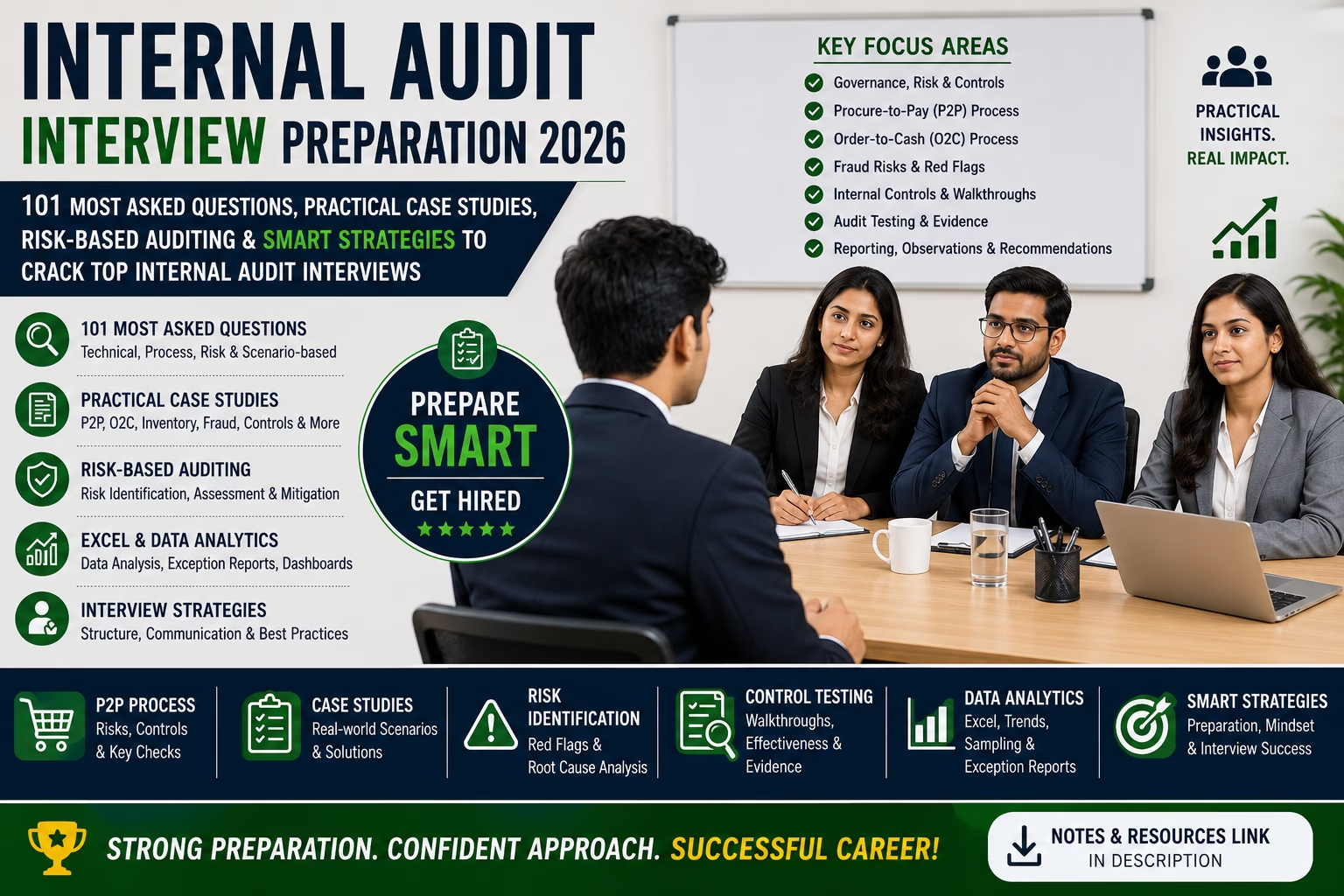
Internal Audit Interview Preparation 2026
Internal Audit has evolved far beyond checklist-based compliance reviews. Today, organizations expect internal auditors to identify risks, strengthen controls, detect fraud indicators, improve business processes, and provide actionable recommendations that create real business value.
As a result, Internal Audit interviews in 2026 are becoming increasingly practical, case-study driven, and focused on analytical thinking. Whether you are a CA student, semi-qualified professional, CMA, MBA Finance candidate, or aspiring risk professional, interviewers want to assess how you approach real business problems rather than merely recite definitions.
This comprehensive guide covers the most frequently asked Internal Audit interview questions, practical case studies, Procure-to-Pay (P2P) process risks, fraud indicators, control weaknesses, and proven preparation strategies to help you secure opportunities in Big 4 firms, consulting organizations, multinational companies, and leading internal audit teams.
Why Internal Audit Is Becoming One of the Fastest-Growing Finance Careers
Modern organizations rely heavily on internal auditors to:
- Identify operational risks
- Evaluate internal controls
- Detect fraud indicators
- Improve business processes
- Enhance governance frameworks
- Strengthen compliance monitoring
- Support management decision-making
- Improve organizational efficiency
Internal Audit professionals often build successful careers in:
- Risk Advisory
- Forensic Audit
- Enterprise Risk Management
- Compliance
- Corporate Governance
- Internal Controls
- Operational Excellence
- CFO and Leadership Roles
What Interviewers Actually Look for in Internal Audit Candidates
Many candidates focus only on theory. However, recruiters assess much broader capabilities.
Risk Identification Skills
Can you identify red flags and unusual business patterns?
Control Understanding
Can you evaluate whether a control is adequately designed and operating effectively?
Analytical Thinking
Can you investigate anomalies and identify root causes?
Practical Audit Approach
Do you know how to test transactions and validate findings?
Recommendation Skills
Can you suggest realistic and implementable solutions?
Strong candidates think like business problem-solvers rather than compliance checkers.
The Most Frequently Asked Internal Audit Interview Question
Explain the Procure-to-Pay (P2P) Process
This is arguably the most commonly asked topic in Internal Audit interviews because procurement and vendor payments are areas where organizations face significant fraud and control risks.
A typical Procure-to-Pay cycle includes:
Step 1: Purchase Requisition
Business requirement is raised.
Step 2: Vendor Selection
Quotation comparison and vendor evaluation.
Step 3: Purchase Order (PO)
Formal approval and issuance of order.
Step 4: Goods Receipt
Verification of delivered goods.
Step 5: Invoice Processing
Vendor invoice validation.
Step 6: Payment Processing
Approval and release of payment.
Interviewers often ask candidates to identify risks and controls at each stage.
Internal Audit Case Study: Vendor Payment Manipulation
One of the most common practical case studies involves vendor payment anomalies.
Scenario
During an audit review, you observe multiple payments made to the same vendor.
Interestingly:
- Most payments are between ₹95,000 and ₹99,000
- Company policy requires additional approval for payments above ₹1 lakh
- Multiple payments are processed within the same week
The interviewer asks:
How would you investigate this situation?
Internal Audit Interview Preparation 2026 :
Step 1: Identify the Red Flags
The first task of an Internal Auditor is identifying warning signals.
Possible red flags include:
Invoice Splitting
Large payments intentionally divided into smaller amounts.
Repeated Payments
Multiple transactions to the same vendor within short periods.
Approval Circumvention
Payments structured specifically to avoid higher-level approvals.
Unusual Payment Patterns
Amounts consistently falling just below approval thresholds.
Identifying red flags demonstrates strong audit instincts.
Step 2: Design Your Audit Procedures
After identifying risks, auditors must validate concerns through testing.
Possible audit procedures include:
Vendor-Wise Analysis
Review all payments made to the vendor during the period.
Weekly Payment Trends
Identify repeated patterns and frequency.
Purchase Order Verification
Examine whether multiple invoices relate to the same procurement activity.
Invoice Review
Check invoice dates, descriptions, and supporting documents.
Approval Trail Examination
Verify who approved transactions.
Vendor Onboarding Review
Review vendor registration and approval documentation.
A structured approach creates credibility during interviews.
Step 3: Determine the Root Cause
Interviewers appreciate candidates who go beyond identifying symptoms.
Potential root causes may include:
Weak ERP Controls
System fails to flag suspicious transaction patterns.
Lack of Automated Alerts
No notification generated for repetitive vendor payments.
Poor Segregation of Duties
Same employee controls multiple stages of the process.
Inadequate Monitoring
Management lacks vendor analytics and exception reporting.
Root cause analysis is a key Internal Audit skill.
Step 4: Draft Audit Observations
Strong observations usually contain:
Condition
What was observed?
Criteria
Which policy or control was violated?
Cause
Why did it happen?
Effect
What risk does it create?
Recommendation
How should management address it?
This structured format is widely used in professional Internal Audit reports.
Step 5: Recommend Practical Solutions
Internal Audit Interview Preparation 2026 :
Interviewers frequently expect actionable recommendations.
Examples include:
ERP-Based Controls
Automated detection of split invoices.
Approval Matrix Enhancement
Aggregate payments by vendor before approval checks.
Exception Reporting
Monthly vendor payment anomaly reports.
Vendor Analytics Dashboard
Monitor unusual payment behavior.
Strengthened Segregation of Duties
Separate procurement, approval, and payment responsibilities.
Practical recommendations often distinguish strong candidates from average ones.
Common Internal Audit Interview Questions
Internal Audit Interview Preparation 2026 :
What is Internal Audit?
Internal Audit is an independent assurance and consulting activity designed to improve risk management, governance, and internal controls.
Difference Between Internal Audit and Statutory Audit
| Internal Audit | Statutory Audit |
|---|---|
| Continuous review | Annual review |
| Management-focused | Shareholder-focused |
| Risk and control evaluation | Financial statement opinion |
| Operational focus | Financial reporting focus |
What Is Risk-Based Internal Auditing?
Risk-Based Internal Auditing focuses audit efforts on areas with the highest business risks rather than reviewing every process equally.
What Is a Risk Control Matrix (RCM)?
An RCM links:
- Business risks
- Existing controls
- Control owners
- Testing procedures
It is one of the most frequently used audit planning tools.
Frequently Asked Control Testing Questions
Internal Audit Interview Preparation 2026 :
What Is a Control?
A measure designed to prevent, detect, or correct errors and fraud.
What Is Preventive Control?
Designed to stop issues before they occur.
Examples:
- Approval hierarchy
- Access restrictions
- Maker-checker controls
What Is Detective Control?
Identifies issues after occurrence.
Examples:
- Reconciliations
- Exception reports
- Variance analysis
What Is Corrective Control?
Addresses identified deficiencies.
Examples:
- Error correction procedures
- Process redesign
- Root cause remediation
Walkthrough Questions Asked in Interviews
Internal Audit Interview Preparation 2026 :
What Is a Walkthrough?
A walkthrough involves tracing a transaction from initiation to final recording while understanding every related process and control.
Why Are Walkthroughs Important?
They help auditors:
- Understand processes
- Validate control design
- Identify control gaps
- Determine audit scope
Difference Between Walkthrough and Testing?
Walkthrough:
- Process understanding
Testing:
- Evaluating effectiveness
This distinction is frequently tested in interviews.
Fraud Risk Questions Frequently Asked
Modern Internal Audit interviews increasingly focus on fraud awareness.
What Are Red Flags?
Indicators suggesting possible fraud, manipulation, or control failures.
Examples:
- Duplicate vendors
- Round-dollar transactions
- Frequent manual journal entries
- Unusual approval patterns
- Excessive vendor concentration
Common Procurement Fraud Indicators
Internal Audit Interview Preparation 2026 :
Split Invoices
Breaking large transactions into smaller amounts.
Fake Vendors
Creation of non-genuine suppliers.
Duplicate Payments
Same invoice paid multiple times.
Related Party Transactions
Undisclosed transactions benefiting connected parties.
Bid Manipulation
Favoring selected vendors during procurement.
Candidates who recognize fraud indicators often perform exceptionally well.
Inventory Audit Questions
Internal Audit Interview Preparation 2026 :
How Would You Audit Inventory?
Typical procedures include:
- Physical verification
- Reconciliation
- Aging analysis
- Slow-moving inventory review
- Cut-off testing
Common Inventory Risks
- Theft
- Obsolescence
- Valuation errors
- Quantity mismatches
Accounts Receivable Audit Questions
Interviewers may ask:
How Would You Audit Receivables?
Possible procedures:
- Customer confirmations
- Aging review
- Collection analysis
- Credit note testing
- Revenue cut-off review
Key Risks
- Revenue manipulation
- Bad debts
- Fictitious sales
- Delayed write-offs
Data Analytics Questions in Internal Audit Interviews
Internal Audit Interview Preparation 2026 :
Internal Audit increasingly relies on data analysis.
Common questions include:
How Can Excel Help Internal Audit?
Applications include:
- Duplicate payment testing
- Trend analysis
- Benford’s Law analysis
- Vendor concentration reviews
- Exception reporting
Important Excel Skills
Candidates should know:
- Pivot Tables
- VLOOKUP
- XLOOKUP
- INDEX-MATCH
- Conditional Formatting
- SUMIFS
- Data Validation
Practical Excel knowledge is highly valued.
Scenario-Based Questions Commonly Asked
Internal Audit Interview Preparation 2026 :
A Vendor Is Receiving Most Company Orders. What Would You Check?
Possible audit areas:
- Vendor selection process
- Quotation comparisons
- Conflict of interest
- Pricing competitiveness
- Approval compliance
Duplicate Payments Were Identified. What Would You Do?
Suggested approach:
- Confirm duplicate occurrence
- Quantify financial impact
- Identify root cause
- Recommend control improvements
- Monitor corrective action
Inventory Losses Are Increasing. How Would You Investigate?
Potential areas:
- Physical controls
- Warehouse access
- Stock reconciliations
- Shrinkage analysis
- System controls
How to Answer Internal Audit Case Studies Effectively
Internal Audit Interview Preparation 2026 :
A powerful interview framework consists of four steps:
1. Identify Red Flags
What appears unusual?
2. Define Audit Procedures
How will you investigate?
3. Draft Observations
What risks exist?
4. Recommend Solutions
How should management respond?
Using this framework creates structured, professional answers.
Smart Preparation Strategy for Internal Audit Interviews
Internal Audit Interview Preparation 2026 :
Step 1: Master P2P and O2C Processes
Understand:
- Risks
- Controls
- Fraud possibilities
- Testing procedures
Step 2: Learn Risk and Control Concepts
Focus on:
- Preventive controls
- Detective controls
- Corrective controls
- Segregation of duties
Step 3: Practice Case Studies
Solve:
- Vendor fraud cases
- Duplicate payment cases
- Inventory loss cases
- Revenue manipulation cases
Step 4: Improve Excel Skills
Practice:
- Data analysis
- Vendor testing
- Exception reporting
- Dashboard creation
Step 5: Learn Report Writing
Understand:
- Condition
- Criteria
- Cause
- Effect
- Recommendation
Step 6: Stay Updated on Emerging Risks
Modern audit functions increasingly focus on:
- Cybersecurity
- ESG compliance
- Data privacy
- Third-party risks
- Artificial Intelligence governance
Candidates aware of emerging risk areas often stand out.
Final Thoughts
Internal Audit Interview Preparation 2026 :
Internal Audit interviews in 2026 are becoming highly practical and business-focused. Recruiters want professionals who can identify risks, analyze data, understand business processes, evaluate controls, investigate anomalies, and recommend meaningful improvements.
Candidates who consistently succeed are those who:
- Understand P2P and O2C processes deeply
- Think in terms of risks and controls
- Recognize fraud indicators quickly
- Use structured audit approaches
- Possess strong analytical skills
- Demonstrate practical business understanding
Mastering these concepts will significantly improve your chances of securing Internal Audit roles in Big 4 firms, multinational corporations, consulting organizations, and risk advisory practices.
🔗 Join 10,000+ CA Students using our Test Series to study smarter and create your own academic brand. Structured tests with detailed feedback.