
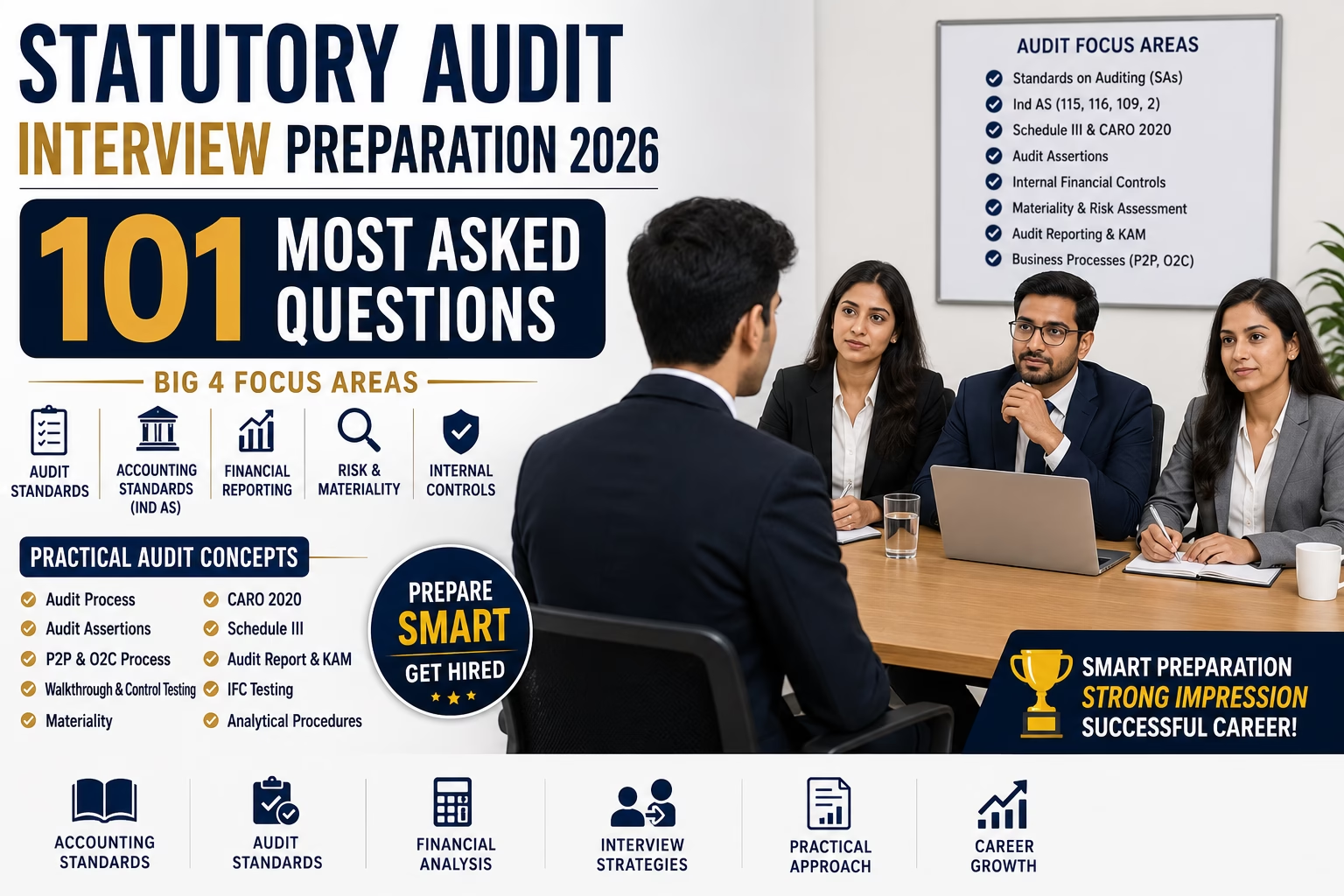
Statutory Audit Interview Preparation 2026
The demand for skilled Statutory Audit professionals continues to rise across Big 4 firms, Big 6 firms, consulting organizations, and leading CA firms. Whether you are a CA student, article assistant, semi-qualified professional, or newly qualified Chartered Accountant, statutory audit interviews have become significantly more practical and application-oriented than ever before.
Recruiters no longer focus only on theoretical knowledge of Standards on Auditing (SAs) and Accounting Standards. They expect candidates to demonstrate practical audit understanding, business process knowledge, risk assessment skills, analytical thinking, and familiarity with real-world audit procedures.
This comprehensive guide covers the most frequently asked Statutory Audit interview questions, technical concepts, practical audit procedures, and proven preparation strategies that can help you secure opportunities in top audit firms.
Statutory Audit Interview Preparation 2026 :
Why Statutory Audit Is One of the Best Career Domains for Finance Professionals
Statutory Audit offers exposure to:
- Financial statement analysis
- Corporate governance
- Internal controls
- Risk management
- Accounting standards
- Regulatory compliance
- Business process understanding
- Industry-specific financial reporting
Professionals who start their careers in audit often transition successfully into:
- Financial Reporting
- Internal Audit
- Risk Advisory
- Corporate Finance
- FP&A
- Investment Banking
- Financial Due Diligence
- CFO Track Roles
What Do Interviewers Look For in Statutory Audit Candidates?
Statutory Audit Interview Preparation 2026 :
Before discussing technical questions, understand what recruiters actually assess.
Technical Understanding
Knowledge of:
- Accounting Standards
- Ind AS
- Standards on Auditing
- Companies Act provisions
- CARO reporting
- Schedule III requirements
Practical Audit Thinking
Interviewers assess whether you can:
- Identify risks
- Design audit procedures
- Understand assertions
- Evaluate internal controls
- Analyze financial statements
Business Awareness
Candidates should understand:
- Revenue models
- Industry risks
- Business processes
- Financial reporting implications
Communication Skills
Auditors regularly interact with:
- Finance teams
- CFOs
- Controllers
- Business heads
- Audit committees
Therefore, communication is equally important as technical expertise.
The Most Common Opening Question in Audit Interviews
Almost every audit interview starts with:
“Which Accounting Standard or Ind AS is your favorite?”
Many candidates underestimate this question.
Once you mention a standard, interviewers often ask multiple follow-up questions from the same area.
For example:
If you say Ind AS 115, be prepared for:
- Revenue recognition principles
- Five-step model
- Performance obligations
- Variable consideration
- Industry-specific scenarios
If you say Ind AS 116, expect questions on:
- Lease accounting
- Right-of-use assets
- Lease liability
- Finance vs operating lease concepts
Choose only those standards that you genuinely understand in depth.
Accounting Standards Every Audit Candidate Must Revise
Statutory Audit Interview Preparation 2026 :
The following standards are among the most frequently discussed during interviews:
Ind AS 115 – Revenue from Contracts with Customers
Prepare:
- Five-step revenue model
- Performance obligations
- Timing of revenue recognition
- Industry-specific examples
Interviewers may ask:
- How would a manufacturing company recognize revenue?
- How does a software company recognize subscription income?
- How is revenue recognized in real estate projects?
Ind AS 116 – Leases
Important concepts include:
- Right-of-use assets
- Lease liabilities
- Short-term lease exemption
- Finance and operating lease treatment
Ind AS 2 – Inventories
Frequently tested topics:
- Inventory valuation methods
- FIFO
- Weighted Average Cost
- Net Realizable Value (NRV)
Ind AS 109 – Financial Instruments
Candidates should understand:
- Financial assets
- Financial liabilities
- Expected Credit Loss (ECL)
- Fair value measurement basics
Schedule III Questions Asked in Audit Interviews
One of the most neglected yet important areas is Schedule III of the Companies Act.
Interviewers commonly ask:
What is Schedule III?
Why is Schedule III important?
What are the recent amendments?
How should financial statements be presented under Schedule III?
Which disclosures are mandatory?
Candidates with strong Schedule III knowledge generally stand out from other applicants.
CARO 2020 Questions Frequently Asked
CARO remains a favorite interview topic.
Typical questions include:
What is CARO?
Which companies are exempt from CARO?
Difference between CARO 2020 and CARO 2016?
Major reporting requirements under CARO 2020?
Auditor responsibilities under CARO?
Prepare practical examples for each clause rather than memorizing clauses mechanically.
Audit Assertions: The Most Important Interview Topic
Statutory Audit Interview Preparation 2026 :
One topic repeatedly asked in Big 4 interviews is audit assertions.
Interviewers may ask:
How would you audit revenue?
How would you audit legal expenses?
How would you audit borrowings?
How would you audit inventory?
A strong answer should always be assertion-based.
Important Audit Assertions
Statutory Audit Interview Preparation 2026 :
Completeness
Have all transactions been recorded?
Occurrence
Did the transaction actually occur?
Accuracy
Is the amount recorded correctly?
Cut-Off
Has the transaction been recorded in the correct accounting period?
Classification
Has the transaction been classified appropriately?
Valuation
Has the asset or liability been valued correctly?
Candidates who structure answers around assertions often create a strong impression.
Financial Statement Audit Report Questions
Statutory Audit Interview Preparation 2026 :
The audit report is another heavily tested area.
Frequently asked questions include:
What is an unmodified opinion?
What is a qualified opinion?
What is an adverse opinion?
What is a disclaimer of opinion?
When is a modified opinion issued?
What is a Key Audit Matter (KAM)?
Give an example of a Key Audit Matter.
Practical examples from listed company annual reports can significantly strengthen your answers.
Internal Financial Controls (IFC) Questions
IFC-related questions are extremely common.
Interviewers may ask:
What are Internal Financial Controls?
Why are IFCs important?
Applicability of IFC reporting?
Difference between Internal Audit and IFC Testing?
How do auditors evaluate controls?
Understanding practical control environments is crucial.
Walkthrough and Control Testing Questions
Statutory Audit Interview Preparation 2026 :
Another favorite interview area is process understanding.
What is a Walkthrough?
A walkthrough involves tracing a transaction from initiation to final recording while understanding every process and control involved.
What is Control Testing?
Control testing evaluates whether controls are designed properly and operating effectively.
Difference Between Walkthrough and Control Testing?
Candidates should be able to explain this with practical examples.
Control Mapping and “What Could Go Wrong” Questions
Modern audit interviews increasingly include scenario-based questions.
Example:
A vendor receives duplicate payment. What control would you recommend?
Possible answers:
- Maker-checker control
- Automated duplicate invoice checks
- Monthly bank reconciliations
- Payment approval hierarchy
Interviewers use these questions to evaluate practical thinking rather than textbook knowledge.
Procure-to-Pay (P2P) Process Questions
P2P is among the most important business processes in audit interviews.
Common questions include:
Explain Procure-to-Pay Process.
What is Purchase Requisition?
What is Purchase Order?
Difference between Purchase Requisition and Purchase Order?
What is Goods Receipt Note (GRN)?
What is Three-Way Matching?
What controls exist in procurement?
Understanding the complete purchasing cycle is essential.
Order-to-Cash (O2C) Process Questions
Revenue-related process questions are equally important.
Interviewers frequently ask:
Explain Order-to-Cash Process.
Revenue recognition controls?
Customer approval process?
Credit control mechanisms?
Revenue cut-off testing?
Accounts receivable controls?
Candidates should understand both accounting and operational aspects of sales processes.
Materiality Questions Asked in Audit Interviews
Statutory Audit Interview Preparation 2026 :
Materiality is a core audit concept.
Frequently asked questions include:
What is Materiality?
Why is Materiality important?
How is Materiality calculated?
What benchmarks are used?
Difference between Overall Materiality and Performance Materiality?
Types of Materiality
Overall Materiality
Determined at entity level.
Performance Materiality
Used at account balance level.
Trivial Threshold
Used for clearly insignificant misstatements.
Interviewers often expect candidates to understand practical applications rather than theoretical definitions.
Test of Controls vs Test of Details
This comparison is extremely common.
Test of Controls
Purpose:
Evaluate effectiveness of controls.
Examples:
- Approval checks
- Access controls
- Segregation of duties
Test of Details
Purpose:
Verify transaction accuracy.
Examples:
- Invoice verification
- Contract review
- Confirmation procedures
Candidates should be able to explain when each approach is appropriate.
Provision vs Contingent Liability Questions
Classic interview questions include:
Difference between Provision and Contingent Liability?
Accounting treatment?
Journal entries?
Disclosure requirements?
Many interviewers test conceptual clarity using practical examples.
Deferred Tax Questions
Deferred Tax continues to be a popular interview topic.
Common questions:
What is Deferred Tax Asset (DTA)?
What is Deferred Tax Liability (DTL)?
Why do temporary differences arise?
Examples of DTA and DTL?
How are they recognized?
Forex Accounting Questions
Statutory Audit Interview Preparation 2026 ;
Candidates should revise:
Foreign Currency Transactions
Exchange Differences
Year-End Translation
Monetary vs Non-Monetary Items
Impact on P&L and Balance Sheet
Practical examples are frequently discussed during interviews.
Limited Review Questions
For semi-qualified and qualified professionals, interviewers may ask:
What is Limited Review?
Difference between Limited Review and Statutory Audit?
Scope of procedures?
Level of assurance provided?
Reporting format?
Excel Questions Every Audit Candidate Must Prepare
Technical interviews increasingly include Excel-related questions.
Common topics include:
Pivot Tables
VLOOKUP
XLOOKUP
INDEX-MATCH
Conditional Formatting
SUMIFS
Data Validation
Duplicate Identification
Financial Data Analysis
Many firms now conduct practical Excel assessments before final interviews.
End-to-End Statutory Audit Process: Must-Know Interview Question
Statutory Audit Interview Preparation 2026 : One question appears repeatedly:
“Explain the complete statutory audit process from start to finish.”
A structured answer should cover:
Step 1: Pre-Engagement Activities
- Client acceptance
- Independence checks
- Communication with previous auditor
- Engagement letter
Step 2: Audit Planning
- Business understanding
- Industry analysis
- Materiality calculation
- Risk assessment
Step 3: Control Evaluation
- Walkthroughs
- Control mapping
- Control testing
Step 4: Substantive Procedures
- Test of details
- Analytical procedures
- Sampling
- External confirmations
Step 5: Completion and Reporting
- Subsequent event review
- Disclosure checklist
- Financial statement review
- Audit opinion formation
- Audit report issuance
This framework demonstrates practical audit understanding and often creates a strong impression.
Resume-Based Questions That Cause Most Rejections
Statutory Audit Interview Preparation 2026 :
Interviewers heavily scrutinize resumes.
If your resume mentions:
- Revenue testing
- Inventory verification
- Bank confirmations
- IFC testing
- P2P audits
- Financial statement reviews
Expect detailed questioning on those activities.
Never include work experience you cannot confidently explain.
Smart Preparation Strategy to Crack Audit Interviews
Statutory Audit Interview Preparation 2026 :
Step 1: Master Core Accounting Standards
Focus on:
- Ind AS 115
- Ind AS 116
- Ind AS 2
- Ind AS 109
Step 2: Revise Audit Standards
Focus on:
- SA 200 Series
- SA 500 Series
- SA 700 Series
Step 3: Understand Business Processes
Prepare:
- Procure-to-Pay
- Order-to-Cash
- Payroll
- Fixed Assets
- Inventory
Step 4: Read Annual Reports
Review:
- Auditor’s Report
- Key Audit Matters
- Notes to Accounts
- Financial Statements
This provides real-world examples for interviews.
Step 5: Strengthen Excel Skills
Practice:
- Pivot Tables
- Lookups
- Data Analysis
- Audit reconciliations
Step 6: Conduct Mock Interviews
Practice:
- HR questions
- Technical questions
- Scenario-based questions
- Case studies
Mock interviews improve confidence, communication, and structured thinking.
Final Thoughts
Statutory Audit Interview Preparation 2026 :
Statutory Audit interviews in 2026 are increasingly focused on practical application rather than pure theory. Recruiters want professionals who understand business processes, audit assertions, internal controls, financial reporting, and real-world audit execution.
Candidates who consistently succeed are those who:
- Understand accounting standards deeply
- Think in terms of audit assertions
- Know P2P and O2C processes
- Understand materiality and risk assessment
- Read annual reports regularly
- Possess strong Excel skills
- Practice answering scenario-based questions
If you prepare these areas thoroughly, you will be well-positioned to crack interviews at Big 4 firms, Big 6 firms, and leading audit organizations.
🔗 Join 10,000+ CA Students using our Test Series to study smarter and create your own academic brand. Structured tests with detailed feedback.