

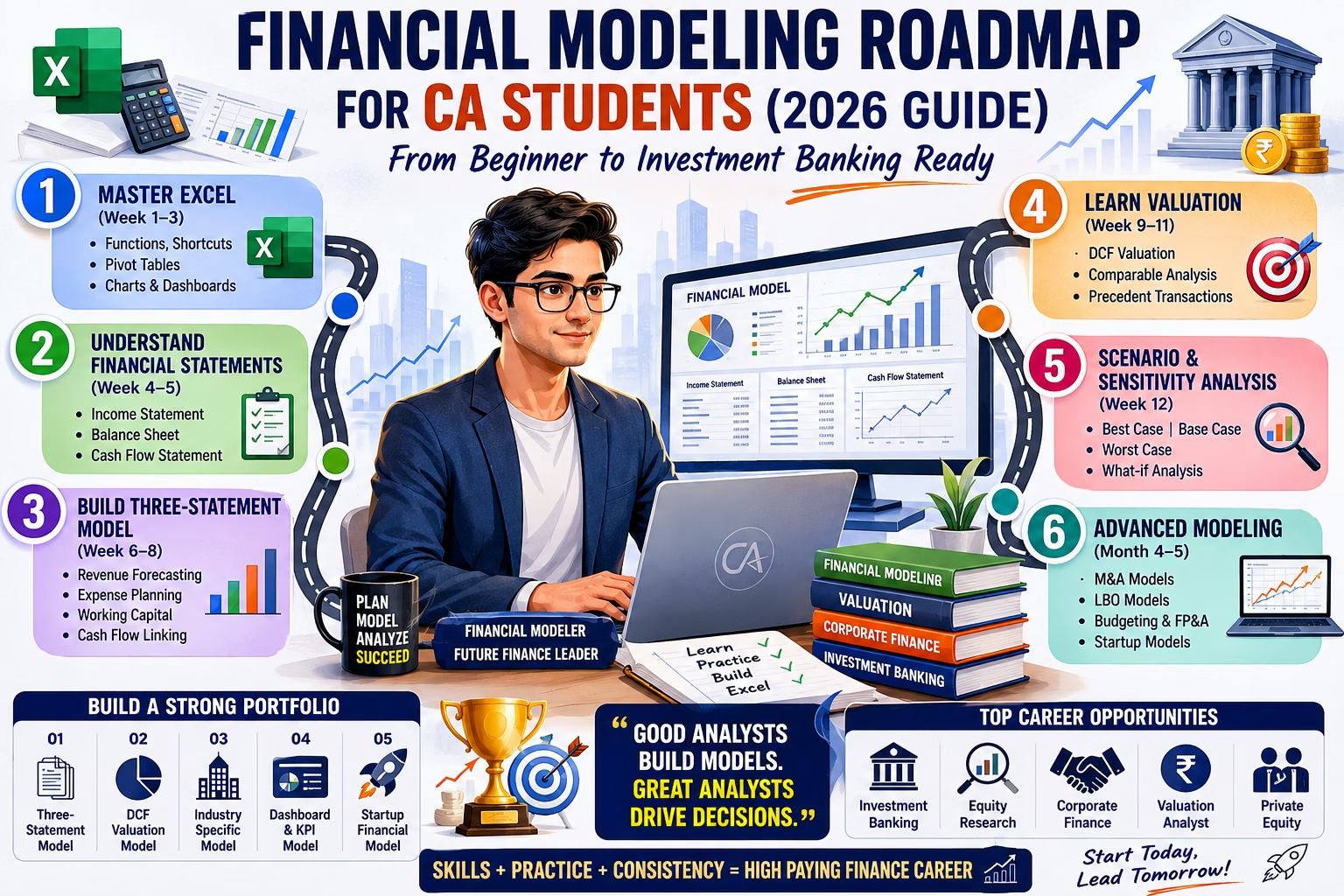
Financial Modeling Roadmap for CA Students
Introduction
In today’s finance industry, clearing the CA exams alone is no longer enough. Recruiters across Investment Banking, Corporate Finance, Valuation, Equity Research, Transaction Advisory, FP&A, and Private Equity increasingly expect candidates to possess strong financial modeling skills.
Financial modeling has become one of the most valuable skills for Chartered Accountancy students because it bridges the gap between accounting knowledge and real-world business decision-making.
If you’re a CA student wondering where to start, what to learn, and how to become industry-ready, this roadmap will guide you from absolute beginner to advanced financial modeler.
Financial Modeling Roadmap for CA Students :
What is Financial Modeling?
Financial Modeling is the process of creating a spreadsheet-based representation of a company’s financial performance.
It helps businesses and investors answer questions such as:
- Should we invest in this company?
- What will profits look like over the next 5 years?
- How much is the business worth?
- Can the company repay its debt?
- What happens if sales increase by 20%?
Most financial models are built using Microsoft Excel and are used extensively in:
- Investment Banking
- Equity Research
- Corporate Finance
- Private Equity
- Mergers & Acquisitions
- Business Valuation
- Startups & Venture Capital
Why CA Students Have a Huge Advantage
Financial Modeling Roadmap for CA Students :
Many professionals struggle with financial statements.
CA students already understand:
✓ Balance Sheet
✓ Profit & Loss Account
✓ Cash Flow Statement
✓ Ratio Analysis
✓ Financial Reporting Standards
✓ Corporate Finance Concepts
This gives CA students a significant head start compared to MBA graduates and engineering students entering finance.
The challenge is converting theoretical knowledge into practical modeling skills.
Stage 1: Master Excel (Week 1–3)
Before building financial models, become comfortable with Excel.
Must-Know Functions
- IF
- SUMIFS
- INDEX
- MATCH
- XLOOKUP
- OFFSET
- INDIRECT
- IFERROR
- TEXT Functions
- Date Functions
Excel Skills Required
- Formatting shortcuts
- Conditional formatting
- Data validation
- Pivot tables
- Charts & dashboards
- Keyboard shortcuts
Goal
Build confidence in Excel without using the mouse frequently.
Stage 2: Understand Financial Statement Linkages (Week 4–5)
This is where financial modeling truly begins.
Learn how:
Income Statement affects
- Net Profit
- Retained Earnings
Balance Sheet affects
- Assets
- Liabilities
- Equity
Cash Flow Statement affects
- Operating Cash Flow
- Investing Cash Flow
- Financing Cash Flow
Understand how all three statements connect.
This is the foundation of every professional financial model.
Stage 3: Build a Three-Statement Model (Week 6–8)
A Three-Statement Model links:
- Income Statement
- Balance Sheet
- Cash Flow Statement
Learn To Forecast
- Revenue
- Cost of Goods Sold
- Operating Expenses
- Working Capital
- Fixed Assets
- Debt Schedule
Practical Project
Choose a listed company and create projections for the next 5 years.
Examples:
- Tata Motors
- Infosys
- HDFC Bank
- Asian Paints
This project becomes your first portfolio model.
Stage 4: Learn Business Valuation (Week 9–11)
Once you can forecast financial statements, learn how businesses are valued.
Key Valuation Methods
1. Discounted Cash Flow (DCF)
Most respected valuation method.
Learn:
- Free Cash Flow
- WACC
- Terminal Value
- Enterprise Value
- Equity Value
2. Comparable Company Analysis
Compare similar companies using:
- P/E Ratio
- EV/EBITDA
- EV/Sales
3. Precedent Transactions
Analyze past acquisitions and mergers.
Stage 5: Scenario & Sensitivity Analysis (Week 12)
Real businesses rarely perform exactly as expected.
Financial modelers must test different situations.
Create
- Base Case
- Best Case
- Worst Case
Analyze Impact Of
- Sales growth
- Interest rates
- Operating margins
- Inflation
- Capital expenditure
Employers love candidates who can think beyond numbers.
Stage 6: Advanced Financial Modeling (Month 4–5)
After mastering fundamentals, move to advanced models.
Investment Banking Models
- Merger Model
- Acquisition Model
- Leveraged Buyout (LBO)
- Accretion Dilution Model
Corporate Finance Models
- Budgeting Models
- Forecasting Models
- FP&A Models
Startup Finance Models
- SaaS Financial Models
- Startup Valuation Models
- Fundraising Models
Stage 7: Build a Portfolio of Models
Most CA students make one mistake.
They complete a course but never build actual models.
Instead, create a portfolio containing:
Model 1
Three-Statement Model
Model 2
DCF Valuation Model
Model 3
Industry-Specific Model
Model 4
Dashboard & KPI Reporting Model
Model 5
Startup Financial Projection Model
A portfolio often impresses recruiters more than certificates.
Tools Every Financial Modeler Should Learn
Financial Modeling Roadmap for CA Students :
Essential
- Microsoft Excel
- PowerPoint
Recommended
- Power BI
- SQL
- VBA Basics
- Python for Finance
Advanced
- Bloomberg Terminal
- Capital IQ
- FactSet
Career Opportunities After Learning Financial Modeling
Financial Modeling Roadmap for CA Students :
Financial modeling opens doors to high-growth finance careers.
Investment Banking Analyst
Average package significantly higher than traditional accounting roles.
Equity Research Analyst
Research listed companies and provide investment recommendations.
Valuation Analyst
Work on M&A and transaction advisory assignments.
FP&A Analyst
Help companies plan future growth and budgets.
Corporate Finance Manager
Support strategic business decisions.
Private Equity & Venture Capital
Evaluate investment opportunities and startup businesses.
6-Month Financial Modeling Roadmap for CA Students
Financial Modeling Roadmap for CA Students :
Month 1
- Excel Mastery
- Financial Statement Analysis
Month 2
- Three Statement Modeling
Month 3
- DCF Valuation
- Comparable Analysis
Month 4
- Advanced Forecasting
- Sensitivity Analysis
Month 5
- M&A Modeling
- LBO Basics
Month 6
- Portfolio Creation
- Interview Preparation
Common Mistakes CA Students Make
Financial Modeling Roadmap for CA Students :
❌ Learning formulas without understanding business logic
❌ Watching tutorials without building models
❌ Ignoring valuation concepts
❌ Not practicing on annual reports
❌ Collecting certificates instead of projects
❌ Focusing only on theory
Final Thoughts
Financial Modeling Roadmap for CA Students :
Financial modeling is no longer an optional skill for CA students aiming for premium finance careers. Whether your goal is Investment Banking, Valuation, Equity Research, FP&A, Corporate Finance, or Private Equity, financial modeling can significantly improve your employability and earning potential.
The best part? As a CA student, you already possess the accounting and financial statement knowledge that many professionals spend years learning. By combining that foundation with practical modeling skills, you can position yourself ahead of the competition and become industry-ready before qualification itself.
Start small, build consistently, and focus on creating real-world models. Six months of focused effort can transform your career trajectory and unlock opportunities in some of the highest-paying finance roles in the market.
🔗 Join 10,000+ CA Students using our Test Series to study smarter and create your own academic brand. Structured tests with detailed feedback.